JERA, Dell and RHAELM Plan $15B AI Infrastructure Project in Japan
Key Takeaways
- •JERA, Dell Technologies, and RHAELM signed an agreement to develop a standardized AI infrastructure model in Japan, starting with a project costing over $15 billion (about ¥2.3 trillion) next to JERA's Chiba Thermal Power Station.
- •The Chiba facility will draw up to 400 MW entirely from JERA's on-site generation to minimize new grid connections, with phased operations beginning in 2028 and full capacity targeted by 2029.
- •Responsibilities are divided so that JERA provides land and electricity, Dell supplies standardized rack-scale AI computing infrastructure, and RHAELM oversees development, financing, and operations, with Apollo Global Management expected to serve as RHAELM's strategic investment and financing partner.
- •If the initial project succeeds, the partners plan to extend the standard design to more JERA facilities and international locations aiming for multi-gigawatt AI capacity in Japan during the 2030s.
- •The partnership reflects the rising importance of power availability in AI infrastructure, as PwC projects global data-center capital expenditure could reach $31.6 trillion through 2050.
JERA, Dell Technologies and RHAELM have signed an agreement to develop a standardized model for AI infrastructure in Japan, beginning with a $15 billion project next to JERA's Chiba power station.
The three partners intend to address power, cooling, and computing challenges together rather than separately, through a replicable design aimed at speeding up the deployment of AI capacity.
Under the arrangement set out in JERA's announcement, RHAELM is in charge of development and delivery, Dell handles the computing infrastructure, and JERA supplies power and land.
A template meant to be copied, not a one-off build
The objective goes beyond constructing a single enormous data center. At present, AI projects in Japan typically have to establish the power supply, electrical systems, cooling, and computing infrastructure for each site from scratch. JERA, Dell, and RHAELM aim to create a standard design that can be reused for future projects, making them faster and easier to assemble.
Chiba will as the initial test case. If it succeeds, the partners plan to extend the model to more JERA facilities and eventually to international locations, and to build out multi-gigawatt AI capacity in Japan in the 2030s.
The move underscores a growing emphasis on power availability in the AI infrastructure race. According to PwC's forecasts, access to power sources is likely to influence decisions on where new data centers are built — which helps explain why a power generator sits at the center of a computing consortium.
The Chiba project: 400 MW, behind the meter
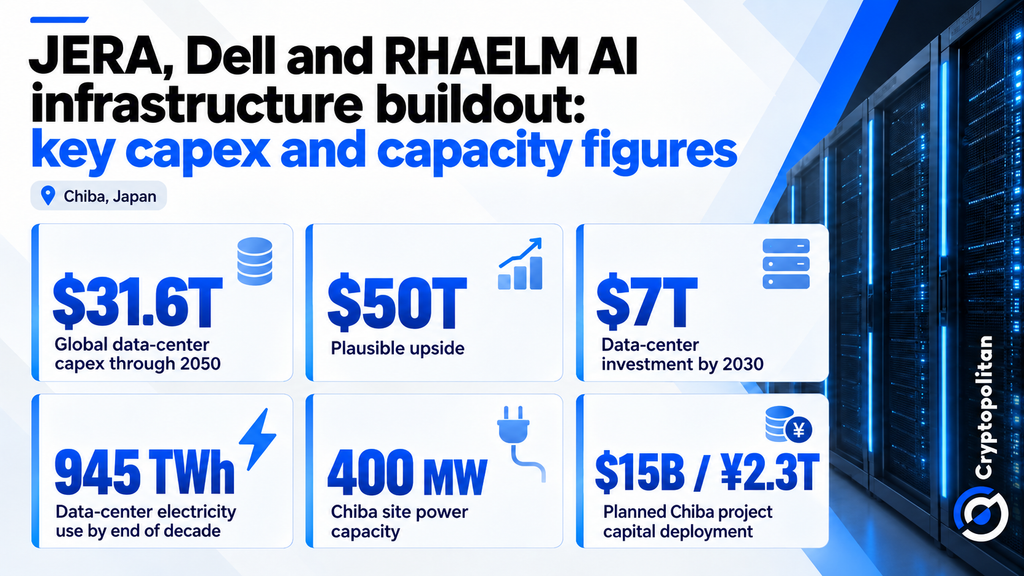
The first project will be located adjacent to JERA's Chiba Thermal Power Station and will have access to as much as 400 MW of power. According to Reuters, the total investment will exceed $15 billion, or approximately ¥2.3 trillion, covering land, power infrastructure, construction, and AI computing equipment.
The facility is designed to draw its entire power requirement from JERA's generation infrastructure, reducing the need for a new grid connection. Phased operations are scheduled to begin from 2028 and reach full capacity by 2029, according to Reuters.
JERA will provide the land and electricity, Dell will supply standardized rack-scale AI infrastructure, and RHAELM will oversee development, financing, and operations. Apollo Global Management is expected to join as RHAELM's strategic investment and financing partner.
The division of labor maps onto the template's two halves: JERA's adjacent generation and land secure the site's physical inputs, while Dell's standardized rack-scale systems are the computing layer that can be redeployed wherever the model is replicated next.
Set against a multi-trillion-dollar buildout
Chiba's $15 billion price tag is still small next to the wider spending wave. PwC estimates that global data-center capital expenditure could reach $31.6 trillion through 2050, with an upside near $50 trillion.
In the nearer term, McKinsey estimates that data-center investment could approach $7 trillion by 2030, while the IEA projects that electricity use by data centers will roughly double to about 945 TWh by the end of the decade.
The spending is already affecting the broader economy. Cryptopolitan previously reported that AI data-center demand is supporting U.S. manufacturing and nonresidential construction while increasing competition for power, materials, and capital.
For Chiba, the real test is whether connecting power and compute through a repeatable design can make that investment cycle faster, cheaper, and easier to scale. The milestones that will answer that question are already scheduled: phased operations starting from 2028, full capacity by 2029, and any follow-on JERA sites or overseas projects announced under the same standard design.

