Cryptopolitan Poll: Readers Split on Whether the Jensen Huang Scandal Will Matter for Nvidia
Key Takeaways
- •US intelligence agencies determined that Alice Huang, an executive at Megaspeed, a company that purchased more than $4.8 billion of Nvidia chips over two years, had been passing sensitive information to Beijing.
- •Jensen Huang admitted infidelity after a Financial Times report exposed his romantic relationship with Alice Huang, and Nvidia's board opened an investigation into a possible foreign intelligence effort while initially keeping him as CEO.
- •A November 11 New York Times report alleged a separate extramarital relationship with Kimberly Powell, Nvidia's Vice President of healthcare and the first reported relationship involving someone inside the company's management.
- •The Wall Street Journal reported the board is preparing to oust Huang, Bloomberg said Nvidia is working with an outside firm to identify candidates, and Polymarket odds of his departure before year-end have surged to 88%.
- •Nvidia has no obvious successor, with CFO Colette Kress cited as a possible interim choice and Ian Buck favored on Polymarket, while open investigations into whether chips reached China through Megaspeed could matter more than the personal revelations.
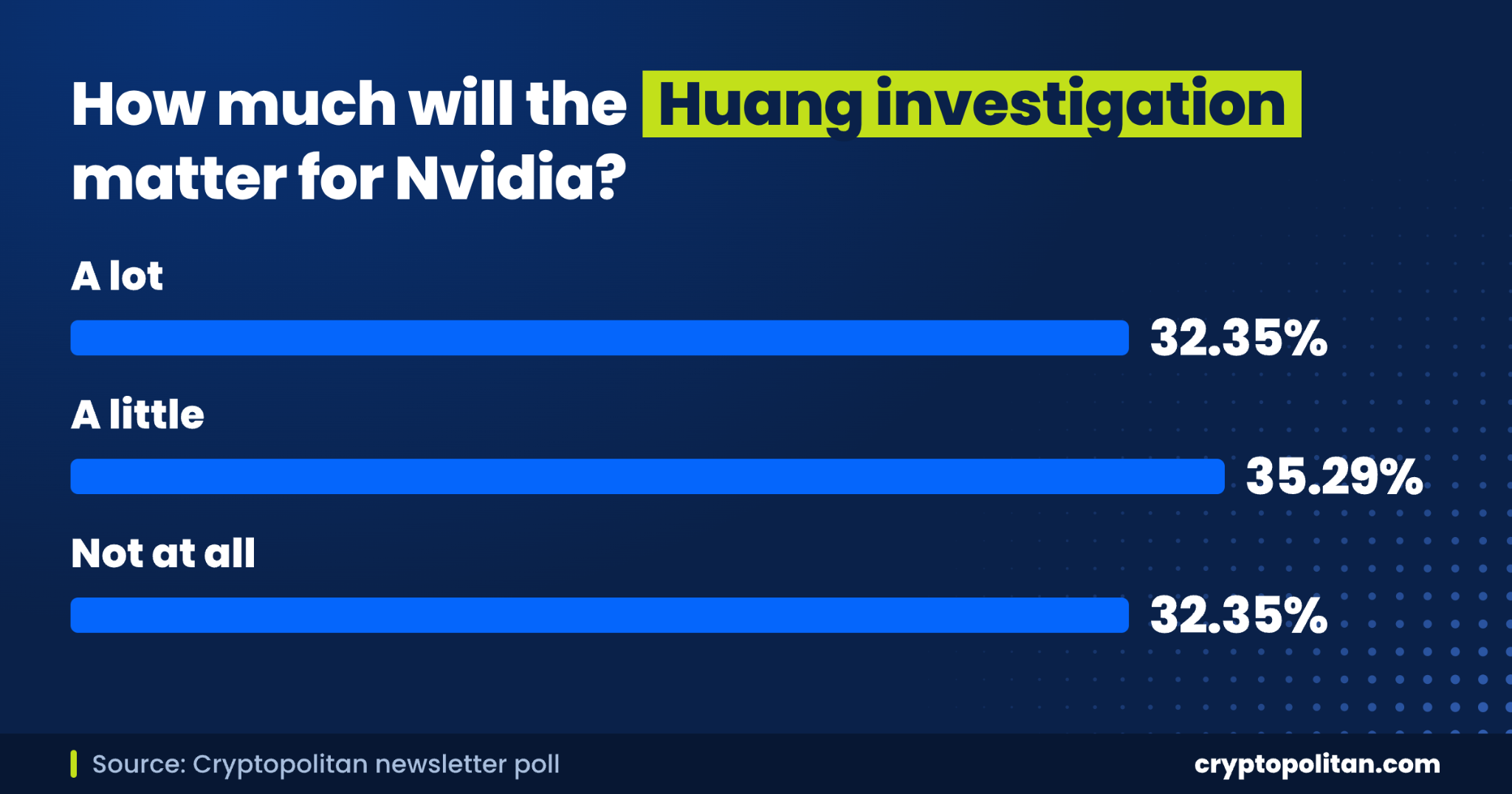
The scandal surrounding Nvidia CEO Jensen Huang has unsettled the company, its board and investor confidence within the span of a few days. When Cryptopolitan ran its newsletter poll asking readers how much the investigation into Huang would ultimately matter, the board was still publicly standing behind him. Within 48 hours, the picture had changed dramatically: reports emerged of a second affair, Nvidia's stock fell sharply in after-hours trading, and reports began circulating that the board was planning to replace the man who co-founded the company 33 years ago.
How the Story Began
The scandal first came to light on October 29, when the New York Times reported that US intelligence agencies had determined that a Singapore-based businesswoman, Alice Huang, had been passing sensitive information to Beijing. According to the Times, Alice Huang served as an executive at Megaspeed, a company that purchased more than $4.8 billion worth of Nvidia chips over a two-year period. US authorities have been examining whether Megaspeed helped channel advanced AI chips into China in ways that export rules are designed to prevent.
Both Megaspeed and Nvidia have denied any wrongdoing, while Beijing has dismissed the spying allegations as unsubstantiated.
The Times also reported that Alice Huang maintained a very close relationship with Jensen Huang. At the time, Huang told Bloomberg that his interactions with her were strictly related to Megaspeed and were “completely normal and not unusual.”
That position did not hold for long. On Friday, November 6, a Financial Times report made their romantic relationship public. Two days later, on Sunday, Huang wrote to Nvidia employees: “I was unfaithful to my wife. My actions hurt her and our children. There is no excuse for what I did. I am deeply sorry.” The letter made no mention of Alice Huang.
The same day, Nvidia's board opened an investigation into reports that Huang had been the target of a foreign intelligence effort. The board said it had “no reason to believe that either national security or NVIDIA secrets were compromised,” and confirmed that Huang would remain CEO during the review.
Why This Is Bigger Than a Personal Scandal
The scale of the fallout stems from what Nvidia is and what Huang represents to it. Most AI models in operation today run on Nvidia chips, and those chips sit at the center of the US-China technology race. Washington continues to restrict which Nvidia products can be shipped to China, and Huang has spent the past two years negotiating those rules with the Trump administration. A CEO in that position becoming personally close to someone US intelligence believes worked for Beijing raises questions that no ordinary personal scandal does.
Then the Story Moved Again
Credibility took another major hit on Wednesday, November 11, when the New York Times reported that Huang had carried on a separate extramarital relationship with Kimberly Powell, Nvidia's Vice President of healthcare, who reports directly to him — the first of the reported relationships to involve someone inside Nvidia's own management structure. According to the Times, five employees at the company described the alleged affair to the newspaper. Nvidia, Huang and Powell have not confirmed any element of the report, but events have escalated quickly over the following 24 hours.
The Wall Street Journal reported that the board was preparing to oust Huang. Bloomberg then reported that the company was working with an outside firm to identify potential replacements and weighing whether to appoint a temporary CEO before settling on a permanent one. On prediction markets such as Polymarket, the odds that Huang resigns or is removed before the end of the year have surged to 88%.
The biggest complication is that the company has no obvious successor. Huang has led Nvidia since co-founding it in 1993, giving him one of the longest tenures of any chief executive running a major US company. Analysts have pointed to CFO Colette Kress as a possible interim choice, while on Polymarket, Ian Buck, who runs the data centre business, is the favorite to take over permanently.
The poll itself ran in Cryptopolitan's daily newsletter.
Reading the Results
The starting point is what readers knew when they voted. Huang had admitted the affair, the board had opened an investigation while expressing confidence in him, and the stock was down about 4%. No second relationship had yet been reported, and no one was discussing a replacement. Against that backdrop, a near-perfect three-way split fairly reflects how uncertain the situation appeared on November 10.
Newsletter readers also bring a particular perspective to this kind of story. Crypto is full of companies and protocols built around a single founder, and readers have watched that concentration risk play out before. When Changpeng Zhao stepped down as Binance CEO in late 2023 as part of a settlement with US authorities, many expected the exchange to suffer badly. It did not, at least not in the way many predicted, and Binance remains the world's largest exchange. That history likely shaped how many readers weighed Huang's situation.
A little (35.29%): The narrow winner, and a defensible read on the facts available at the time. The board had publicly backed Huang and said it saw no sign that secrets were compromised. Demand for Nvidia's chips has never depended on the CEO's personal life, so a dip in the stock and an awkward few weeks of headlines looked like the most likely outcome. What this group could not price in was what came next.
A lot (~32.4%): This group saw the risk most clearly, and events since the poll have largely backed them up. Their instinct was probably about concentration. Huang is not simply Nvidia's CEO; he is its chief strategist, its main voice in Washington and the person most investors picture when they think of the company. A scandal touching national security, at a firm whose biggest challenge is securing export approval, was always going to be difficult to contain.
Not at all (~32.4%): A third of readers believed the business would carry on regardless, and that view has not yet been disproven. There is a real distinction between what happens to Huang, what happens to Nvidia's share price and what happens to Nvidia as a business. Data centres still need chips, and Nvidia still sells the ones most of them want. If this group was answering about the business rather than the stock or the CEO, they may still turn out to be right.
That distinction is the most useful lens for interpreting the poll. Readers were not really disagreeing about the facts; they were answering slightly different questions — about Huang, about the stock and about the company — and each answer was reasonable for the question being asked.
What Comes Next
The immediate question is whether Huang keeps his job. Whatever the board decides, Nvidia has already demonstrated that it has contemplated a future without him, and that alone changes how investors will price the company. A business that treated its founder as permanent must now explain who leads it next and how quickly.
Nvidia's quarterly earnings arrive next week, and they will land in an unusual position. The numbers are likely to remain strong, since AI spending has not slowed because of any of this. But for perhaps the first time in years, analysts on the earnings call will focus more on governance and succession than on guidance.
The longer-running thread is China. The board's investigation and the US scrutiny of Megaspeed both remain open, and any findings about chips reaching China would matter far more to Nvidia's future than any personal revelation. When the poll ran, a third of readers thought this would not matter at all. The answer now depends less on Huang's personal life than on what those investigations uncover.

