Jensen Huang’s Return to Nvidia Restores Confidence but Raises Governance Questions
Key Takeaways
- •Nvidia's board voted unanimously to reinstate Jensen Huang six days after stating on November 17 that it would not bring him back, citing conduct inconsistent with company standards.
- •Huang resigned on November 12 amid revelations about extramarital affairs and an unproven Chinese espionage allegation involving a former customer executive, and Nvidia's independent investigation remains ongoing.
- •Nvidia shares surged more than 30% on the reinstatement news while the Nasdaq rose nearly 7%, and Nvidia-backed companies CoreWeave and Nebius each gained more than 20%.
- •During the leadership transition, interim CEO Colette Kress reported quarterly sales of roughly $116 billion and projected about $130 billion for the next quarter, while promising December pay increases and stock awards to reassure employees.
- •Nvidia is establishing a board committee to oversee national security and export-control matters and is recruiting a chief compliance officer, while the status of Chinese orders delayed or canceled during the turmoil remains a key marker to watch.
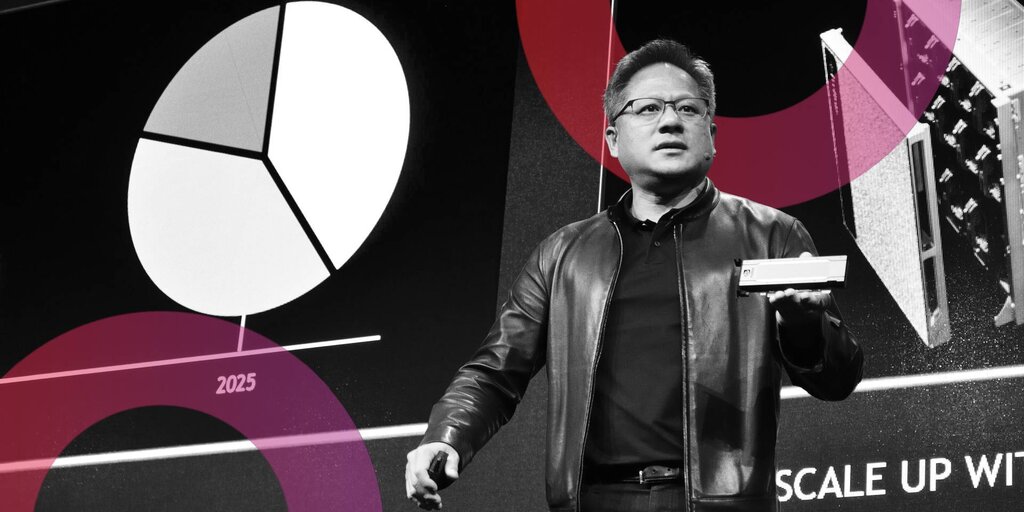
Nvidia's brief attempt to operate without co-founder Jensen Huang triggered employee anxiety, investor pressure and uncertainty among customers. His return as CEO, president and director reflects support from major shareholders, technology founders and President Donald Trump, but the board's reversal has also raised questions about corporate governance.
Huang did not unveil a new chip on Monday. He got his former job back—and Nvidia shares surged more than 30%, while the Nasdaq rose nearly 7% in midday trading. The reaction showed that investors had spent the previous 11 days confronting how much of the artificial-intelligence boom runs through one person. That dependence turned a personnel crisis at one company into a stress test for the broader AI sector.
Huang resigned on November 12 amid revelations about extramarital affairs and an unproven Chinese espionage allegation involving a former customer executive. Nvidia's board has said his reinstatement poses no national security risk, based partly on input from senior U.S. officials. The company's independent investigation, however, is still ongoing. Nvidia's official announcement is available here.
The 11 days Nvidia tried to move on
Nvidia continued making chips during the leadership transition. Chief Financial Officer Colette Kress became interim CEO, while Harvey Jones became Nvidia's first board chairman. Executives said the company's technology roadmap and customer commitments remained intact.
Kress presided over earnings showing roughly $116 billion in quarterly sales and a projection of about $130 billion for the following quarter. Those figures were substantial but did not calm the market during the leadership uncertainty. Nvidia's financial results were reported in its official release.
Inside the company, the transition appeared less routine. Employees submitted about 700 questions ahead of the first companywide meeting without Huang, many focused on compensation and board transparency. Kress promised pay increases and additional stock awards in December, months earlier than planned. Executives repeatedly assured employees that Nvidia could serve customers without Huang, but some workers discussed leaving if his absence became permanent.
The pressure also extended beyond Nvidia's headquarters. An online petition collected roughly 200,000 names, although the signers' claimed employee or shareholder affiliations were not independently verified. Brad Gerstner of Altimeter Capital and Gavin Baker of Atreides Management—whose firms had disclosed approximately $2.1 billion in Nvidia shares—called for a deliberate succession process that left open the possibility of Huang's return.
It was an unusual message for directors seeking a replacement: Do not rush to replace the founder.
This letter was sent to Nvidia's board today. A first for @atreidesmgmt Absolutely share @altcap belief that this letter outlines minimum acceptable standards. pic.twitter.com/ST2f5TMAa1 — Gavin Baker (@GavinSBaker) November 14, 2026
In effect, the crisis was not only about the scandal surrounding Huang's conduct. It was also about the consequences of Huang leaving Nvidia.
Why Huang matters beyond the executive suite
Huang co-founded Nvidia in 1993 and helped turn graphics processors into the hardware underpinning modern AI. His influence also extends through the relationships around those chips: cloud companies purchasing entire GPU data centers, developers using Nvidia's CUDA software, suppliers building the company's next-generation systems and policymakers determining which markets it can serve.
Reuters reported that Huang has overseen roughly 60 direct reports and personally shaped major deals and product decisions. He has also become a financier and ambassador for the AI ecosystem. Nvidia has invested in companies including CoreWeave and Nebius, which purchase computing hardware to rent AI capacity to other customers.
That network of investment, sales and financing is why Huang's absence unsettled markets beyond Nvidia. After his ouster, Chinese customers delayed or canceled orders while the company's leadership was unsettled. The Nasdaq and the broader S&P 500 fell sharply, while prediction-market odds of an AI-bubble burst rose above 70%.
Minutes after Huang's return on Monday, CoreWeave and Nebius shares each gained more than 20%. Nvidia recorded its best day in history. The source article also described the rebound as potentially Huang's best day ever financially, though it did not provide a specific figure.
A comeback backed by Silicon Valley and Washington
The breadth of support for Huang became clear through the prominent figures backing his reinstatement. Elon Musk supported the campaign, while Y Combinator chief Garry Tan and Epic Games' Tim Sweeney were among other notable supporters. Bill Ackman marked Monday's announcement by writing, “sanity prevails.”
Trump personally pressed the case for Huang's return. He later said his intervention was “very important” and that the administration had assured Nvidia's directors there was no national security obstacle to reinstating Huang.
That support helps explain the board's rapid reversal. On November 17, Jones said the board would not reinstate Huang, citing conduct inconsistent with Nvidia's standards. Six days later, the same directors voted unanimously to bring him back. The board said its meetings with Huang satisfied members regarding his candor and leadership, but it has not explained precisely what changed.
Supporters view the decision as recognition of an indispensable founder. Critics see a board yielding to powerful external figures. The reversal has therefore restored Huang's position while leaving questions about the board's independence and decision-making process.
What Huang's return means for Nvidia investors
Bullish analysts argue that Huang's reinstatement reduces execution and talent-retention risks. Dan Ives has described Nvidia as a $300 stock with Huang and a $225 stock without him. Melius Research upgraded Nvidia shares to “buy” and set a $220 target.
The roughly 30%-plus rebound on Monday followed a Friday close of $125.53. Even near $165, Nvidia remained well below its October peak. The rally therefore increased the price investors were paying for the same projected chip sales.
The risks are more difficult to measure. Michael Burry criticized the board's reversal, while legal scrutiny of Huang, Nvidia's export controls and the board continues. Nvidia is establishing a board committee to oversee national security and export-control matters and is recruiting a chief compliance officer. The near-term markers to watch include the conclusions of the independent investigation, the appointment of that officer and what becomes of the Chinese orders that were delayed or canceled during the turmoil.
Those steps do not resolve the broader question facing the AI industry: whether customers can generate sufficient returns from massive infrastructure spending to sustain Nvidia's growth.
Huang's return repairs a missing link between Nvidia, its customers, Wall Street and Washington. The 11-day crisis demonstrated how much confidence that relationship carries—and how vulnerable the AI trade becomes when it breaks. It has not, however, restored an unquestioned mandate for Huang to lead.

