Jensen Huang’s resignation exposes Nvidia’s central role in the AI boom
Key Takeaways
- •Jensen Huang resigned as Nvidia's CEO after 33 years amid reports of alleged affairs, including one with a former Megaspeed executive accused by U.S. intelligence of being a Chinese intelligence asset, with CFO Colette Kress appointed interim CEO.
- •Nvidia had invested roughly $99 billion across the AI ecosystem and pledged $170 billion in financing commitments, drawing criticism that such circular funding inflated a bubble and made the company a single point of failure for the industry.
- •Nvidia's stock dropped as much as 14% after the resignation, briefly taking the company below a $4 trillion market capitalization for the first time in more than a year.
- •Huang's departure could accelerate new U.S. export controls on AI chips, with three proposed bills attached to a defense authorization bill and analysts suggesting the scandal may push the legislation to passage.
- •Major customers including Google, Amazon, OpenAI, and Anthropic are already developing or adopting alternative processors, positioning rivals such as AMD and Broadcom to gain market share in Nvidia's post-Huang era.
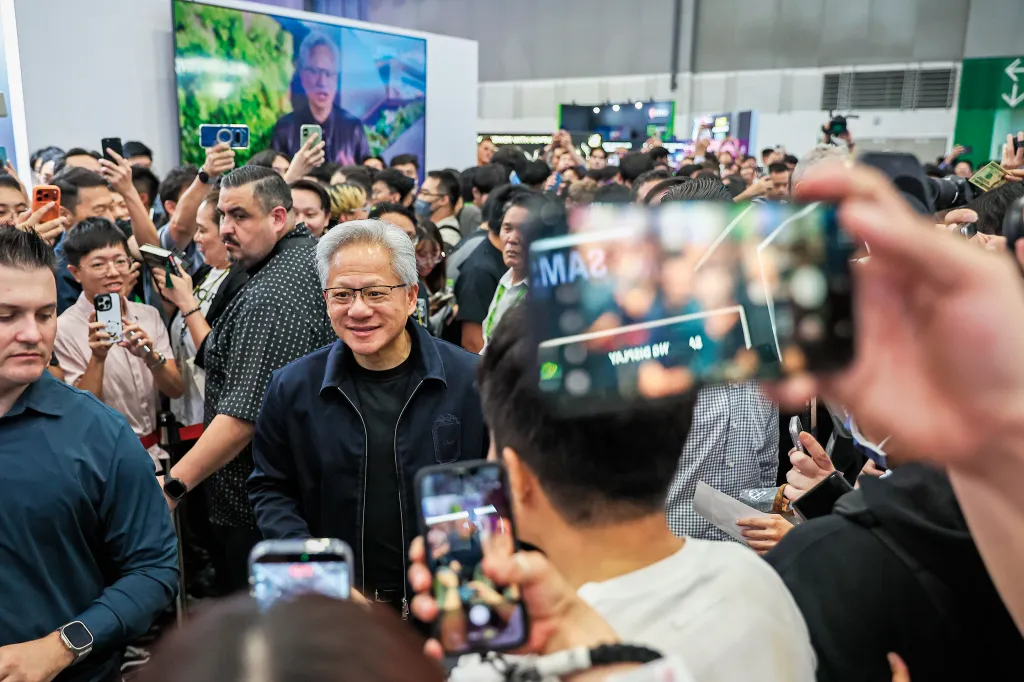
In October, Jensen Huang stepped onto a stage in a converted church in West London and delivered a message to a packed audience of politicians, technology executives and journalists, including Fortune: The artificial-intelligence boom was only beginning, and Nvidia was prepared to help finance it.
“I’m gonna invest in you! I’m gonna invest in you!” Huang shouted at founders in the crowd. “We’re not your largest investor, but we are your best investor.”
The London appearance was part of a European tour that also took Huang to France, Sweden and Germany. At the time, the trip looked like a victory lap. Nvidia had become the default supplier of the chips powering the AI industry’s rapid growth. Its market capitalization had at one point exceeded $5.7 trillion, and it had helped seed an ecosystem that increasingly depended on the company’s support.
If the AI boom was a religion, Huang had become its high priest: promoting the technology to investors and policymakers, encouraging its believers and distributing capital to startups, AI laboratories and so-called neoclouds. Nvidia was the world’s most valuable company, and Huang was one of its most influential executives.
Three weeks later, the European tour looked more like a final public appearance. The man who had sold the world on his vision of an AI future was fighting for his own future. On Thursday morning, news broke that Huang had resigned as Nvidia’s CEO.
His abrupt departure followed reports that U.S. intelligence agencies believed Huang had been involved with Alice Huang, a former executive at Singapore-based data-center company Megaspeed who was allegedly working as a Chinese intelligence asset. Alice Huang is not related to Jensen Huang. Megaspeed had purchased billions of dollars’ worth of Nvidia chips.
Within a week, Huang had sent a memo to Nvidia’s 42,000 employees acknowledging that he had been “unfaithful” to his wife and was “deeply sorry.” Nvidia’s board opened an independent investigation, U.S. congressional leaders summoned Huang for questioning and federal agencies said they were investigating. Nvidia shares fell, while prediction sites began accepting bets on whether Huang would resign.
The New York Times later reported allegations of a second affair, this time involving an Nvidia executive who reported directly to Huang. By the following morning, Nvidia’s CEO of 33 years had submitted his resignation. Nvidia’s short announcement also said that Chief Financial Officer Colette Kress would become interim CEO, but gave no reason for Huang’s departure.
The timing was difficult for Nvidia and for the AI industry, where Huang had played a central role. Concerns about higher interest rates, warnings about AI’s potential catastrophic risks and opposition to data centers—visible in November’s midterm elections—had already weakened the foundations of the boom.
Critics have long argued that Nvidia’s investments created a risky “circular” system: Nvidia provides money to AI laboratories and data-center companies, which then use that capital to buy Nvidia chips. The company said that, as of the end of July, it had invested nearly $50 billion in leading AI model companies alone, including OpenAI, Anthropic and Elon Musk’s xAI. Its equity investments across the AI ecosystem totaled twice that amount.
Nvidia has also increasingly used its investment-grade credit to help AI companies and neocloud data-center providers obtain financing. It has pledged $170 billion in commitments of this kind, including guarantees valued at $105 billion to OpenAI for a single facility in Ohio. The company has also discussed a plan with a consortium of Wall Street lenders to backstop a $500 billion program that would turn AI chips into tradable securities.
Critics have described Nvidia’s role as a “central bank of AI,” arguing that it concealed weak demand and inflated a dangerous financial bubble. The arrangement also made Nvidia a potential single point of failure for the industry. Even the company’s harshest critics, however, did not expect its greatest threat to come from Huang himself.
Nvidia’s core business is not expected to disappear simply because its founder is no longer CEO. Its chips remain the industry standard, and its supply is sold out and contracted through the following year. The company can survive “independent of his cult of personality,” said Francine McKenna, an investigative journalist and expert on corporate governance and accounting.
But Jay Goldberg, an analyst at Seaport Research Partners, said Nvidia could lose what made it exceptional: Huang’s willingness to make large bets and continue moving forward after failures, including the company’s unsuccessful effort to develop chips for mobile phones. “If they lose that,” Goldberg said, “they’re going to become just another chip company.”
Nvidia was never invulnerable. Some major customers were already turning to rival chips or developing their own, while governments were promoting “sovereign AI” that would not depend on American technology. The AI boom is larger than any one company, but the industry has not yet shown that it can thrive without Nvidia, and Nvidia has not shown that it can thrive without Huang.
China and Nvidia’s political influence
In a wide-ranging Fortune interview in London, conducted before the affairs became public but months after concerns about Nvidia’s dealings with Alice Huang and Megaspeed first emerged, Huang remained focused on the company’s future. He said he had eaten only “half of a half sandwich” all day and was late for his next engagement at a church across town. “I’ve been late all day,” he said.
Huang was optimistic about AI and about China. The opportunity there, he said, “is large and growing.” Wearing his signature black leather jacket in the lounge of a Central London office building that had hosted an Nvidia-sponsored hackathon, he said: “We should provide, and we do provide, the best, the soonest, and the most to American companies. However, we should compete.”
Nvidia’s relationship with China has long been important to the Santa Clara, California-based company. That business suffered in 2022 when the Biden administration barred Nvidia from selling its most advanced AI chips in China in an effort to slow Beijing’s progress in the AI race. Later rule changes also excluded Nvidia’s scaled-down chips, while Beijing discouraged Chinese AI companies from buying American products.
Huang once publicly complained that U.S. export controls had reduced Nvidia’s share of China’s AI-chip market from 95% to zero. He lobbied for the restrictions to be rolled back, arguing that allowing Nvidia to sell in China would help make American technology the global standard and hold back rapidly advancing Chinese competitors.
After Donald Trump won a second term in 2024, Huang donated $1 million to Trump’s inaugural fund and began making frequent trips to Mar-a-Lago. The two men became close. During one summit in Los Angeles, Trump called while Huang was onstage. Huang put him on speaker, and they dismissed concerns about AI to the audience.
In late 2025, Huang secured a compromise under which Nvidia could ship a second-tier chip model to approved Chinese customers. Under the unprecedented arrangement, the U.S. government would receive a 25% share.
Huang’s lobbying was “very effective,” said Ed Mills, a policy analyst at Raymond James. “There was an ‘in Jensen we trust’ mantra within D.C. and a push within the tech industry to pivot away from seeking to restrict what China got, to seeing if we could get China hooked on our technology.”
After the scandal broke, reports said Megaspeed had long been suspected of helping Chinese companies evade export controls. People briefed on U.S. intelligence told The New York Times that Alice Huang had been recruited by China’s Ministry of State Security to gather information about American AI chips and persuade Nvidia to seek permission to sell its advanced chips in China.
China hawks in both U.S. political parties have accused Nvidia of minimizing chip smuggling and exaggerating the strength of China’s domestic chips in order to obtain looser restrictions. The alleged affair gave them new grounds to question Huang’s motives.
“This episode makes clear what we have been alleging the whole time, which is that Nvidia is deeply compromised,” said Brad Carson, president of Americans for Responsible Innovation, which lobbies for technology and AI regulation. “At best they turned a blind eye to smuggling of their chips into China. At worst, they were complicit in it.”
China called the allegations “groundless speculation and slander.” Nvidia’s board said it had “no reason to believe” that company secrets or national security had been compromised. Nvidia did not respond to multiple questions from Fortune seeking additional comment after the affair reports and Huang’s resignation.
Later reporting said a Commerce Department investigation into whether Megaspeed had smuggled Nvidia chips into China was halted and transferred to the Justice Department after Nvidia’s general counsel contacted the agents handling it. An Nvidia spokesperson told The New York Times that the company had contacted officials “to answer their questions, provide information we have gathered from the field,” and seek guidance.
After news of Huang’s alleged affair with Alice Huang emerged, Trump called the Nvidia CEO “very aboveboard” but described the situation as “very complex.” The matter also exposed tensions within the Trump administration. Treasury Secretary Scott Bessent told CNBC that Howard Lutnick’s Commerce Department had delayed efforts to restrict Megaspeed. Bessent said Treasury, Defense and State had “for months” supported placing the company on the entity list, the U.S. Commerce Department’s list of companies barred from receiving American technology without a license.
Bessent said the focus on Huang’s personal life was missing the central issue. “The real story here should be: Did Nvidia know their client, and was there a robust effort at Nvidia to make sure that there was no leakage?” he said.
Reports also said Bessent had challenged Lutnick in the White House Situation Room over his opposition to export controls. A Commerce spokeswoman denied that account. Huang and Lutnick were summoned to testify before the Senate Banking Committee about the department’s handling of Nvidia chip exports and the Megaspeed case.
Pressure on the AI market
At Nvidia’s flagship GPU Technology Conference in Berlin, held days after Huang’s London visit, his keynote reached capacity almost two hours before he took the stage. He urged Europe to embrace AI and build more AI “factories,” his preferred term for data centers. He ended the event with a Eurovision song contest performed by AI agents.
Despite Huang’s enthusiasm and his rock-star reception, the AI boom was already showing signs of strain. “He is a cheerleader for a market, and he is cheerleading it,” Paul Miller, a principal analyst at Forrester, said after the event. “But even he’s not blind to the problems that this sector faces.”
Those problems included concerns about an AI bubble and fears that AI could pose catastrophic risks to humanity. By November, the U.S. midterm elections had created another challenge. Democrats who campaigned on limiting AI and data-center development won control of Congress, and voters strongly supported ballot measures restricting new data centers. AI stocks fell after the elections as investors prepared for tighter regulation.
Nvidia’s customers were also seeking greater control over chip supply and lower costs by developing their own AI processors. Google trains its Gemini models on its own TPU chips rather than relying entirely on industry-standard GPUs. Amazon is promoting its Trainium chips. OpenAI is designing silicon with Broadcom, while Anthropic increasingly uses Google TPUs, AMD GPUs and Amazon Trainium chips, as well as Nvidia products.
AI coding agents are making it easier for customers to switch between chip types by handling much of the difficult work involved in migrating workloads. Countries including the U.K. are developing their own chips and pursuing models that can run on “heterodox compute,” which combines different types of chips in one data center to reduce dependence on American technology.
Hyperscalers and large cloud providers generate about half of Nvidia’s data-center revenue, which accounts for more than 90% of the company’s total sales. Huang’s European trip was partly an effort to counter the continent’s sovereign-AI movement by presenting Nvidia as the solution. European customers, he argued, could run any model they wanted—including open-source models from French AI company Mistral—as long as the models ran on Nvidia chips.
Huang and Nvidia have strongly supported open-source AI, in which model weights are published so anyone can download, modify and run them on their own hardware. Anthropic and OpenAI, by contrast, keep their weights private and sell access through their own applications and cloud services.
For Nvidia, an open-source ecosystem filled with companies that need Nvidia chips and its CUDA software—the software platform developers use to build and run AI applications on Nvidia hardware—could provide protection if leading closed AI laboratories shifted to other chip suppliers. “Our business model is so transparent,” Huang said in London. “We benefit when the world uses AI. Period. Whether it’s closed or open.”
Aldo Podestà, CEO of Italian AI startup Giotto.ai, disagreed and called Nvidia’s strategy a “Trojan horse.” Nvidia distributes free software that works best on its own chips, he said, encouraging users to become increasingly dependent on the company. “Some dependence is easier to accept when it arrives in the language of freedom,” Podestà said.
The AI “five-layer cake”
Nvidia controls an estimated 80% of the global AI-chip market, and its hardware fills the data centers being built by technology companies. At GTC Berlin, that dependence was visible across the exhibition floor, where Nvidia’s partners—including neocloud providers—occupied a large share of the space.
Companies such as Nebius and CoreWeave buy Nvidia chips in large quantities, install them in data centers and rent computing capacity to AI laboratories and businesses. Many count Nvidia as a supplier, investor and, in some cases, customer. Megaspeed, the Singapore-based company at the center of the scandal, is also a neocloud.
As of late July, Nvidia held about $99 billion in investments across what Huang calls AI’s “five-layer cake”: energy companies, data-center operators, chipmakers, model developers and the applications built on top. Several investments included commitments from the recipients to spend heavily on Nvidia chips.
“Every single one of the layers we’ve selected are very strategic and really high-quality companies to invest in,” Huang said. “Everybody we invest in are connected into Nvidia’s ecosystem, and so we’re making our platform more vibrant.”
Michael Burry, the investor known for betting against the U.S. housing bubble, has argued that Huang is inflating a dangerous AI bubble through “circular financing.” Huang rejected the idea that Nvidia was propping up the industry. The company takes minority stakes, he said, meaning other investors must also support the businesses. He argued that AI requires unusually large amounts of upfront capital. “We’ve created an industry that the VCs alone cannot fund,” he said. The investments, he added, “have returned fabulously.”
Neocloud companies made a similar argument in Berlin. “If it’s all going to come down to Nvidia’s capital, we would have run out already,” said Marc Boroditsky, chief revenue officer at Nvidia-backed Nebius. He acknowledged, however, that “many companies out there … have more extreme financial relationships with Nvidia than we do.”
Francine McKenna said Nvidia’s role in supporting the AI sector could place enormous pressure on weaker participants if demand fell short of optimistic forecasts. In the worst case, companies such as OpenAI or CoreWeave might not earn enough to pay their bills. Nvidia could then lose chip sales and equity investments while also becoming responsible for some debts.
Such a failure could spread through financial markets, beginning with Nvidia’s share price. Cisco provides a historical comparison. Its routers and switches carried much of the early internet’s traffic, giving the company a role similar to Nvidia’s during the dot-com bubble. Cisco also used vendor financing to expand the market for its networking equipment. When the bubble burst in late 2000, Cisco survived, but its market value fell more than 85% and never returned to its previous level.
“Weak links come from unexpected places and create systemic risks that can ripple through supply chains and sales cycles,” McKenna said in late October. The vulnerability had now appeared at the center of Nvidia’s network. The extent of any damage remained uncertain.
A company built around one person
Nvidia’s influence came not only from its cash, credit rating and chips but also from Huang’s reputation. He was well regarded before AI turned him into a corporate celebrity. His personal history gave him an underdog credibility unusual among technology billionaires. His first job was as a teenage dishwasher at Denny’s, and he and his cofounders later sketched the idea for Nvidia in one of the chain’s booths.
They founded the company in 1993. Nvidia chips became a standard in video gaming, and Huang guided the company through an early near-death experience when it nearly ran out of money. He built Nvidia into a Fortune 500 company and, two decades later, recognized the opportunity in artificial intelligence.
If Nvidia was the linchpin of the AI industry, Huang was the linchpin of Nvidia. After his resignation, the company’s stock fell as much as 14% in trading, briefly taking Nvidia below a $4 trillion market capitalization for the first time in more than a year before it recovered somewhat.
Huang placed himself at the center of a company that still operates “like a startup,” said Laura Fay, who reported directly to him for a decade before retiring in July. His management structure was famously flat. Huang has said that he once had about 60 direct reports.
That structure helped Nvidia move at what Huang called the “speed of light,” but it also left the company unusually dependent on one person. At the time of his resignation, Nvidia had no president, no chief operating officer and no obvious No. 2. Its board also had no executive chairman.
Huang’s absence could be felt most strongly in Washington, where he had developed close relationships and spent years advocating for policies favorable to Nvidia. In May, Trump brought Huang aboard Air Force One to China and joked to Fortune that he was surprised Huang did not have his own private jet. That was reportedly around the time Secretary of State Marco Rubio briefed Trump about the suspected spying operation. Trump later said the warning “didn’t make much of an impact on” him.
Nvidia pushed back against think tanks calling for stricter chip-export controls. According to The Information, some customers—including OpenAI CEO Sam Altman—avoided taking public positions on the issue because they feared angering Nvidia. In a statement to the outlet, an Nvidia spokesperson defended the company’s opposition to export controls: “America cannot win the AI race unless America’s AI infrastructure wins worldwide.”
Some industry participants called Nvidia a bully and said that people who disagreed with the company could be placed in “Jensen jail” and denied access to needed chips. Others said Nvidia’s influence reflected the strength of its products. “They make the best chips, and companies want them a lot and are afraid of doing things that could anger [Nvidia],” said Nathan Calvin, general counsel and vice president of state affairs at Encode, a nonprofit focused on AI and Big Tech regulation. “They have a lot of influence and leverage that they can use to advance their favored policy positions.”
Huang had been Nvidia’s most effective advocate in Washington. His departure removed the company’s strongest voice against tighter restrictions on chip sales to China. Raymond James analyst Ed Mills said Huang’s departure “guarantees new export controls.” Three bills proposing new controls on AI chips and advanced semiconductor equipment were attached to a defense authorization bill awaiting passage in Congress. The scandal, Mills said, was “the accelerant to push [the legislation] over the finish line.”
The scope of the restrictions and how forcefully the Trump administration would enforce them remained uncertain. The bills contained a “remote access” loophole that allowed Chinese AI companies to use Nvidia chips in data centers located in other Asian countries. Mills said that was exactly the type of access Megaspeed reportedly provided to Chinese firms.
He said the loopholes could be closed by requiring Nvidia and other chipmakers to adopt know-your-customer procedures. Resellers and cloud companies could also be required to identify their customers’ customers. Washington could additionally impose licensing requirements or restrictions on open-source AI models, measures Huang had opposed.
Because leading open-source models had been developed by Chinese AI laboratories, Mills said many lawmakers viewed “open-source equals China.” “If Washington is serious about trying to win the AI race against China we need to see regulations on open-source,” he said.
Nvidia after Huang
For investors, the policy questions were secondary to a more immediate issue: Who would keep the AI boom together after Huang’s departure?
Neocloud companies were among the businesses most exposed. Some of Huang’s most ambitious financing plans, including the more than $500 billion platform Nvidia announced with Wall Street firms in August, had already met resistance from senior Nvidia executives, according to Goldberg. “Nobody at Nvidia could replace Jensen’s role in bringing that together,” he said. Without Huang, Goldberg expected many neocloud projects would not receive funding.
Investors could also begin examining the figures Huang used to justify Nvidia’s complex investment network. Jason Schloetzer, an associate professor at Georgetown University’s McDonough School of Business, asked whether “‘Jensen’s Math,’ the term used for the complex financial entanglements of these AI firms … [was] about to collapse.” He also asked: “What else has he covered up? What else is lacking candor?”
Nvidia’s partners could gain negotiating power. Companies that had accepted Nvidia’s money on Nvidia’s terms might begin to resist. “Maybe they’ll drive a harder bargain,” McKenna said.
The wider industry would also face consequences. Goldberg said AI had enough momentum to continue, but would become “much more vulnerable to political pressure,” especially as opposition to data centers grew. Anthropic, scheduled to go public days after Nvidia reported its first quarterly earnings without Huang, would provide an early test of the post-Huang environment.
Nvidia agreed to purchase about $10 billion of shares as part of a $26 billion private placement connected with Anthropic’s listing, and investors expected that commitment to proceed without Huang. His departure could nevertheless increase scrutiny of Anthropic’s relationships with Nvidia and with customers linked to the chipmaker. Schloetzer said he expected “much closer scrutiny of [Anthropic’s] ties to Nvidia and customers associated with Nvidia.”
Nvidia’s rival chipmakers were likely beneficiaries. The turmoil was “really good for AMD, and it’s really good for Broadcom,” Goldberg said. Google’s TPUs could also benefit from concerns about Nvidia’s long-term prospects. AMD, Nvidia’s longtime rival in graphics processors, could gain market share.
Since the scandal emerged, Huang has withdrawn from public appearances. His only public statement has been an apology to Nvidia employees. “I support the investigation and will cooperate fully,” he wrote. “I am committed to protecting Nvidia and supporting America’s national security.”
That tone differed sharply from the confident executive who had spoken in London about the most optimistic possible version of AI’s future. Huang said the technology would give a small local business the same software power as a technology giant. “As a result, everybody will become more ambitious,” he said. “And so I’m excited about that.”
The AI boom had depended in large part on faith in Huang and the story he told about Nvidia. He argued that demand for the company’s chips would continue to grow, that AI’s risks could be engineered away and that the companies building the technology could regulate themselves. Investors, customers and governments had accepted that vision.
Huang’s resignation has challenged that confidence. The industry must now determine whether it can continue without the executive who became its most prominent advocate—and whether Nvidia’s network of investments, customers and political relationships can remain intact without the person who built it.
Original source: https://fortune.com/2026/11/14/jensen-huang-nvidia-ai-5-7-trillion-downfall/

