J.B. Hunt Sees Driver Shortage as Recovery Constraint Amid 'Summer of Many Minibids'
Key Takeaways
- •Driver recruitment needs have risen to their highest level since 2022 as regulators intensify enforcement on noncompliant operators.
- •Rising fuel costs, broker-liability exposure, and higher insurance costs are pressuring smaller carriers and reducing lower-tier market capacity.
- •J.B. Hunt said its annualized cost savings run rate has reached $135 million and it posted four straight quarters of year-over-year margin improvement without material pricing support.
- •The company reported record intermodal volumes and said the current road-to-rail conversion opportunity is the strongest in a decade.
- •J.B. Hunt's brokerage unit returned to profitability for the first time in 14 quarters, while intermodal pricing remains far below truckload rates.
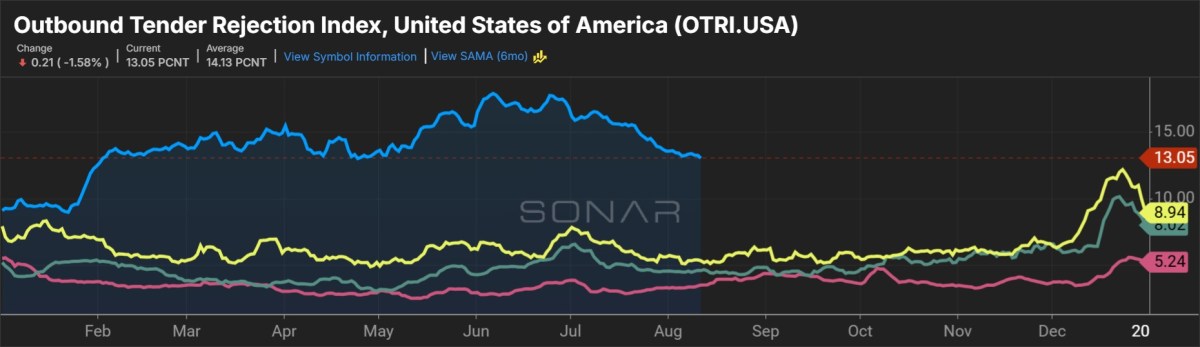
Executives from J.B. Hunt Transport Services (NASDAQ: JBHT), one of the largest surface transportation and logistics companies in North America, said Tuesday that the freight industry remains in the "early innings of supply correction," though the supply side of the equation could ultimately cap the upside of any demand-driven recovery. Speaking at Deutsche Bank's Chicago Industrials Summit, management highlighted intensifying labor pressures, noting that driver recruitment needs have reached their highest level since 2022. A tighter driver market, however, could serve as a demand tailwind for the company's less driver-intensive intermodal division.
Driver Recruitment Challenges Mount
Regulatory authorities began clamping down on noncompliant operators last year. Strict enforcement of English-language proficiency requirements and non-domiciled commercial driver's license (CDL) restrictions were compounded by crackdowns on electronic logging device (ELD) providers and truck driving schools.
The driver exodus, however, predates those enforcement actions. Many owner-operators who obtained their own authorities during the pandemic-era freight boom exited the industry following an extended stretch of weak economics that followed. Rising fuel prices—which most small carriers cannot fully recoup through fuel surcharges—have emerged as the latest headwind for this market segment.
The Supreme Court's ruling expanding broker liability exposure has introduced an additional bottleneck for driver hiring. The decision is also pushing up insurance costs, creating a further barrier to entry.
These developments have been a net positive for large carriers. The bottom tier of capacity, which typically relies on cheap rates, is being steadily eliminated from the market. Large fleets have reported meaningful improvements in equipment utilization, and contractual rate renewals are yielding low-double-digit percentage increases. After several quarters of trimming truck counts to boost utilization, some publicly traded fleets are once again pursuing growth—though expansion will be constrained by an increasingly competitive driver market.
J.B. Hunt has substantially expanded its driver recruiting teams in recent weeks, management told attendees at the Deutsche Bank event. While wages are rising in certain regions, the company believes it holds several recruiting advantages. Management noted that the regulatory crackdown is pushing drivers toward financially stable carriers with robust safety protocols.
The company's dedicated segment offers an additional edge: the average length of haul in the recent quarter was just 172 miles, allowing drivers to work what are essentially standard daytime hours.
Financial Recovery Outpaces Market Cycle
While acknowledging that broader demand still has room to strengthen, management expressed confidence in J.B. Hunt's trajectory, pointing to improved financial performance over the past year. Those gains came despite the fact that the company's two largest segments—intermodal and dedicated—do not immediately benefit from truckload (TL) market inflections.
J.B. Hunt initiated aggressive cost reductions last year, ramping up cost takeouts and AI-driven efficiency programs. The company has achieved an annualized cost savings run rate of $135 million, measured against $956 million in trailing-12-month operating income. Four consecutive quarters of year-over-year margin improvement were delivered without a material contribution from pricing. Intermodal pricing typically lags the TL market by two to three quarters, while multi-year dedicated contracts carry annual cost-based price escalators that adjust more slowly when market conditions shift.
The company has also recorded record intermodal volumes across its network—operating one of the largest domestic container fleets in North America—as it emerges from the downturn. Management described the current road-to-rail conversion opportunity as the best in a decade, citing a convergence of high fuel prices, elevated TL rates, and strong rail service quality. A competitive driver market further supports modal conversion, since drayage drivers are needed for only a fraction of the total intermodal shipment distance.
Stacey Griffin, senior vice president of pricing for intermodal, described the current environment as "the summer of many minibids," as shippers seek to mitigate TL rate increases through shorter-term bidding cycles that allow more frequent repricing than traditional annual contracts.
Even with what management called a "normal peak season" approaching, shippers will find it more difficult to avoid volume surcharges this year. J.B. Hunt anticipates narrowing the pricing gap between TL and intermodal. According to Sonar data, that gap has widened throughout the summer, with intermodal currently priced 34% below TL—far exceeding historical benchmarks of 10% to 15% in the truck-competitive East and 25% in the transcontinental West.
The company's intermodal bid season begins in October, with 10% of annual contracts repriced in the fourth quarter. The remainder are distributed evenly across the first, second, and third quarters. With TL rates still climbing and beginning to flow through to carrier results, management indicated there is "more opportunity" for intermodal rate increases—a dynamic shippers and competitors will be watching as a signal of how much pricing power carriers can reclaim heading into 2025.
Brokerage Unit Returns to Profitability
J.B. Hunt's dedicated pipeline closed the second quarter at an all-time high. Management characterized the second quarter as "the squeeze quarter" for the TL brokerage industry, as spot rates—reflecting purchased transportation costs—surged. Despite that pressure, J.B. Hunt's brokerage unit returned to profitability for the first time in 14 quarters.
Industry-wide, brokerage margins likely improved in July—typically the second-weakest volume month of the year—as spot rates cooled while contract pricing continued to reset higher.
The broader takeaway from J.B. Hunt's presentation is that structural supply-side constraints, rather than demand shifts alone, are forging a durable competitive advantage for large, financially stable carriers.

