Why Is Jay Clayton Back in Crypto Policy? Trump's Reported Super Intelligence Force Pick, Explained
Key Takeaways
- •President Trump reportedly selected former SEC Chairman Jay Clayton on October 4, 2026, to head the Super Intelligence Force, but the appointment has not been confirmed by any official White House announcement or Federal Register filing.
- •Clayton served as the 32nd SEC chairman from May 2017, an era defined by applying securities law to token markets that culminated in the December 2020 charge against Ripple over a $1.3 billion unregistered XRP offering.
- •The Super Intelligence Force's mandate, jurisdiction, and relationship to existing regulators such as the SEC and CFTC have not been formally defined, leaving unclear whether the role will address crypto policy or focus on artificial intelligence and national security.
- •XRP traded at $1.49 at the time of report, down 1.36% over 24 hours with a market capitalization near $94.3 billion, while the crypto Fear & Greed Index stood at 73, indicating the market was not pricing in significant regulatory alarm.
- •The initiative's expected 120-day report would be the first substantive output for evaluating whether the White House role accelerates regulatory clarity for digital assets.
The Reported Appointment
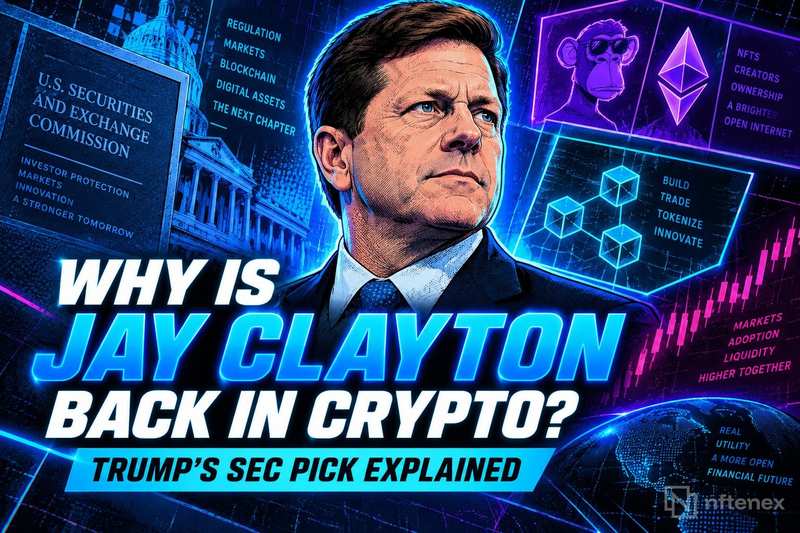
Trump selected former Securities and Exchange Commission (SEC) Chairman Jay Clayton on October 4, 2026, to head the Super Intelligence Force, a White House initiative expected to deliver a 120-day report as its first policy output, according to an unconfirmed report by CoinGape.
No White House announcement or Federal Register notice — the government's official journal for publishing federal appointments and agency actions — had been independently verified at the time of writing, and the appointment should therefore be treated as reported rather than settled fact.
Why Clayton's SEC Background Matters
Clayton's résumé is far from abstract for crypto markets. The SEC confirmed that he was sworn in as its 32nd chairman on May 4, 2017, nominated by Trump and confirmed by the Senate. His tenure set the tone for how the United States treated digital assets as securities — a designation that obliges issuers to register offerings and disclose material information to investors — and it closed with a major enforcement action.
In December 2020, the SEC under Clayton charged Ripple and two of its executives with conducting a $1.3 billion unregistered securities offering involving XRP, alleging that the company had raised funds through XRP sales since 2013. The same enforcement release alleged that Ripple executives separately made approximately $600 million in personal XRP sales.
Stephanie Avakian, then co-director of the SEC's Division of Enforcement, said the agency alleged that "Ripple, Larsen, and Garlinghouse failed to register their ongoing offer and sale of billions of XRP to retail investors, which deprived potential purchasers of adequate disclosures about XRP and Ripple's business and other important long-standing protections." That emphasis on retail disclosure lies at the center of the classification question that crypto projects still navigate today: whether a token offering requires securities registration.
Why Clayton's Return Matters for Crypto Regulation
Signals for crypto companies and investors
Clayton presided over an era of aggressive application of securities law to token markets, making his reported return to a policy role significant any project navigating the boundary between commodity and security — the line that determines whether the SEC or the Commodity Futures Trading Commission (CFTC) holds primary oversight of a given asset. His reported mandate involves a White House initiative rather than a direct regulatory agency role — a different dynamic from his SEC tenure — but his views on digital assets shaped enforcement priorities for years after he left office.
The SEC's current posture on crypto products has shifted considerably since Clayton's departure, including pauses and pivots on ETF review timelines. Whether a Clayton-adjacent White House role would accelerate or complicate that evolution is an open question that the 120-day report is expected to begin answering.
Market snapshot
XRP was trading at $1.49 at the time of the snapshot, according to CoinGecko data, down 1.36% over 24 hours, with a market capitalization of approximately $94.3 billion and 24-hour trading volume near $1.75 billion. Broader crypto sentiment sat at 73 on the Fear & Greed Index, classified as "Greed," suggesting the market was not pricing in significant regulatory alarm from the reported appointment at the time of writing.
Questions the appointment does not answer yet
The Super Intelligence Force's mandate, jurisdiction, and relationship to existing regulators such as the SEC and CFTC have not been formally defined in any accessible official record. Whether Clayton would have authority to recommend changes to how XRP or other digital assets are classified — or whether the role is primarily focused on artificial intelligence and national security rather than crypto-specific policy — remains unclear from the single-source report.
The CFTC's evolving position on Bitcoin and digital asset oversight — the US derivatives regulator has historically characterized Bitcoin as a commodity — adds another layer of jurisdictional complexity that a new White House-level initiative would need to navigate carefully to produce durable policy change.
Near-Term Signals to Watch
The most concrete indicator will be a formal White House announcement or Federal Register filing that confirms the role's title, scope, and reporting structure. Until that exists, the CoinGape report represents a single unconfirmed source. The described 120-day report, if produced, would be the first substantive output to evaluate.
Crypto companies and investors tracking regulatory infrastructure should also watch whether Clayton makes any public statements signaling continuity with his SEC-era enforcement stance or a departure from it. His 2017-to-2020 record at the agency, including the Ripple complaint filed on his final full day in office, provides the baseline for that comparison.
Developments in institutional frameworks for crypto risk are also accelerating independently of any single appointment, meaning the market structure Clayton would be entering looks significantly different from the one he left. For projects and creators in the digital ownership space, the structural question is whether a White House-level initiative changes the pace of regulatory clarity or simply adds another voice to an already crowded policy conversation. The answer likely depends on whether the Super Intelligence Force is granted real enforcement-adjacent authority or functions primarily as an advisory body.
Disclaimer: This article is for informational purposes only and does not constitute financial or investment advice. Cryptocurrency and digital asset markets carry significant risk. Always do your own research before making decisions.

