Japan's Foreign Currency Reserves Plunged by $95 Billion in August as It Dumped US Treasuries to Support the Yen — but the Interventions Are Hugely Profitable
Key Takeaways
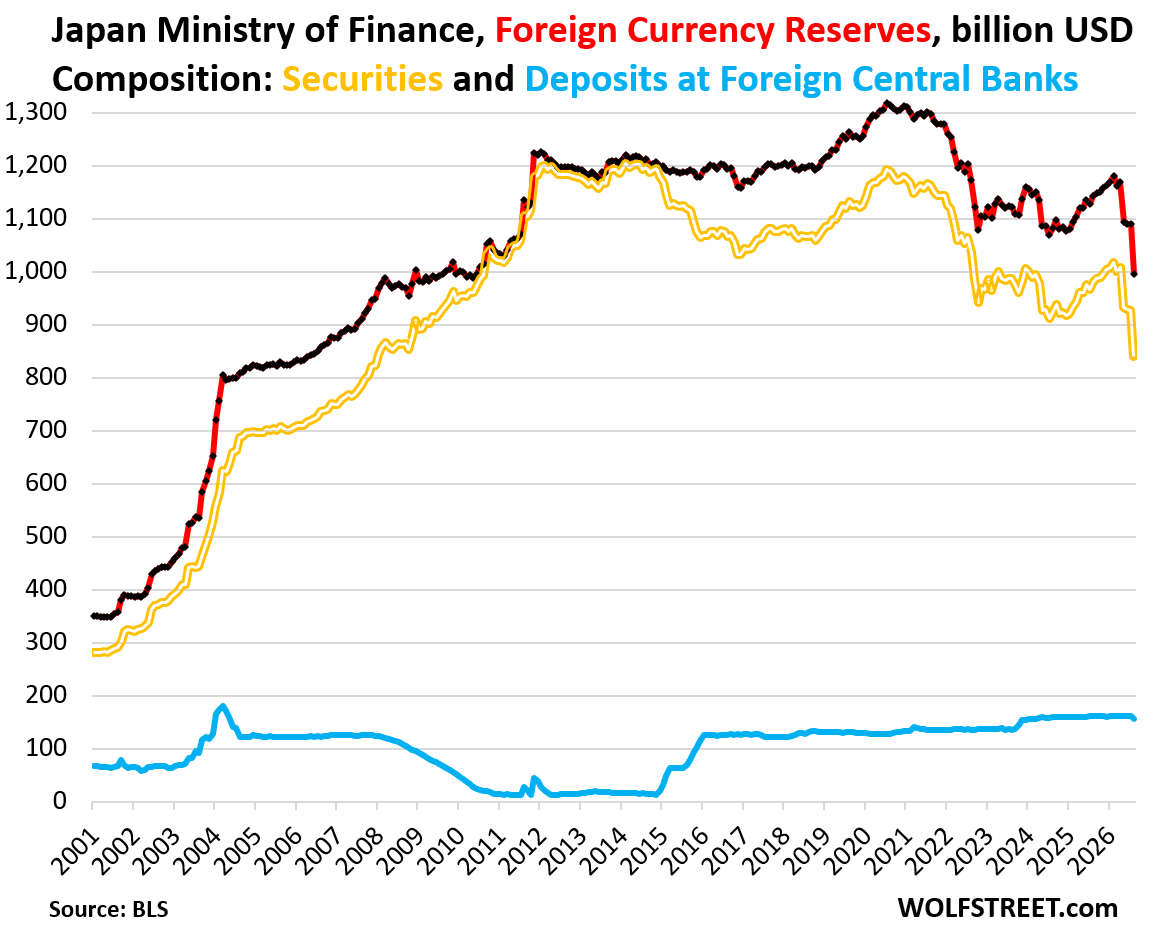
- •Japan's foreign currency reserves dropped a record $94.6 billion, or 8.7%, in August to $995 billion, falling below $1 trillion for the first time in the current data series.
- •The decline stems from a joint Japan-US currency intervention, with the July 31 operation — the largest to date — involving the purchase of ¥15.4 trillion in yen.
- •Securities holdings, mostly US Treasuries, fell $87.8 billion to $840 billion, while foreign currency deposits declined $6.9 billion to $155 billion in August.
- •The interventions generated large yen-denominated profits because the MOF bought most of its Treasuries between 2001 and 2011 when the yen was stronger, with FEFSA booking ¥5.06 trillion (~$31 billion) in profits for the fiscal year through March 2026.
- •The government is debating how to use ¥3.54 trillion transferred to the General Account, with a compromise reached in August to cut the food consumption tax to 1% for two years, effectively 0% for low- and middle-income households.
Japan's government is already busy fighting over what to do with the $31 billion in profits generated by its foreign exchange interventions last fiscal year.
Japan's Ministry of Finance disclosed on Monday that the country's foreign currency reserves plunged by a record $94.6 billion in August, a decline of 8.7%, falling to $995 billion at the end of August from $1.09 trillion at the end of July. It was the first time in the current data series that the reserves had fallen below the $1 trillion mark. The drop reflects the effects of the joint Japan-US intervention in the foreign exchange markets — the biggest so far — designed to put a floor under the plunging yen.
Currency intervention — the government selling dollars and buying yen — is a tool Japan has repeatedly deployed over the decades when rapid yen weakness threatened to destabilize the economy, and the scale of the July 31 operation underscores how sharply the yen had come under pressure.
Looking at the broader four-month window from May through August, a period that includes the yen interventions in May and on July 31, foreign currency reserves fell by $174 billion, or 14.9%.
Composition of the reserves
Japan's foreign currency reserves consist mostly of securities, the majority of which are US Treasury securities. Japan has for years been among the largest foreign holders of US Treasuries, which means the composition of its reserves draws close attention from Treasury market watchers whenever intervention forces sales. In August, securities holdings dropped by $87.8 billion from July, to $840 billion.
The remainder of the reserves is made up of foreign currency deposits held at other central banks, including the MOF's USD deposits at the Fed's Reverse Repo facility for Foreign Official and International Accounts, which is a liability for the Fed. These deposits declined by $6.9 billion in August, to $155 billion.
Monday's release shows the impact of the interventions on the reserves and provides additional detail. On August 28, the MOF had already disclosed that it bought back ¥15.4 trillion of yen in cash in the foreign exchange markets during the July 31 intervention, selling foreign currency to do so.
Don't cry for Japan
There is another side to this story. The MOF bought most of these securities — mostly Treasuries — between 2001 and 2011, when the yen was much stronger against the USD than it is today. In other words, it could purchase more US Treasuries with fewer yen at the time. In February 2012, foreign currency securities holdings reached $1.20 trillion, roughly the peak of the MOF's foreign securities holdings.
2012 was also the year Abenomics took off. The Bank of Japan launched massive quantities of QE and pushed interest rates to zero, and then below zero, while the government ran large deficits. Over the years, the yen collapsed by 48%, despite its recent rally.
Now the MOF is selling those US Treasuries and buying yen with the USD proceeds — receiving many more yen for those securities than it originally paid, and thereby realizing large cash profits in yen terms. Each intervention has generated substantial profits, but none more than this one, since it was the biggest intervention to date.
A slush fund forms from those profits
All yen cash proceeds from these currency interventions, along with all cash proceeds from yields paid in foreign currency, flow into the Foreign Exchange Fund Special Account (FEFSA). The FEFSA is legally separate from the government's General Account, precisely so that politicians cannot turn the intervention proceeds into a slush fund.
The yen's collapse has massively amplified these returns as interventions continued over the past few years, while USD yields on Treasury securities have surged since 2021. For Japan's fiscal year through March 2026, the FEFSA booked profits of ¥5.06 trillion, according to the MOF — about $31 billion at the time. That figure does not include profits from the interventions in May and on July 31.
The law governing the FEFSA requires that 30% of cash proceeds from interventions and yields be retained in the FEFSA as a buffer against future losses and for reinvestment in the foreign exchange reserves.
The remaining 70% is transferred into the government's General Account — at which point, it becomes political slush-fund material.
The government is now busy arguing over what to do with the ¥3.54 trillion in foreign exchange profits (70% of ¥5.06 trillion) transferred to the General Account, split between fiscal year 2025 and fiscal year 2026.
Prime Minister Takaichi stated when she took office that the slush fund from foreign exchange profits should be used to fund her policy initiative of cutting the consumption tax on food from 8% to 0%. In August, a compromise was approved that reduces the consumption tax on food to 1% for two years, with special benefits for low- and middle-income households that effectively bring that tax rate to 0%.
The stated goal is to avoid issuing new bonds to fund the tax cut, and the government is now debating which slush fund to tap, with all eyes on the profits from the foreign currency interventions. How the funding debate resolves — and how far the reserves are drawn down if further yen-support operations prove necessary — will be visible in the MOF's monthly reserve releases going forward.
Source: Wolf Street
