Rising JGB Yields Put Japan's Debt Strategy and Global Markets at Risk
Key Takeaways
- •Japan's gross government debt stands at approximately 250% of GDP, the highest ratio among major developed economies, making debt servicing costs highly sensitive to interest rate changes.
- •The Bank of Japan holds roughly half of all outstanding government bonds, with holdings reaching ¥518.2 trillion as of July 20.
- •Benchmark 10-year JGB yields climbed to 2.9% in July, the highest level since 1996, while 30-year yields surpassed 4%.
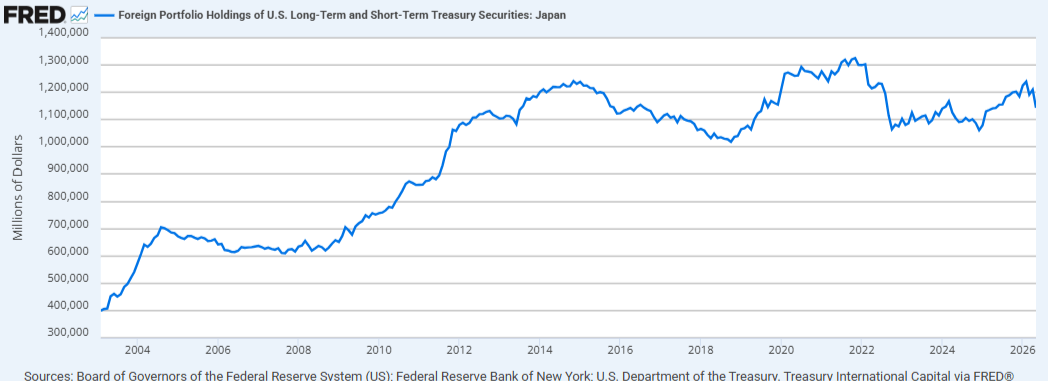
- •Japan is the largest foreign holder of U.S. Treasury securities at approximately $1.143 trillion, meaning capital repatriation could pressure American borrowing costs.
- •Japan may have spent up to $58.97 billion on yen-buying intervention on July 30, with the U.S. Treasury reportedly participating through coordinated action.
Japan's effort to support the yen while containing borrowing costs has exposed a delicate policy balance with consequences extending well beyond its domestic economy. Rising Japanese Government Bond (JGB) yields are placing increasing pressure on public finances, currency policy, and international capital flows.
The strain reflects three decades of cheap money policies following the collapse of Japan's property and equity bubble in the early 1990s. Low interest rates, quantitative easing, and large-scale bond purchases reduced financing costs even as government debt expanded to historic levels. Today, Japan's gross government debt stands at roughly 250% of GDP, the highest ratio among major developed economies, making the cost of servicing that debt acutely sensitive to even modest rate increases.
Rising Bond Costs Test Japan's Debt Strategy
EGRAG CRYPTO described the challenge as a conflict between protecting the currency and preserving the sovereign bond market. That tension is intensified by the Bank of Japan's vast holdings, which reached ¥518.2 trillion in government securities on July 20.
— EGRAG CRYPTO (@egragcrypto) July 31, 2026
— EGRAG CRYPTO (@egragcrypto) July 31, 2026
A BOJ policymaker also stated in May that the central bank still owned approximately half of all outstanding Japanese government bonds. Meanwhile, central government debt reached ¥1.3438 quadrillion in March, encompassing bonds, borrowings, and financing bills.
Against that backdrop, higher interest rates could strengthen the yen and ease imported inflation from fuel, food, and raw materials. However, tighter monetary policy would simultaneously increase refinancing costs across one of the world's largest sovereign debt markets.
Rising borrowing costs could also reduce the value of existing long-duration bonds. As a result, banks, insurers, and pension funds holding large government-debt portfolios could face mounting balance-sheet pressure as JGB yields climb.
Those risks became more pronounced in July when the benchmark 10-year yield reached 2.9%, its highest level since 1996. At the same time, the 30-year yield climbed above 4%, further tightening long-term financing conditions. The moves mark a sharp departure from the ultralow-rate environment Japan maintained for years, even as peers such as the Federal Reserve and the European Central Bank aggressively raised rates to combat post-pandemic inflation.
Conversely, maintaining low interest rates would generate a different set of pressures. While such a policy could support bond prices, it could also leave the yen vulnerable to further weakness and push import costs higher.
The BOJ therefore maintained its policy rate at 1% while preserving room for another increase. Officials indicated that a rate hike could be considered as early as September if inflation risks persisted.
Yen Support Risks Spilling Into Global Markets
Japan's policy decisions carry significance beyond its borders, given the yen's long-standing role in supporting international carry trades. Investors typically borrow cheaply in yen before purchasing higher-yielding bonds, equities, and digital assets elsewhere.
A stronger yen and higher domestic rates, however, would make those positions more expensive to maintain. Investors could be forced to sell foreign assets to repay yen-denominated funding, transmitting pressure across global markets. The unwind of such trades has contributed to sharp volatility episodes in the past, including during the August 2024 market turbulence that followed the BOJ's surprise rate increase.
The United States faces particular exposure, as Japan remains the largest foreign holder of U.S. Treasury securities. Japanese holdings stood near $1.143 trillion in May, linking Japanese capital flows directly to American debt markets.
As JGB yields rise, domestic bonds may become more attractive to Japanese investors. Consequently, capital could flow back to Japan, while Treasury sales used to finance currency intervention could place additional upward pressure on U.S. borrowing costs.
Currency intervention has already intensified. Japan may have spent as much as $58.97 billion buying yen on July 30 after the dollar approached ¥164.
Reuters later reported that the U.S. Treasury also purchased yen through the New York Federal Reserve, underscoring coordinated concern over the currency's decline and the broader risks associated with disorderly exchange-rate movements.
The episode recalls June 1998, when coordinated intervention included $833 million from the American side. However, the market turmoil that followed had several larger and more immediate causes. The IMF and Federal Reserve primarily attributed the 1998 disruption to Russia's default, the Asian financial crisis, and the near-collapse of Long-Term Capital Management. The comparison therefore highlights market vulnerability rather than proving that intervention alone causes financial instability.
The current risk lies in the interaction between rising debt costs, currency support measures, and cross-border funding dynamics. Japan must navigate this adjustment carefully to avoid destabilizing its bond market and disrupting global liquidity.

