Japan's FSA Requests Crypto Exchanges to Delay Withdrawals Amid Rising Scam Activity
Key Takeaways
- •Japan's Financial Services Agency has asked domestic cryptocurrency exchanges to implement mandatory delays on customer withdrawals to help combat a growing wave of investment scams.
- •The proposed holding period would create a defined interval between when a user initiates a transfer and when the exchange actually releases the funds, allowing additional time for fraud screening.
- •The FSA has scoped this guidance specifically to scam prevention and does not consider it a broader policy shift targeting cryptocurrency trading activity.
- •Japanese exchanges will need to adjust their compliance and operational workflows to incorporate the delay requirements alongside existing anti-money-laundering and customer-protection procedures.
- •The FSA has not yet specified a fixed duration or detailed scope for the withdrawal delays, leaving implementation specifics to be determined by how exchanges respond and whether further guidance follows.
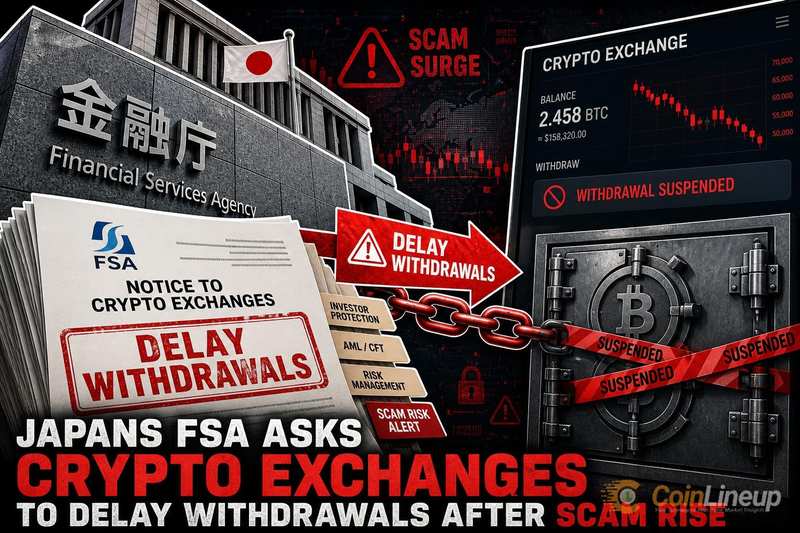
Japan's Financial Services Agency (FSA) has asked domestic cryptocurrency exchanges to implement delays on customer withdrawals in response to a growing wave of scams, a measure designed to give platforms additional time to screen transactions before funds leave user accounts.
Details of the FSA's Request
The FSA's notice centers on introducing a mandatory interval between when a customer initiates a withdrawal request and when the cryptocurrency or fiat funds are actually released. Under such a framework, an account holder who initiates a transfer would not see it processed immediately. Instead, the transaction would be held for a defined period before the exchange completes it.
The regulator has framed this as a targeted response measure tied specifically to fraud activity, rather than a broad policy shift on cryptocurrency trading. This approach aligns with Japan's broader ongoing efforts to formalize how it treats crypto as a financial asset, building on the country's existing licensing regime under the Payment Services Act, which was significantly strengthened after major exchange incidents including the 2018 Coincheck hack.
Why Rising Crypto Scams Prompted the Move
The withdrawal delay is a direct response to an increase in fraudulent activity. Social media–based investment scams have become a persistent problem in Japan, with fraudsters impersonating legitimate figures and platforms to lure victims into transferring funds through crypto channels that are difficult to trace. The holding period is intended to interrupt the movement of stolen or fraudulently obtained funds before they can be transferred off a platform, as reported on the fraud-control push involving both the FSA and the National Police Agency.
The rationale is straightforward: a mandatory waiting window creates time for exchanges to conduct additional fraud checks or for flagged transactions to be intercepted before completion. By slowing the exit point, the measure aims to reduce how quickly victims' assets disappear after being deceived. Japan has previously employed similar cooling-off concepts in other consumer-protection contexts.
The FSA's guidance is specifically scoped to scam prevention and does not represent a wider crackdown on cryptocurrency activity or unrelated financial crime.
Implications for Exchanges, Compliance, and Users
For cryptocurrency exchanges operating in Japan, the request implies operational and compliance adjustments, including adding or extending monitoring windows on outbound transfers. Platforms in the country, including groups such as SBI's expanding crypto operations, are the primary audience for this type of regulatory guidance. Japan's already-registered exchanges, overseen in coordination with the self-regulatory Japan Virtual and Crypto Assets Exchange Association (JVCEA), would need to integrate any new delay requirements into their existing anti-money-laundering and customer-protection workflows.
For customers, the near-term effect is increased friction. Users moving funds may experience slower processing times and potentially higher support inquiry volumes as questions about delayed transfers arise.
The practical next step is monitoring how exchanges implement the request and whether the FSA follows up with more detailed guidance or enforcement signals. The regulator has not, in the available material, specified a fixed duration or scope for the delays.

