Mizuho, MUFG and SMBC Complete Joint Yen Stablecoin Pilot for Cross-Border Payments
Key Takeaways
- •Mizuho, MUFG and SMBC jointly completed a pilot testing a yen-denominated stablecoin intended for cross-border payments.
- •The project was a controlled test, and no commercial launch of the stablecoin has been announced or confirmed.
- •The initiative targeted cross-border payment settlement, a process that is often slow and costly because funds pass through multiple intermediary banks.
- •A yen-pegged token would be notable because stablecoins currently in circulation are overwhelmingly pegged to the US dollar, while the yen is among the world's most traded currencies.
- •Since June 2023, revisions to Japan's Payment Services Act have permitted licensed banks and trust institutions to issue fiat-backed stablecoins that maintain reserve backing and allow redemption at face value.
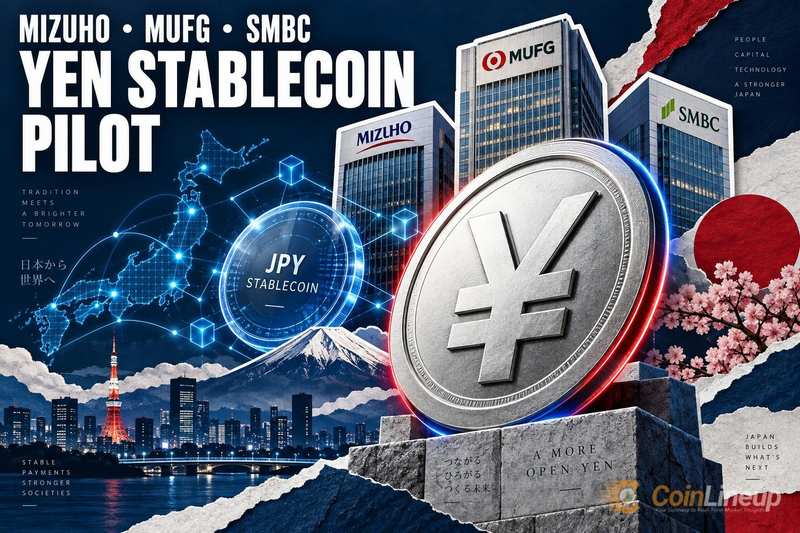
Three of Japan's largest banking groups — Mizuho, Mitsubishi UFJ Financial Group (MUFG) and Sumitomo Mitsui Banking Corporation (SMBC) — have completed a joint pilot testing a yen-denominated stablecoin for cross-border payments. The project marks a notable step by major institutional lenders into digital settlement using a currency-pegged token, though it remains a controlled test rather than a commercial launch.
What the joint yen stablecoin pilot involved
The three banks ran the pilot together as a single, coordinated initiative. A stablecoin is a digital token designed to hold a fixed value — in this case pegged to the Japanese yen — rather than fluctuating in price like decentralized cryptocurrencies such as Bitcoin or Ethereum.
Because the pilot was structured as a joint effort, each institution participated in testing the shared infrastructure rather than running separate internal experiments. The project focused specifically on cross-border payments, meaning transfers of funds between countries or financial systems. The stated purpose of the initiative is improving cross-border payment settlement.
The pilot is described as completed, not launched as a commercial product. That distinction matters: a completed pilot means the banks have finished a controlled test, not that they have released a yen stablecoin for use by the public or by businesses. No commercial launch has been announced or confirmed.
Why the pilot matters for cross-border payments
Cross-border payments are often slow and expensive. They typically pass through multiple intermediary banks, each adding fees and processing time before funds reach their destination. For banks and their customers, those layers of intermediation add both cost and time. A stablecoin that settles on a shared ledger could reduce those steps, although this pilot does not confirm that outcome.
The choice of currency adds a further layer of significance. Stablecoins in circulation today are overwhelmingly pegged to the US dollar, and the yen ranks among the world's most traded currencies, so a yen-denominated token would extend blockchain-based settlement to a major non-dollar currency rather than adding another dollar-pegged alternative. The involvement of all three banking groups is significant in its own right: Mizuho, MUFG and SMBC together represent the core of Japan's largest financial institutions, and a joint pilot signals coordinated exploration rather than a single bank experimenting in isolation. Similar institutional efforts include Visa's exploration of USDC for round-the-clock cross-border payment funding, where backing from major financial players drives the credibility of stablecoin settlement projects.
Whether the pilot ultimately leads to a commercial product depends on regulatory approval, the technical results of the test, and each bank's internal decisions. None of those outcomes has been confirmed. Any launch would, however, unfold within a framework Japan already has in place: since June 2023, revisions to the country's Payment Services Act have allowed licensed banks and trust institutions to issue fiat-backed stablecoins, giving Japan one of the earliest explicit legal regimes for these tokens. Mizuho has previously shown interest in digital asset infrastructure, including involvement in broader crypto-finance developments connected to the Mastercard and BVNK crypto-fiat network space.
A controlled test, not a commercial launch
The completed pilot is an example of established financial institutions testing blockchain-based tools in a controlled setting. It does not mean a yen stablecoin is coming to consumers soon. Under Japan's stablecoin rules, issuers must maintain reserve backing and allow holders to redeem tokens at face value, obligations that would shape the structure of any commercial rollout. What to watch next is whether the banks translate the pilot's findings into regulatory engagement or a formal issuance decision, neither of which has been announced. It does, however, show that Japan's top banks are actively exploring the technology rather than waiting on the sidelines.
Disclaimer: This article is for informational purposes only and does not constitute financial or investment advice. Cryptocurrency and digital asset markets carry significant risk. Readers should always do their own research before making decisions.

