Jakada aims to be the trusted hands Nigerians abroad can rely on for errands
Key Takeaways
- •Jakada connects Nigerians abroad with vetted taskers in Lagos who handle errands such as bill payments, document collection, property checks, gifting, and car rentals, with prices starting from $15 to $50.
- •Clients book online, are matched with a tasker within an hour, pay in advance through Stripe with funds held in escrow, and receive photo and video updates via WhatsApp without needing an app.
- •Taskers must complete an application process that includes National Identification Number verification, proof of address, and an in-person onboarding session before accepting jobs.
- •Jakada Services Ltd is registered in London, where co-founder Seun Abimbola oversees diaspora strategy, while operations run from Lagos with coverage concentrated in affluent districts such as Lagos Island, Victoria Island, Lekki, and Ikoyi.
- •The startup competes with existing players like Helpmewaka, Taskeeu, and Reyvah, and is betting that Nigerians abroad, amid the 'Japa' emigration trend and roughly $20 billion in annual remittances, will pay for documented proof that tasks were completed.
For Nigerians abroad, sending money home is easy. Getting a document collected, a property checked, or a surprise gift delivered is not. The first of those flows is measured in the billions — World Bank estimates put annual remittances to Nigeria at roughly $20 billion in recent years, among the largest in Sub-Saharan Africa. Jakada, a Lagos-based startup, is building a service to close that gap.
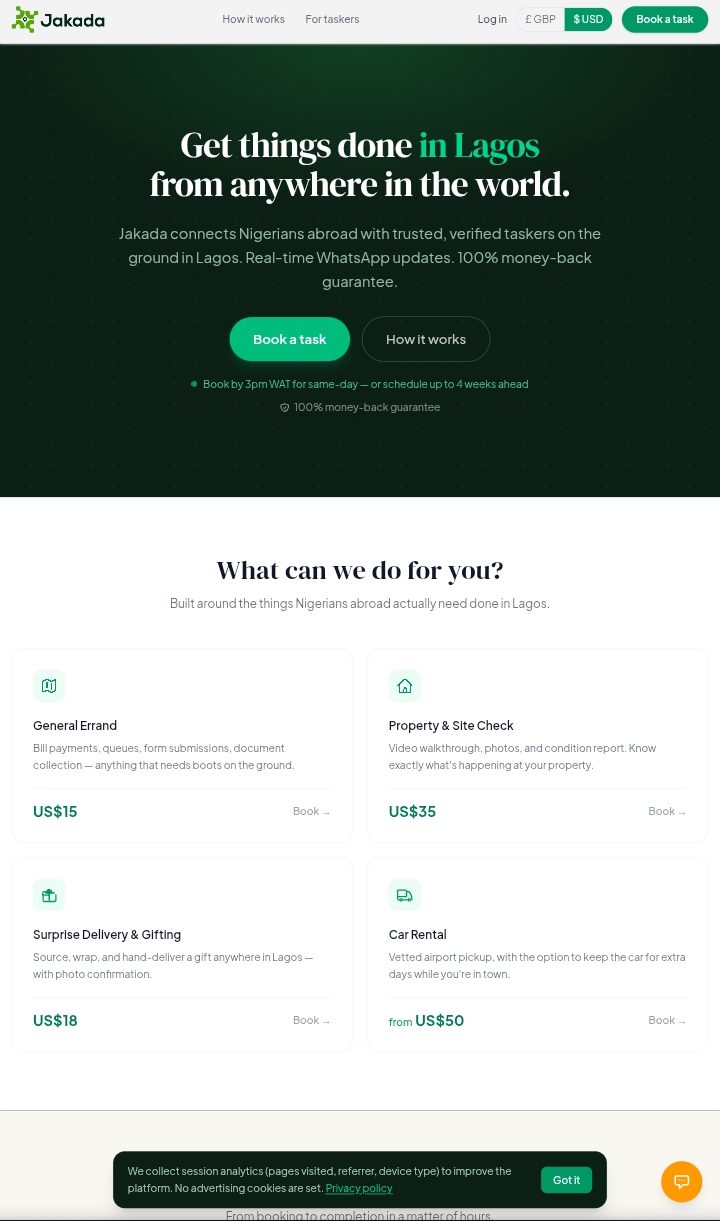
The platform connects Nigerians in the diaspora with vetted taskers on the ground in Lagos who carry out physical errands on their behalf and send photo and video updates as the job progresses. According to the company, clients book online, are matched with a tasker within an hour, and pay in advance through Stripe, with funds held in escrow until the task is confirmed complete.
Jakada currently offers three categories of tasks. General errands, including bill payments, queuing, and document collection, start from $15. Property and site checks, which include a video walkthrough and condition report, start from $35. Surprise delivery and gifting starts from $18. A car rental option, including vetted airport pickups, starts from $50. All updates are delivered through WhatsApp, and no app is required.
How Jakada vets taskers
Taskers go through an application process that includes National Identification Number (NIN) verification, proof of address, and an in-person onboarding session before they can accept jobs. The company says this is central to its pitch: that clients thousands of miles away can delegate a task and still trust how it was carried out.
Jakada is structured across two countries. Company records on LinkedIn show that Jakada Services Ltd is registered in London, where co-founder Seun Abimbola oversees the platform’s diaspora-facing strategy, according to his LinkedIn profile, which lists the role as starting in May 2026. Operations, including the tasker network, run out of Lagos, with coverage currently concentrated in Lagos Island, Victoria Island, Lekki, and Ikoyi — some of the city’s most affluent districts. Beyond those areas, and beyond Lagos itself, the model remains untested.
A crowded field built around proof, not promises
The company is entering a market that already has several players addressing the same need. Helpmewaka runs errands for the diaspora across Nigeria, Ghana, and Cameroon, while Taskeeu operates across Lagos, Abuja, and Port Harcourt. Reyvah covers Lagos, Calabar, Ibadan, and Abeokuta. The format itself echoes gig platforms such as TaskRabbit, which IKEA acquired in 2017, but with a twist: the person booking the task and the person carrying it out are on different continents.
Jakada says its differentiation is an emphasis on documented proof: photos, videos, and timestamped updates at every stage of a task, rather than a simple confirmation message.
The broader trend behind these platforms is Nigeria’s continuing wave of emigration, popularly called “Japa,” which has left many middle-class families abroad still responsible for ageing parents, unfinished property projects, and paperwork back home. Startups like Jakada are betting that Nigerians abroad will pay for verified, documented proof that a task was actually done, not just a message saying it was handled.
Also read: How E Don Kast is making Nigeria’s election results more transparent in real time

