Is MEXC Safe? Security, Privacy, and Risks Explained in 2026
Key Takeaways
- •MEXC keeps over 95% of user assets in offline multi-signature cold storage, with hot wallets limited to roughly 5% of total assets.
- •The exchange maintains a $100 million Guardian Fund and a futures insurance pool exceeding $550 million to cover potential platform-side losses.
- •MEXC operates without major regulatory licenses and has faced warnings from the UK Financial Conduct Authority and Hong Kong's Securities and Futures Commission, with its app unavailable in countries including South Korea, India, Japan, and the UK.
- •KYC is not mandatory for basic spot trading, but withdrawal limits scale with verification level, from 10 BTC daily without KYC up to 200 BTC with Advanced KYC.
- •Despite a strong security record with no platform-wide hack, users are advised to store long-term holdings in private hardware wallets rather than on the exchange.
MEXC is a leading global cryptocurrency exchange that operates as a centralized platform using advanced security features to protect user accounts and funds. The platform supports spot and futures trading, offers thousands of trading pairs, and lists a wide range of digital crypto assets for users worldwide. Like all centralized exchanges, it holds custody of customer funds on their behalf — a model whose risks have been highlighted repeatedly across the industry, from the collapse of Mt. Gox in 2014 to the failure of FTX in 2022, which is why questions about an exchange's security practices and financial transparency matter as much as its fees or trading features.
The exchange describes itself as highly safe, offering mandatory two-factor authentication (2FA), withdrawal whitelist protection, anti-phishing codes, multi-signature cold wallet storage, hot-cold wallet separation, SSL data encryption, DDoS protection, AI-driven risk monitoring, and public proof-of-reserves reports — a suite of safeguards that became an industry baseline after several high-profile exchange failures prompted users to demand verifiable asset backing. MEXC also maintains a $100 million Guardian Fund along with an additional insurance pool to help protect user assets in case of unexpected security incidents.
This guide reviews whether MEXC is a safe and legitimate crypto exchange for trading and explains its security measures.
Overview of Account Security on MEXC
MEXC uses a multi-layered defense system to protect user assets. The foundation of its protection is the $100 million Guardian Fund, which acts as a dedicated insurance policy to cover users if the exchange ever faces a technical breach or a platform-wide hack.
The exchange keeps over 95% of all user digital assets in offline cold storage using advanced multi-signature technology. MEXC also offers multiple account protection tools, including withdrawal whitelists and anti-phishing codes, and regularly publishes proof-of-reserves (PoR) data demonstrating that it holds the assets it reports. PoR became a widely adopted practice after FTX's collapse revealed a gap between what exchanges claimed to hold and what they actually held, so its publication is now one of the main signals traders use to gauge an exchange's solvency.
All data transfers use SSL encryption, and DDoS protection helps keep the platform stable during attacks. An AI-driven risk control system monitors trades, deposits, and withdrawals for suspicious behavior and can trigger temporary freezes to prevent losses.
MEXC Authentication and Login Protection
Secure login on MEXC begins with a username and a password that must meet strict complexity rules: at least ten characters, combining upper and lower case letters and numbers. A strength meter indicates whether a password is weak, moderate, or strong.
MEXC also logs every device that accesses an account. Through the security center, users can review the list of phones, tablets, and computers that have logged in and remove any that they do not recognize.
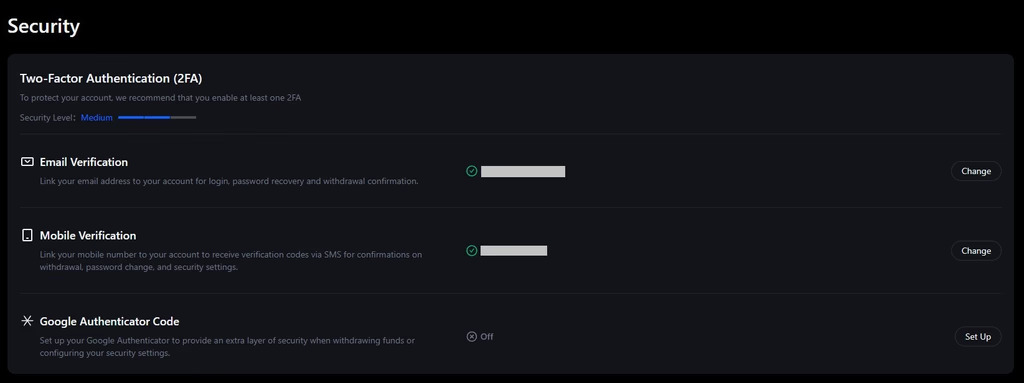
Passwords alone are not sufficient to protect a crypto account, so MEXC requires 2FA for nearly all meaningful actions, including logging in, changing security settings, and withdrawing funds. Enabling 2FA immediately after opening the app is described as one of the most important steps users can take to protect their cryptocurrency from thieves.
MEXC supports several 2FA methods. SMS codes are available but carry risks such as SIM swapping. A more secure approach is an authenticator app such as Google Authenticator or Microsoft Authenticator. MEXC also supports passkeys, which use a phone's built-in fingerprint or face ID scanner.
Users are advised to save backup codes in a secure place. If a phone is lost, the authenticator can be unlinked using backup keys or by completing identity verification — extra work, but a strong additional layer of protection.
MEXC applies strict rules to withdrawals. Users typically must enter codes from both email and a 2FA app simultaneously to complete a withdrawal.
Accounts can be further secured with a withdrawal whitelist — a list of pre-approved wallet addresses permitted to receive withdrawals. If a hacker gains access to an account, they cannot send coins to their own wallet because the address is not whitelisted. With the 24-hour lock enabled for newly added addresses, the process cannot easily be bypassed, giving users time to stop a theft before it happens.
MEXC Monitoring and Suspicious Activity Detection
MEXC's AI-powered automated risk control system checks deposits, orders, and withdrawals for signs of trouble, including rapid self-trading, unexpected spikes in order size, deposits from flagged addresses, or many accounts controlled by one user.
When the system identifies something unusual, it may temporarily block an action or freeze the account until the user confirms that everything is legitimate.
MEXC can impose a temporary freeze if it believes an account is compromised or is being used for money laundering or price manipulation. During a freeze, trading, deposits, and withdrawals may be unavailable. The user receives a risk alert explaining why the restriction was triggered and can upload documents through the Help Center to request removal, such as proof of identity, transaction evidence, or source-of-funds statements. Verified users generally enjoy faster reviews, while unverified accounts may be required to complete KYC before restrictions are lifted.
Phishing attacks are among the most common threats to traders, and MEXC provides several tools to distinguish real messages from scams. The anti-phishing code feature requires users to choose a short word or number sequence that appears in every official email from the exchange; a message lacking the code should be treated as fake and ignored.
The security center also includes a tool for verifying social media profiles. Users can enter the handle of a Telegram, X, or Facebook account, and the tool will indicate whether it belongs to MEXC. Official notices always come from domains ending in "mexc.com" or "mexc.co," so users should be wary of look-alike sites or addresses on other domains.
How MEXC Protects User Funds
MEXC follows a cold-hot wallet strategy: most user deposits sit in offline cold wallets that are not connected to the internet, while a smaller portion stays in hot wallets for day-to-day withdrawals. The platform uses secure socket layer (SSL) encryption for all data transfers and deploys distributed denial-of-service (DDoS) protection to keep trading services running during attack attempts.
Hot and Cold Wallet Infrastructure
MEXC describes a cold-hot wallet separation setup in which most funds sit offline in cold storage, while a smaller portion sits in hot wallets for daily withdrawals. The platform states that hot wallets typically hold only a small share of total user assets, with a limit of around 5%.
Cold storage uses multi-signature technology, meaning several high-level managers must all sign off with their private keys before any large amount of money can move. This limits the damage from many online attacks.
However, cold storage does not make an exchange "invincible." A major breach can still occur through key management failures, insider risk, or bad approvals — a risk illustrated by the 2024 Bybit hack, in which roughly $1.5 billion in ether was stolen from an exchange cold wallet through a compromised signing interface, one of the largest crypto thefts on record. Users are advised to maintain personal risk limits and never store large amounts on centralized crypto exchanges.
Internal Risk Management Systems
MEXC uses multi-signature approval for sensitive fund movements. The platform also conducts penetration testing and plans bug bounty programs aimed at identifying weaknesses before attackers do.
The company maintains a dedicated team of experts that manages liquidity and technical risks. Its Guardian Fund is currently worth $100 million and exists specifically to repay users if something goes wrong on the platform's side, such as a technical glitch. The exchange also has a futures insurance pool exceeding $550 million.
Is MEXC Legit and Regulated?
MEXC is a legitimate crypto exchange, but not a regulated one. It operates in many regions but does not hold formal licences due to its no-KYC trading nature, and it operates globally across hundreds of countries.
Does MEXC Have a License?
MEXC is mainly an offshore exchange based in places such as the Seychelles. It holds some registrations in certain regions, such as the MTR registration in Estonia for European operations, but it is not officially regulated by the major agencies of the United States or the United Kingdom.
Some government regulators have warned about the exchange because it allows users to trade futures with up to 500x leverage without holding a local license in those specific jurisdictions. The UK's Financial Conduct Authority warned in 2024 that "MEXC Global Ltd" is not authorized and may be targeting people in the United Kingdom. Hong Kong's Securities and Futures Commission listed MEXC on an alert list, stating that it is not licensed by the regulator while targeting investors in Hong Kong.
Some governments have ordered Apple and Google to remove the MEXC app from their stores for local users. As a result, the mobile app is not available in South Korea, India, Japan, or the UK. Users can still access the web platform in some of these places, though they may face extra restrictions or need special domains such as mexc.co in India.
MEXC effectively operates in a "gray area" in many parts of the world, a consideration for users who prefer a platform that follows every local law in their home country. This trade-off is not unique to MEXC: many offshore exchanges attract users with low fees, no-KYC access, and high leverage, while licensed exchanges such as Coinbase or Kraken operate under stricter oversight, including regulatory audits and mandatory customer identification. Which model suits a given user depends on how much weight they place on regulatory protection versus convenience and privacy.
Is KYC Verification Mandatory on MEXC?
No, KYC is not mandatory on MEXC for basic cryptocurrency trading, particularly basic spot trading. The exchange offers several ID verification levels: No KYC, Primary, Advanced, and Institutional.
- No KYC: Users can trade and deposit coins but cannot withdraw more than 10 BTC per day in most regions.
- Primary KYC: Requires full name and a photo of an ID, allowing withdrawals of up to 80 BTC per day.
- Advanced KYC: Requires a live facial recognition scan on a phone, allowing withdrawals of up to 200 BTC per day and access to special events.
Note: Extra checks should be expected during risk events, as MEXC says withdrawals may require KYC facial verification based on circumstances.
Where is MEXC Not Allowed?
MEXC is not allowed in countries such as North Korea, Cuba, Sudan, Iran, China, Singapore, the United States, the United Kingdom, Hong Kong, Ukraine regions described as Russian-controlled (including Crimea, Donetsk, Luhansk, and Sevastopol), and Canada.
Residents of these locations are technically not supposed to use the site. Some people attempt to use VPNs to hide their location, which carries significant risk.
Does MEXC Share User Data With Third Parties?
MEXC states that it cares about user privacy, but it is also a large business subject to international rules. It collects substantial information, including IP addresses, device types, fiat currency deposits, and trading habits.
This data is generally shared with "service providers" such as identity verification companies and anti-money-laundering firms. If a government submits a legitimate legal request for a police investigation, MEXC will likely hand over user data. The exchange does not sell user emails to random companies for advertising, but users are tracked while active on the platform.
Common Security Risks and Scams on MEXC
Common security risks and scams on MEXC include phishing websites, fake tokens and investment products, fake support staff, and social engineering attacks.
- Phishing websites and apps: Cybercriminals create websites and mobile apps that mimic MEXC's interface to trick users into entering login details or recovery phrases. Users should rely only on bookmarked links or manually typed addresses, and download the app only from the official Apple App Store or Google Play Store. If the app is unavailable in a region, it should not be downloaded from third-party stores.
- Fake tokens and investment products: Users may receive offers to buy newly launched tokens or claim free airdrops in exchange for sending stablecoins to a specific contract. The tokens often turn out to be worthless or nonexistent. Users should participate only in token sales or promotions announced by MEXC itself and verify contract addresses on official channels.
- Fake support staff: Impersonators on Telegram or X (Twitter) posing as "MEXC Help" may ask for passwords or secret information, which should never be shared.
- Social engineering: Scammers may call a user's phone pretending there is an account emergency to panic them into granting access. These attempts should be avoided.
What to Do If Your MEXC Account Is Hacked
If a MEXC account is hacked, users can follow these steps:
- Freeze the account: Go to the security settings page or the login screen and press the "Freeze Account" button immediately. This stops all trading and withdrawals for at least 24 hours.
- Change the email password: The hacker may have gained access through the user's email first. Use a new, strong password and enable 2FA on the email account.
- Contact official support: Open Live Chat inside the official app, explain exactly what happened, and provide the UID number.
- Check authorized devices: Go to the "Device Management" list in settings and delete every device that is not recognized.
- Gather evidence: Take screenshots of stolen transactions and retrieve IP addresses from login logs to provide to police or the support team.
MEXC Customer Support for Security Incidents
The MEXC support team is available around the clock, which benefits users in different time zones, though response times can slow during periods of heavy market activity. Users should always use the official chat button inside the app or on the real website and never trust "support" accounts found on social media.
Personal assistance can be requested by submitting a ticket through the customer service form, which asks for name, email, issue category, and supporting files such as screenshots. The form accepts documents up to 50 megabytes.
MEXC has faced criticism for inconsistent communication during account freezes, most famously in a 2025 case where it froze a large account without a clear explanation. After public pressure, the exchange apologized and refunded the funds, and it promised to improve its complaint resolution process.
How to Keep Your MEXC Account Safe
To keep an account safe, users should follow measures such as maintaining a strong password, enabling 2FA, activating an anti-phishing code, and using the withdrawal whitelisting feature, among others explained below.
- Use a strong, unique password: Combine upper and lower case letters, numbers, and symbols. A password manager can help generate and store complex passphrases.
- Enable multi-layer 2FA: Set up Google Authenticator or another time-based app, paired with email and SMS verifications if available. Check that the security level indicator in the account turns green, showing all key protections are active.
- Activate an anti-phishing code: This code appears in official emails. Treat any email missing the code as suspicious and delete it without clicking links.
- Use withdrawal whitelists: Withdraw only to wallets approved in advance. Update or add new addresses only through the official site, not through instructions sent in messages.
- Limit API permissions: For trading bots, set API keys to read and trade only. Avoid enabling withdrawal permissions, rotate keys regularly, and delete unused keys to minimize exposure.
- Check domains and apps: Always access MEXC by typing the address or using a bookmark. Download mobile apps from official stores; if the app is unavailable in a region, do not install it from third-party sources.
- Beware of high-leverage groups: Groups on Telegram or Discord promising secret strategies or high returns are often scams.
- Store large holdings offline: For long-term holdings, use a hardware wallet and transfer only what is needed for trading onto MEXC, reducing exposure if something goes wrong on the exchange.
- Monitor announcements: Regulations and platform policies change. Check the Help Center for updates on restricted countries, KYC requirements, and new security features.
Is MEXC Crypto Exchange Truly Safe and Trustworthy?
MEXC is generally described as a very safe choice for people who want to trade coins actively on a global investment platform. The exchange has a solid track record and has not experienced a massive, platform-wide hack that destroyed the company. It reports over 40 million users and daily trading volume exceeding $10 billion, which indicates substantial user trust.
Many users choose the platform for its competitive trading fees, which are generally lower than many other major exchanges. The platform is especially popular among experienced traders seeking high-leverage products and advanced order types.
However, a crypto exchange is not a regulated bank; MEXC is an offshore company that operates with its own rules. The recommended approach is to use the exchange for trading while keeping main holdings in a private wallet where the user owns the keys — a principle often summarized in the industry as "not your keys, not your coins." MEXC also offers demo trading accounts for users who want to test strategies before risking real funds. Users evaluating the platform over time can watch for continued publication of proof-of-reserves data, updates on its planned bug bounty program, and any changes in its regulatory status across major jurisdictions.
Is the MEXC App Safe To Use?
The MEXC mobile app mirrors most of the security features found on the website, including 2FA, withdrawal whitelists, and risk monitoring. It holds high ratings, such as 4.7 stars, and is described as fast, secure, and user-friendly for beginners and advanced users. It supports phone biometrics, such as face scan or fingerprint, to keep accounts locked.
However, because the app has been removed in some countries due to regulatory orders, users should not download it from third-party websites, as fake apps are a common way to steal credentials. If the official app is unavailable in a region, users should stick to the web version and check regional announcements on alternative domains.
