Is It Too Late to Buy Bitcoin? Key Statistics to Know
Key Takeaways
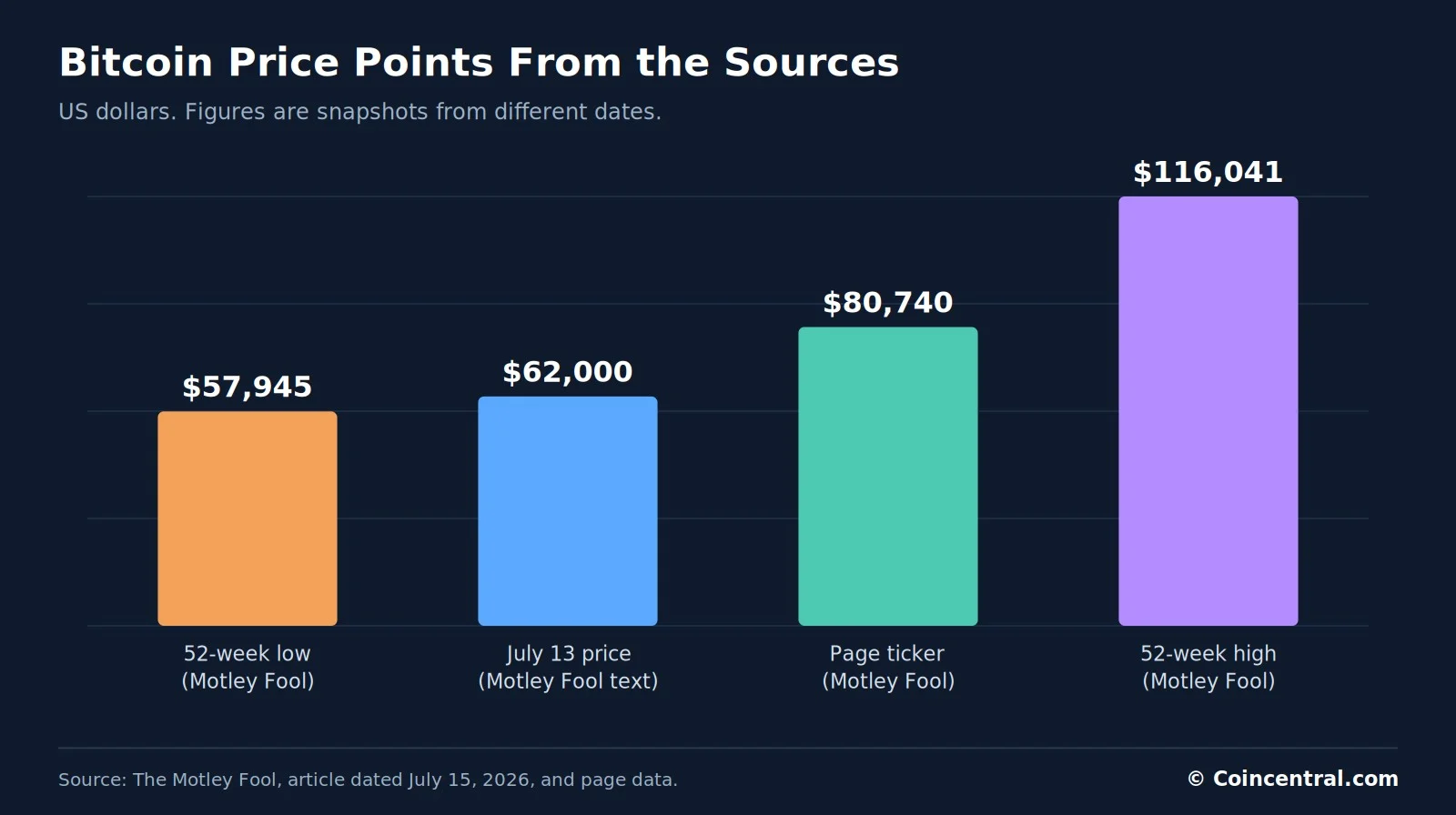
- •Published Bitcoin price data varied widely across sources, with a reported $62,000 figure as of July 13, 2026 standing roughly $18,700 below live ticker values near $80,740.
- •Bitcoin has suffered multiple crashes of 70% or more, each followed by a recovery to a new all-time high, though CoinLedger warns another crash remains very likely.
- •CoinLedger figures put Bitcoin's ten-year gain above 10,000% against roughly 200% for the S&P 500, while stressing that Bitcoin is considerably more volatile and risky.
- •Analysts at Fidelity and ARK Invest have projected Bitcoin could exceed $1 million per coin by the end of the decade, and Citigroup raised its 12-month target to $113,000.
- •Institutional adoption continues to grow, with BlackRock and Morgan Stanley launching Bitcoin products and the U.S. announcing plans for a strategic Bitcoin reserve.
The question has followed Bitcoin through every stage of its history: has the window to buy already closed? The answer depends on the timeframe under review, the data being cited and the level of risk a buyer can absorb. This report compiles figures from three separately published sources — Nexo, The Motley Fool and CoinLedger — each carrying its own date and its own perspective. Where numbers conflict, the source is named.
Bitcoin's price can swing sharply over short periods, and past results do not predict future ones. This article is for information only and is not financial advice.
Bitcoin Price Data: One Asset, Several Numbers
The Motley Fool published its article on July 15, 2026, reporting that Bitcoin traded at about $62,000 as of July 13 — roughly 50% below the all-time record set in October 2025. The same page, however, also displayed a live price of $80,740 with a day's range of $80,444 to $83,005, while Nexo's page showed $80,604.81 at the time it was captured. Those ticker prices stand about $18,700 above the July 13 figure.
The 52-week range on the Motley Fool page runs from $57,945.16 to $116,041.09, with the high roughly double the low. At $80,740, Bitcoin sits about 30% below that peak, according to a calculation included in the article.
The conflicting readings illustrate why a single price can mislead. A reader who sees $62,000 in July and one who sees $80,740 on a ticker will draw different conclusions. Dates matter when interpreting any Bitcoin statistic.
Price alone, however, does not answer the timing question. It shows only where Bitcoin trades relative to its recent past. The sections below add context drawn from market cycles, supply, market size and historical returns.
Nexo's page also listed other assets: Ethereum at $2,349.39, Solana at $101.66 and XRP at $1.2993. It showed the overall market down 2.85% over 24 hours, with Bitcoin down 2.66% and Ethereum down 5.26%.
Boom-and-Bust Cycles and Drawdown Statistics
The Motley Fool notes that Bitcoin has repeatedly moved through boom-and-bust cycles. No two cycles are alike, but past deep drawdowns have been followed by strong bull markets. The author argues it is only a matter of time before the price trends higher — a stated opinion, not a fact.
CoinLedger offers firmer figures. It says Bitcoin has suffered multiple crashes of 70% or more, each followed by recoveries to new all-time highs, and it warns that another crash is very likely.
Drawdowns are mathematically difficult to undo. A 50% loss requires a 100% gain to break even, and a 70% loss requires a gain of about 233%. The recovery figures in the article's table are its own calculations and are not taken from the sources.
CoinLedger also reaches back to 2011, when Bitcoin was hard to buy, few exchanges existed and public trust was low, with mainstream outlets frequently predicting its collapse. Since then, the price has grown from under $1 to more than $120,000, according to CoinLedger.
Nexo makes a similar point, saying the "too late" call has been made at every major price level and has proven wrong over multi-year periods. That record guarantees nothing — Nexo itself states that no one can promise the price will rise. Its argument is narrower: waiting for a perfect entry has often cost more than accepting an imperfect one. Prices move in cycles, drawdowns will always occur, Nexo says, and those who wait for absolute certainty often end up with neither the dip they wanted nor the gains they missed.
Network Activity, Security and the Supply Cap
The Motley Fool points to network activity as evidence that Bitcoin still functions. Citing River Financial, it reports Bitcoin processed $3.6 trillion in volume in 2025 — the fifth consecutive year with volume above $1 trillion. It also says the Bitcoin blockchain has never been hacked in its nearly two-decade life.
CoinLedger agrees the protocol has run since 2009 without security issues, adding that scams have hit exchanges and unrelated crypto projects, but not the Bitcoin protocol itself.
Supply is fixed: only 21 million bitcoins can ever exist. The Motley Fool calls this cap possibly the network's most valuable feature and notes halving events, which slow the creation of new coins into that capped supply, have occurred about every four years. It also recalls Bitcoin's origin — a white paper published in 2008 describing how two parties could send value to each other without a central intermediary. The page lists daily trading volume of $39.3 billion.
CoinLedger says the network is kept running by thousands of independent nodes, with every transaction recorded on a public ledger called the blockchain, and no government or central authority in control.
New products keep appearing. The Motley Fool names the Morgan Stanley Bitcoin Trust as one example, while CoinLedger notes BlackRock and other asset managers have launched Bitcoin ETFs. Nexo says the approval of spot ETFs permanently accelerated institutional adoption and that sovereign wealth funds and corporate treasuries have begun allocating capital to Bitcoin. These are claims from a company that sells crypto services, and readers may wish to verify them independently.
Market Size: Bitcoin Compared With Gold and Other Assets
CoinLedger compares Bitcoin with gold, putting gold's market value at more than $23 trillion against just over $2 trillion for Bitcoin — less than one tenth of gold's worth on those numbers.
The Motley Fool uses different Bitcoin figures: its article text gives a market cap of $1.2 trillion, while data box on the same page shows $1.6 trillion. The sources do not match because they were written or captured on different dates, during which prices moved. Each figure should be treated as a snapshot, and the percentages in the article's table are its own calculations.
The Motley Fool also describes a far larger pool of capital: the market for a new form of money, spanning currencies, stocks, bonds, real estate and commodities, which it puts in the hundreds of trillions of dollars. The article says that if Bitcoin captured 5% of this market over the next 25 years, the upside would be large. Using $200 trillion as a low estimate for "hundreds of trillions," 5% would amount to $10 trillion — the article's arithmetic, not the source's.
CoinLedger adds that if Bitcoin one day passes gold in value, buying now could make sense — a long-term argument that depends on events that have not happened. The Motley Fool says Bitcoin is currently a small slice of that total and describes the network as a monetary system that runs on math and software instead of a central bank. Whether it grows into a larger share remains an open question.
Bitcoin vs the S&P 500: Returns and Risk
CoinLedger compares ten-year results, putting Bitcoin's gain at more than 10,000% against about 200% for the S&P 500. Bitcoin has outperformed the index over that period, but the same source stresses it is far riskier. The S&P 500, a broad index of large U.S. companies, has been one of the more stable long-term investments; Bitcoin is newer and considerably more volatile.
One day of market data from the Motley Fool page shows the gap: the S&P 500 down 1.1%, the Nasdaq down 1.9%, the Dow down 0.1% and Bitcoin down 2.6%.
If both figures are treated as total gains, a $1,000 stake would have grown to about $3,000 in the S&P 500 versus more than $101,000 in Bitcoin. is the article's arithmetic, and it assumes the percentages represent total gains.
CoinLedger says many investors hold both assets, keeping a smaller share in Bitcoin for growth while maintaining broad exposure to stocks. It also notes that higher risk tends to come with higher returns, though returns are never guaranteed.
CoinLedger additionally compares Bitcoin with the dollar, saying the dollar supply has grown sharply since the COVID-19 pandemic, raising worries about debasement. Bitcoin's supply is fixed, but it is far more volatile than the dollar, which may make it riskier for anyone who needs cash soon.
Analyst Price Forecasts and Institutional Interest
CoinLedger says analysts at Fidelity and ARK Invest have projected that Bitcoin could pass $1 million per coin by the end of the decade. It stresses these are best-case estimates, built on assumptions of ongoing institutional adoption, nations buying Bitcoin for reserves and falling trust in fiat currencies.
A headline on the Motley Fool page, dated October 15, 2026, says Citigroup raised its 12-month Bitcoin price target to $113,000. Measured against the $80,740 price shown on that page, the target is about 40% higher, while a $1 million price would be roughly 12 times higher.
Forecasts often miss. CoinLedger cautions that even expert predictions are frequently inaccurate; they show what some analysts believe, not what will happen. The Motley Fool adds that the bear market has fed critics who call Bitcoin a failure, while the author argues past cycles point the other way. Both positions rest on judgment, since no one can time the market.
Institutional steps are easier to count than prices. CoinLedger notes BlackRock has launched a Bitcoin ETF and that President Trump has announced the U.S. would hold Bitcoin in a strategic reserve; the Motley Fool names the Morgan Stanley Bitcoin Trust. CoinLedger says Bitcoin is held by some of the world's biggest financial institutions and will soon be held by the U.S. government — the source's own wording — and readers may want to check the latest status of any reserve plan.
Nexo says the global user base keeps growing year after year, but it provides no user count, so the claim cannot be verified from the page. Adoption figures from a neutral source would help here. For readers tracking the timing question over time, the verifiable markers are concrete: whether the announced U.S. reserve plan advances from statement to actual holdings, whether further products along the lines of the Morgan Stanley trust and the BlackRock ETF appear, and the horizons attached to the forecasts — 12 months for the Citigroup target and the end of the decade for Fidelity and ARK.
Earning Interest on Crypto: Rates and Compounding
Nexo argues that what a holder does after buying matters as much as the entry price. It says most holders keep their assets idle in a wallet or on an exchange, and its answer is to earn interest on holdings. Nexo sells these services, so the figures below are company claims.
Its listed top annual rates are up to 5.7% on BTC, up to 6.25% on ETH and up to 9.5% on USDC. The rates apply to eligible clients with a minimum portfolio balance of $5,000, vary by asset and loyalty tier, and can change.
Nexo says $10,000 earning 5.7% a year grows to about $13,190 over five years, before any change in Bitcoin's price. The article's check shows that figure matches yearly compounding; daily compounding at the same rate would produce about $13,300. The five-year values in the table are the article's calculations using the listed top rates, and real results depend on each client's tier and on rate changes.
Nexo says a USDC position is not subject to crypto volatility, since a stablecoin is designed to stay near one dollar — though the 9.5% rate remains an "up to" figure and can change. Interest is not free of risk. Nexo's own notice states that digital assets carry a high degree of risk, are not backed by a government or central bank, and that past results do not predict the future. Rates marked "up to" may not be available to every client.
Nexo also frames earning as an addition to holding rather than a replacement. If prices rise, a holder gains from both the price move and a larger balance; if prices move sideways, the balance still grows. Nexo offers two savings formats: Flexible Savings with no lock-up periods, and Fixed-term Savings, which requires clients to commit funds for a set time — terms of up to 12 months are listed on the Nexo menu — in return for higher yields.
Buying Basics, Risk and the Bottom Line
CoinLedger outlines four steps for new buyers: use a reputable platform such as Coinbase or Kraken; move holdings to a cold wallet such as Ledger, which stores private keys offline; consider dollar-cost averaging; and track tax obligations.
It also lists the main reasons people buy Bitcoin: scarcity, no central control, global transfers in minutes, wider adoption and diversification. It says Bitcoin often moves independently from stocks.
Dollar-cost averaging means buying a fixed amount on a set schedule. CoinLedger gives $100 a month as an example, which adds up to $1,200 in a year and $6,000 over five years, before any gains or losses. The method removes the need to pick the perfect day, but it does not remove risk: if the price keeps falling after purchases, the value of holdings still declines.
All three sources warn about risk. CoinLedger says never invest more than you can afford to lose, warns that Bitcoin is very likely to crash again and urges buyers to avoid panic selling. Readers should also weigh each source's interests: The Motley Fool discloses that it holds positions in and recommends Bitcoin, Nexo sells crypto savings products and CoinLedger sells crypto tax software.
So, is it too late? Nexo says probably not, but argues that timing is the wrong question. The Motley Fool says history and fundamentals point to better days. CoinLedger says it is not too late, though returns may not match those of 2011.
The statistics describe a volatile asset with a fixed supply, a long record of deep drawdowns and recoveries, and a growing set of institutional products. They do not show where the price goes next. A buyer's timeframe and risk tolerance matter more than any single number.
Sources
- Is it too late to buy Bitcoin, or are you asking the wrong question? (Nexo)
- Is It Too Late to Buy Bitcoin? (The Motley Fool, by Neil Patel, July 15, 2026)
- Is It Too Late to Buy Bitcoin? (Expert Predictions) (CoinLedger)

