Is Cryptocurrency a Good Investment in 2026? What Investors Need to Know
Key Takeaways
- •Bitcoin rallied roughly 42% in three months to $87,397 on September 21, 2026, but remains about 33% below its October 2025 record near $126,000 and is down 3.7% for the year.
- •Ethereum traded at $2,503.64 on October 13, 2026, down about 41% over twelve months amid recession worries, large sales by co-founder Vitalik Buterin, and competition from networks like Solana and Avalanche.
- •Bitcoin's annualized volatility of roughly 45% to 60% runs about three times that of the S&P 500, and every prior Bitcoin cycle featured a drawdown of 77% or more.
- •Institutional adoption has deepened, with U.S. spot Bitcoin ETFs drawing more than $58 billion since January 2024, over 190 public companies holding Bitcoin, and the SEC and CFTC classifying Bitcoin and 15 other digital assets as commodities in March 2026.
- •Financial firms recommend limiting crypto to about 1% to 5% of a retail portfolio, or up to 10% for aggressive investors, and caution that only long-term investors with high risk tolerance should participate.
Cryptocurrency has endured a turbulent year. Bitcoin closed June 2026 at $58,524, then rallied to $87,397 on September 21 — its highest level since January. That swing has left many people asking whether now is a good time to invest.
This article draws on recent data from financial firms and news outlets to lay out the facts. It does not tell readers what to buy. As Fidelity puts it, the answer depends on an investor's financial goals, risk tolerance and time horizon.
The Crypto Market at a Glance
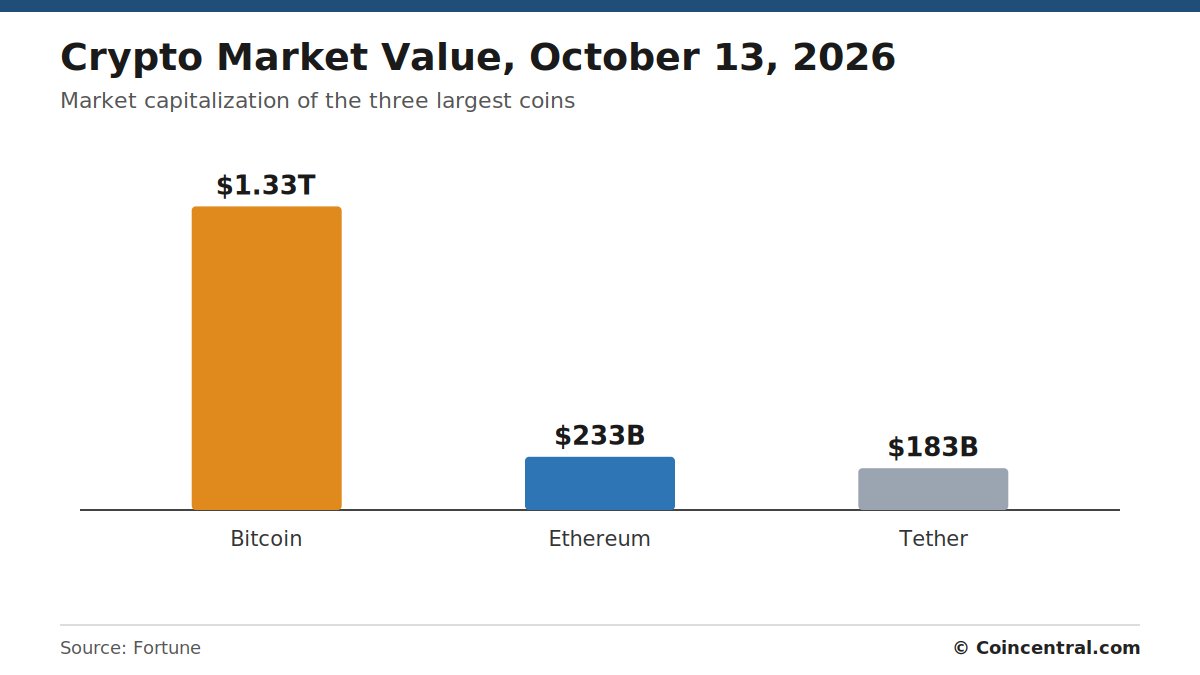
Bitcoin leads the market by a wide margin. Fortune pegs its market value at about $1.33 trillion as of October 13, 2026, with Ethereum second at $233 billion and Tether third at $183 billion. Other outlets report higher figures for Bitcoin: The Motley Fool puts it at $1.6 trillion and 24/7 Wall St. at $1.7 trillion. Totals vary by source and date, so they are best treated as estimates.
Prices on that same morning illustrate how different these assets are. Tether is a stablecoin pegged to the U.S. dollar, so it stays near $1, while Bitcoin and Ethereum move far more. Fortune compares Bitcoin to digital gold and Ethereum to digital oil: Bitcoin is held mostly as a store of value, while Ethereum powers applications built on its network.
Fidelity says a coin's value derives from supply and demand, its use and belief in its technology. It adds that some coins, such as certain meme coins, are vanity projects and that others may be scams — each coin must be judged on its own merits. Many coins do have real uses, however. Fidelity lists digital payments without a bank, storing value as Bitcoin does, and running applications on blockchain networks as Ethereum does.
Ethereum Price Data: Down 41% in a Year
At 7:45 a.m. ET on October 13, Ethereum traded at $2,503.64 — $50.33 below the previous morning, a decline of 1.97%. Over one month the price slipped 0.83% from $2,524.77, and over one year it fell 41.02% from $4,245.28, a gap of roughly $1,742.
Ethereum came close to $5,000 at its peak in August 2025. Its 2014 token offering sold at 31 cents, so the earliest buyers remain far ahead despite the drop. Fortune links the early 2026 slide to recession worries and to large ETH sales by co-founder Vitalik Buterin. Rival networks such as Solana and Avalanche also offer faster or cheaper options.
Ethereum changed how it operates in 2022, dropping the energy-intensive mining system in favor of staking, in which owners lock up ETH to help confirm transactions and earn rewards.
Fortune identifies five forces that move Ethereum's price: trader speculation; network use and decentralized finance; the health of the economy; regulation; and competition. Speculation tends to matter most in the short term, while network use matters more over time — the 2020 to 2021 decentralized finance boom showed how heavy usage pushed prices higher.
Bitcoin's 2026 Price Path
Bitcoin set a record near $126,000 in October 2025. A tariff shock and a wave of forced sales beginning on October 10 pushed it below $105,000, according to 24/7 Wall St., and months of ETF outflows followed. The price closed June 2026 at $58,524 and July at $63,694, then rose to $87,397 on September 21 and stood at $84,883 on September 27.
That amounts to a 42% gain in three months, per 24/7 Wall St., while The Motley Fool measured 33% over five weeks. Even so, Bitcoin is down 3.7% for 2026 and 23% over the past year. At $84,883, the price sits about 33% below the peak; put the other way, it needs a gain of about 48% to return to $126,000 — two framings that are easy to confuse.
Buying has also cooled. Bitcoin rose 32% over two months but only 8% in the latest month. Daily moves can be sharp: Pluang reported $13.95 million in liquidations in one hour on October 14 as the price fell 1.48%, from $83,782 to $82,542.
Industry news has been mixed. The Motley Fool says spot Bitcoin ETFs remain popular, and Block has enabled its Square merchants to accept Bitcoin payments. On the negative side, the Coldcard wallet hack dented confidence in self-custody; the Motley Fool piece lists it, along with quantum computing, among the risks to watch.
How Bitcoin Has Fallen in Past Cycles
Binaxity's data show that every earlier Bitcoin cycle included a drawdown of 77% or more. The 2013 to 2015 drop of about 85% followed the Mt. Gox collapse, and the 2017 to 2018 decline of about 84% followed the end of the ICO boom. The current cycle looks deeper than the 45% fall Binaxity listed in August: using the June close of $58,524 and the $126,000 peak, the decline was about 54%.
Yearly results show the same pattern. The Motley Fool notes that Bitcoin fell 65% in 2022 and then rose 154% in 2023, and that it fell 71% in 2018 before gaining 85% in 2019. Motley Fool argues that this four-year rhythm points to a low before the end of 2026 and a better 2027. Binaxity adds a caution from Morgan Stanley strategists, who say a large asset cannot repeat the gains of a small one.
Volatility Compared With Stocks, Gold and Bonds
Binaxity puts Bitcoin's annualized volatility over ten years at roughly 45% to 60%, versus 15% to 18% for the S&P 500 — meaning Bitcoin's swings run about three times those of U.S. stocks. Bitcoin pays no dividend or interest, so any return must come from the price rising.
It is often called digital gold, but Binaxity says it has tracked the Nasdaq more closely than gold in recent cycles. Fidelity says crypto is still in a price discovery phase and that swings could ease as the market matures.
Fidelity names several causes of crypto price swings, including inflation, interest rates, new laws, global conflicts and endorsements from large companies or celebrities. New crypto products and shifts in who owns crypto also move prices. As more major firms buy and hold crypto, more retail investors could follow, Fidelity says.
The Main Risks Investors Face
Binaxity sorts Bitcoin risk into five groups: volatility, custody, counterparty, regulation and behavior — each requiring a different response. Past recoveries took about two to three years, and anyone who sold at the low missed them.
Counterparty risk is real. Celsius, BlockFi, FTX and Genesis failed in 2022 and 2023, and Binaxity notes these were platform failures, not failures of Bitcoin itself. Self-custody carries risks too: The Motley Fool reports that a Coldcard wallet hack led to the theft of well over $100 million, and it lists quantum computing as a more distant threat.
Fidelity adds that crypto is not insured by the FDIC, can become illiquid and may be easier to manipulate than securities. Bitwise's Matt Hougan called behavioral risk the biggest single risk in this space in a January 2026 Morningstar interview.
How Much of a Portfolio Should Go Into Crypto?
Binaxity says most institutional research points to 1% to 5% of a portfolio for retail investors, and up to 10% for aggressive profiles. Fortune also suggests a modest share inside a diversified portfolio, and both warn against going all in. The math is simple: at 1%, an 80% crash removes 0.8% of the portfolio; at 10%, it removes 8%.
Binaxity also lists steps to take first, including an emergency fund covering three to six months of expenses and paying off high-interest debt. Note that Binaxity is a fintech firm that sells a Bitcoin product, so readers may want to compare its view with neutral sources.
Ways to Hold Crypto
Taxes matter in the U.S. Binaxity says the IRS treats Bitcoin as property, so selling, swapping or spending it is a taxable event. Gains on coins held under a year are taxed as ordinary income. Swapping Bitcoin for Ethereum also counts as a sale for tax purposes, and Binaxity says a forced sale inside a crypto-backed loan is taxable too.
Platforms differ in what they offer. Fidelity currently offers Bitcoin, Ethereum, Litecoin and Solana and says it has no new coins launching soon. Before adding one, it reviews the coin's track record, adoption, purpose and regulatory environment.
Who Owns Bitcoin: ETFs, Companies and Market Share
Bitcoin makes up 59% of the $2.9 trillion crypto market, according to 24/7 Wall St., with its own value at about $1.7 trillion. For Bitcoin to reach $100,000, its market value would need to rise by about $300 billion — and since it already holds most of the market, 24/7 Wall St. says that money must come from outside crypto.
Institutions are a large source of demand. U.S. spot Bitcoin ETFs have drawn more than $58 billion since January 2024, per SoSoValue data cited by Binaxity. More than 190 public companies hold Bitcoin, and Strategy owned 818,334 coins as of May 2026.
Rules have also become clearer. In March 2026 the SEC and CFTC classified Bitcoin and 15 other digital assets as commodities, Binaxity reports. Coinbase says 2025 rule changes opened the door to new spot ETFs and digital asset treasury companies, which have since seen valuation-driven consolidation. Coinbase forecasts the stablecoin market could reach about $1.2 trillion by the end of 2028.
Coinbase names other themes for 2026, including privacy tools, payments made by AI agents, specialized blockchains and the tokenization of real-world assets such as stocks. Stablecoins, it says, have become the top use case in crypto, and it expects growth in cross-border payments, money transfers and payroll.
Inflation, Interest Rates and AI Spending
Inflation is the main economic worry. U.S. consumer prices rose 3.6% to 3.7% in September, with gasoline up 9.1%, according to reports carried on Pluang — well above the Federal Reserve's 2% target. The Motley Fool says the Fed has just raised rates and another hike could follow, and a Motley Fool headline notes that Treasury yields above 5% can pull money away from riskier assets.
Artificial intelligence is a newer factor. Nvidia estimates that the five biggest hyperscalers will spend $1.3 trillion on capital projects in 2027, and The Motley Fool says some of that money might otherwise reach Bitcoin.
Even with the swings, long-term holders have done well against tech stocks: over three years Bitcoin is up 225% and the Nasdaq is up 109%, though the ride included deep falls. Coinbase struck a hopeful note in its December 2025 outlook, calling the U.S. economy resilient while admitting the range of outcomes was wide.
The latest inflation report showed how sensitive prices are. Bitcoin fell about 1% to near $82,600 on October 14 after data pointed to a possible October rate hike. Bitwise's Matt Hougan had expected a broader crypto drop of 3% to 5%, as reported on Pluang. Bitcoin's smaller fall was seen as a sign of relative strength, while Optimism's token rose nearly 20% the same day.
What Forecasts and Prediction Markets Say
Prediction markets lean cautious for 2026. Polymarket gives Bitcoin a 27% chance of hitting $100,000 this year and sees a stronger chance of a drop toward $80,000. Kalshi's October forecast is $87,000, with a year-end figure near $83,554. Longer-term odds improve: traders see about a 70% chance of $100,000 by the end of 2027, and a separate Kalshi market, per a 24/7 Wall St. headline, puts the split at 17 to 83 between $50,000 and $100,000 coming first.
24/7 Wall St. expects Bitcoin to trade between $63,694 and $100,000 in 2027, with a monthly close below $63,694 potentially sending it back toward $58,524. To pass $100,000, it says, Bitcoin must stay above its July close, end 2026 higher and clear its September high of $87,397. BitMEX co-founder Arthur Hayes expects $126,000 by year end, but 24/7 Wall St. says the math to get there is hard. Forecasts reflect trader bets and opinion, not facts, and they can change quickly.
So, Is Crypto a Good Investment?
The sources agree on one point: it depends on the investor. Fidelity says crypto may make sense for long-term investors with high risk tolerance, and that people who will not stay invested for more than three years may want to look elsewhere. Binaxity suggests a four-year minimum, matching the length of past Bitcoin cycles. Both views point to patience as a requirement.
Fortune says crypto is not ideal for anyone who loses sleep over market swings, and it advises readers to watch competing projects and avoid putting everything into one asset. The data show large gains and deep falls within the same few years: Bitcoin is about 33% below its peak after a 42% rally, and Ethereum is down 41% over twelve months.
This article is for general information and is not financial advice. Readers should speak with a licensed adviser before investing.
Sources
- Current price of Ethereum for Oct. 13, 2026 (Fortune)
- Is Bitcoin a Good Investment in 2026? Risks & Returns (Binaxity)
- 2026 Crypto Market Outlook (Coinbase)
- Top 5 crypto questions of 2026 so far (Fidelity)
- History Says This Is What Will Happen With Bitcoin in 2027 (The Motley Fool)
- Bitcoin Price Prediction for 2027: What to Expect After a 42% Surge (24/7 Wall St.)
- Prediction markets give Bitcoin just a 27% chance to hit $100K before 2027 ends (Pluang)
This article first appeared on CoinCentral: https://coincentral.com/is-cryptocurrency-a-good-investment-in-2026/

