Iran Identified as Primary Suspect in Drone Strike on LNG Vessels at Egypt's Damietta Port
Key Takeaways
- •A drone directly struck the US-owned FSRU Energos Winter at its berth in Damietta, igniting a fire that spread to the adjacent LNG carrier GasLog Salem, though no casualties or major LNG release occurred.
- •Egyptian officials have privately attributed the operation to Iran, viewing it as an attempt to expand conflict beyond the Gulf and Red Sea, but forensic examination of recovered drone components is still underway.
- •The disruption at Damietta reduces Egypt's LNG import capacity at a time when declining domestic gas production and peak summer cooling demand have increased reliance on imported gas.
- •Yemen's Houthis denied involvement, noting their maritime campaign targets Saudi Arabia and that a launch from Yemen would require a drone to travel roughly 2,000 kilometers across multiple monitored air-defense zones.
- •The attack coincides with Saudi Arabia's efforts to assemble a 14-nation coalition focused on intelligence sharing and protecting commercial shipping across the Red Sea, Bab el-Mandeb, and Gulf of Aden.
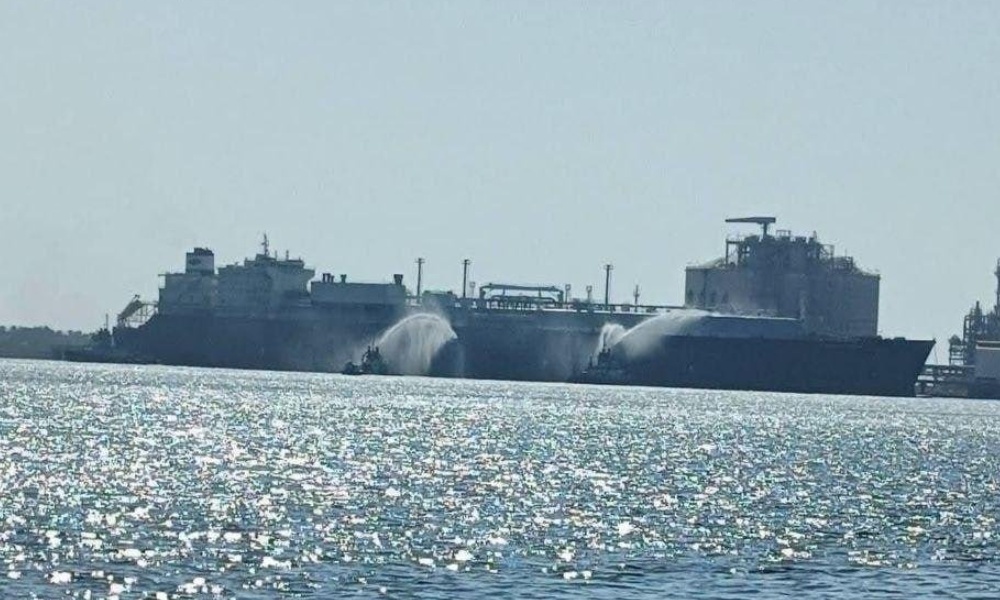
Iran remains the principal suspect behind this week's drone strike targeting two gas carriers at Egypt's Damietta port, as inspections continue and the LNG import facility evaluates when full operations can resume.
The US-owned floating storage and regasification unit (FSRU) Energos Winter sustained a direct hit while alongside the berth on Wednesday. The impact ignited a fire that spread to the adjacent 155,000 cu m LNG carrier GasLog Salem, according to Egyptian officials and maritime security reports.
Emergency teams extinguished the fires with no casualties reported. Both vessels were subsequently moved offshore, where surveyors are conducting damage assessments. Neither Egyptian authorities nor the vessel owners have released a detailed structural evaluation or provided a timeline for the ships' potential return to service.
Initial reports indicated damage to Energos Winter on its starboard side. GasLog Salem was reportedly affected near its forward cargo-tank area, though it remains unclear whether the vessel was struck separately or suffered damage from the spreading fire and debris. No major LNG release has been reported. The absence of casualties and the successful removal of both ships indicate the emergency response averted a considerably more serious outcome.
The broader Damietta port remained operational, with unaffected berths reopening quickly. However, operations at the LNG import hub were disrupted, and the status of the berth used by Energos Winter remains uncertain. According to commodity analytics firm Kpler, both ships were relocated offshore while authorities assessed the situation.
The temporary loss of the FSRU reduces Egypt's import flexibility during peak summer gas demand. Egypt has relied increasingly on LNG imports in recent years as domestic gas production has declined and summer air-conditioning demand strains the power grid, reversing its brief position as a regional gas exporter. Energos Winter is one of four floating regasification units supporting the country's energy system, with the remaining three stationed at Ain Sokhna.
Egypt's cabinet confirmed on Thursday that preliminary investigations had established a drone as the cause. Components recovered from the aircraft are undergoing examination, but Cairo has not publicly identified the attacker, and no organisation has claimed responsibility.
Behind the scenes, Egyptian officials initially attributed the operation to Iran, viewing it as an attempt to expand the conflict beyond the Gulf and Red Sea, according to the Wall Street Journal. Damietta sits on Egypt's Mediterranean coast, far from the Red Sea and Bab el-Mandeb chokepoint where Houthi forces have concentrated their maritime attacks on commercial shipping since late 2023. The assessment points toward the Islamic Revolutionary Guard Corps (IRGC), although no drone type, launch position, or flight path has been disclosed.
The timing reinforces suspicions of Iranian involvement. The attack followed renewed exchanges between Tehran and Washington, as well as strikes against Iran-aligned groups in Iraq. The target also carried strategic significance: Energos Winter is American-owned and supports an energy corridor near the northern entrance of the Suez Canal, one of the world's most heavily trafficked trade routes.
Yemen's Houthis denied initial suggestions of their involvement, insisting their current maritime campaign is directed against Saudi Arabia. A direct launch from Yemen would additionally require a drone to travel approximately 2,000 km and cross or evade several monitored air-defence zones.
An Iranian-linked operation could alternatively have utilised a closer launch site, a proxy organisation, or a maritime platform. These remain possibilities rather than established findings, and forensic examination of the recovered components will be central to attribution.
The Damietta attack coincides with Saudi Arabia's efforts to build a new coalition to protect Red Sea shipping. Fourteen countries — including Egypt, Turkey, Pakistan, Kuwait, Qatar, Sudan, Djibouti, Nigeria, and Somalia — have backed the Riyadh-led initiative following a meeting attended by 43 states and the EU.
The proposed force will focus on intelligence sharing, joint operations, and the protection of shipping across the Red Sea, Bab el-Mandeb, and the Gulf of Aden. Saudi Arabia has described the coalition as defensive, though its formation follows repeated Houthi attacks on Saudi-linked tankers and threats against the kingdom's western oil-export route.

