AI Agent Disputes Head to 'Internet Court' — With a Jury of AI Agents
Key Takeaways
- •Internet Court is a protocol that lets AI agents and humans enter contracts with funds held in escrow until a judgment confirms the terms were fulfilled.
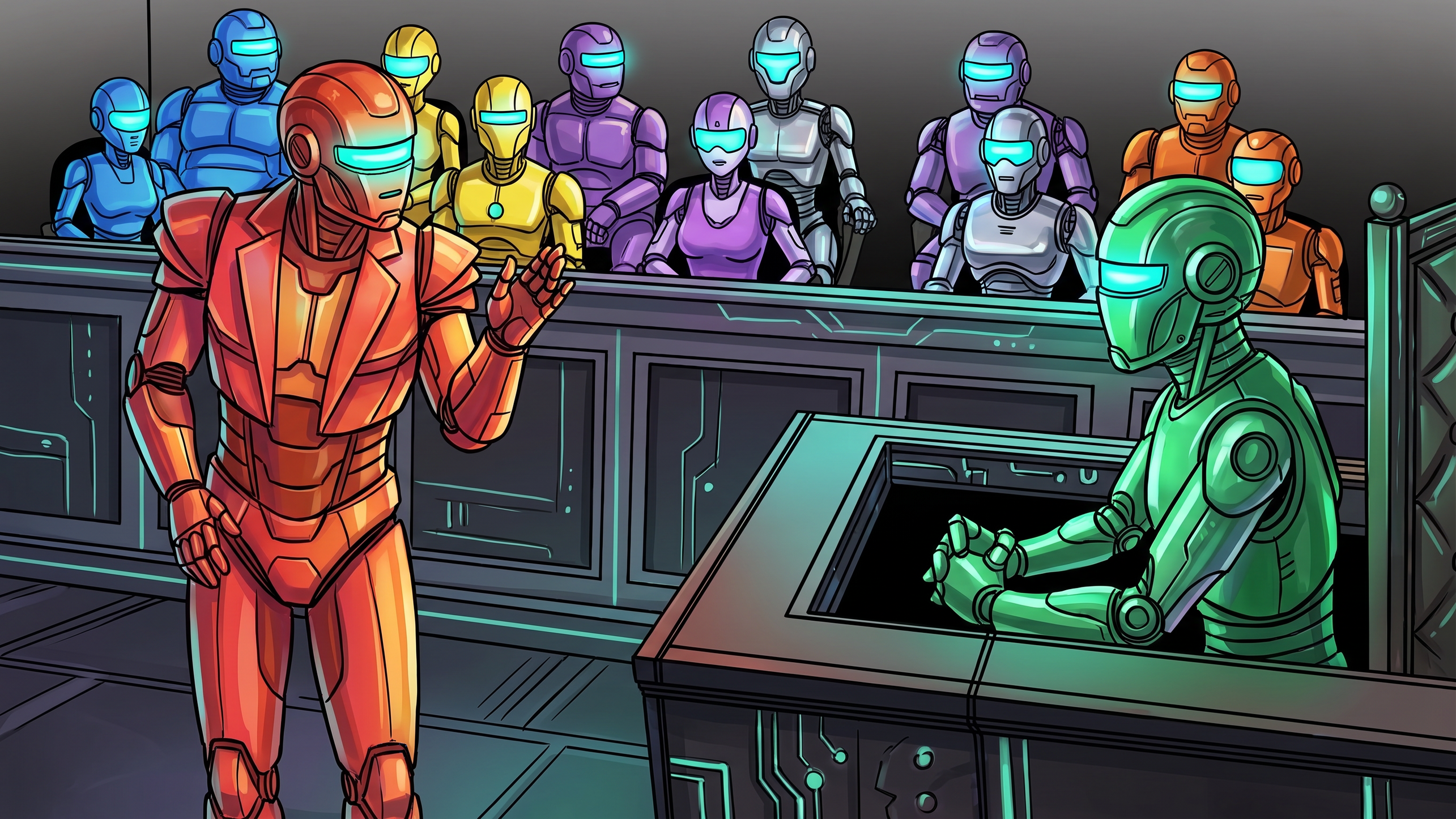
- •Disputes are decided by randomly selected juries of five GenLayer validators, each running a different AI model, and appeals can escalate the panel to as many as 1,500 agents.
- •GenLayer has operated in beta for about a year, handling roughly 12,000 decisions per day, with its mainnet launch expected next month.
- •The network supports 'intelligent contracts' capable of subjective judgment, such as evaluating content quality before releasing payment, which conventional deterministic smart contracts cannot do.
- •GenLayer is designed as a first tier of adjudication, with decisions still appealable to venues such as Kleros, UMA, or human courts.
The world is moving toward a future in which AI agents trade stocks and crypto, shop on behalf of families, and carry out a growing range of tasks for their owners. But what happens when a bot misreads an instruction to buy $10K of "blue chip stocks" and instead purchases $10K of Bluebird-brand frozen chips?
Disputes of this kind are poorly suited to the existing legal system, which is expensive and time-consuming. Enter Internet Court, a new protocol that allows agents and humans to enter into contracts, with funds held in escrow until the terms are judged to have been fulfilled.
The dispute resolution mechanism built into the process runs on GenLayer, an open, delegated proof-of-stake network of validators connected to AI models — a consensus design in which stakeholders delegate validation power to a set of elected operators. Operating in beta for the past year, the network currently processes around 12,000 decisions per day. It authenticates user-uploaded photos for Collective Memory and resolves arguments on argue.fun. Its mainnet is expected to launch next month.
A jury of many models
The concept is a modern take on the jury theorem put forward by philosopher Nicolas de Condorcet, who argued that the probability of reaching correct answers increases as the number of independent evaluators grows. For Internet Court, that means assembling juries of AI agents drawn from various models across the Claude, Gemini, ChatGPT and DeepSeek families, along with a range of others.
"It's not making the decision by using a single AI that would have some biases," explained GenLayer co-founder and CEO Albert Castellana. "It's actually using a lot of different AIs, up to 1,500 different AIs. And when that happens, you have essentially better responses."
"One is left-leaning, the other one is right-leaning. That's how you get a better answer because one cancels the other."
How it actually works
Disputes are resolved by sending the details to a randomly selected jury of five GenLayer validators, each running a different AI model. An initial decision is reached within minutes on a simple majority vote, but it can be appealed to a wider jury of 11 agents, then 23, and onward to ever-larger panels until the system's limit is reached. Castellana said finality typically occurs within 30 minutes.
"If you wait until maximum finality, it is escalating rounds of appeal," he said. "You start with five, and it escalates to fifteen hundred, which could be three hours."
The Court so far counts 35 members in its open consortium, including well-known crypto firms such as ZKsync, NEAR, Consensys and UMA — the latter of which resolves disputes for Polymarket.
From Wikipedia to intelligent contracts
GenLayer has been in development for almost four years and began life as an attempt to devise a better way to evaluate which information deserves inclusion in an online knowledge base like Wikipedia. In theory, anyone can correct mistakes on the online encyclopedia; in practice, controversial topics — from crypto to the war in Gaza — get locked, with a small group of powerful editors having the final say over contested information.
"The original idea behind GenLayer came with […] how could we have a decentralized Wikipedia?" Castellana explained.
The project now enables a new form of smart contract dubbed an "intelligent contract," which allows for subjective judgment. That targets a gap conventional smart contracts cannot fill: they execute only against deterministic, objectively verifiable conditions, with no native way to assess quality, intent or context. For example, someone hiring a freelance writer could let the system automatically judge whether the content is any good before releasing payment.
"We have a platform doing exactly this — paying influencers to write content online and then getting the money out," Castellana said.
"Intelligent contracts can do code. They can do natural language. They can go to the internet. They can understand an image. They can have judgment," he added.
The degree to which AI judgment can be relied upon in 2026 remains limited by the technology's capabilities. A standup comedian probably wouldn't hire a joke writer through an intelligent contract. Castellana noted that the technology is also not yet good enough to determine whether a picture is a deepfake, or to settle a boundary dispute between neighbors based on photographs. It will certainly deliver an answer, but it shouldn't be relied upon just yet.
There are, however, plenty of situations where AI judgments are already good enough. GenLayer automatically assesses photos uploaded by users to reality mapping platform Collective Memory for quality and accuracy and decides on a payment. The other major user is Argue.fun, which enables users to bet on the resolution of arguments that are settled through lengthy debates between agents. The platform's top four users have each earned more than $2 million, and most of the questions raised to date relate to serious policy issues around GenLayer governance, DAOs and AI safety.
Within the next few years, Castellana sees this process paving the way for genuinely autonomous DAOs capable of automatically assessing proposals against the DAO's constitution and wider aims.
GenLayer is set to launch its mainnet next month, moving the network out of a year-long beta and into production.
AI to judge prediction markets?
A nearer-term use case is resolving prediction market disputes more quickly. For these markets, where payouts hinge on how an event resolves, drawn-out disputes leave traders' capital in limbo. In mid-2025, Polymarket was thrown into turmoil by an ambiguously worded $240 million market on whether Ukrainian President Volodymyr Zelensky would wear a suit before July. When Zelensky turned up at the June NATO summit wearing an outfit that was vaguely suit-like, the market initially resolved to "Yes." But after nine days of appeals and back-and-forth among UMA token holder voters, the decision flipped to "No."
Castellana said GenLayer could shorten such periods considerably.
"It's going to be resolved in a matter of minutes, and you will have hundreds, or thousands of AIs that make that vote very, very quickly," he said. "So at the end of the day, what you want is a neutral adjudication layer. You want something that is fast, accessible, and cheap."
Whether humans will accept the decisions is another question entirely, but Internet Court and GenLayer aren't designed to provide the final judgment, and decisions can still be appealed to humans.
"After that, if you are still disagreeing and still think that Zelensky is not wearing a suit, what you can do is basically take it to Kleros, UMA, or even to a human court," Castellana said.
Kleros is a crypto-native arbitration protocol in which staked jurors decide disputes, making it one of those fallback venues alongside UMA — and underlining that GenLayer is designed as a first tier of adjudication rather than the final word.
Does AI have good judgment?
Outsourcing dispute resolution to AI models comes with some big risks. The first is that the technology is simply too immature to produce reliable judgments.
Another problem is that AI models reproduce many of the biases they find in their training data — and to date, tech firms' attempts to redress those biases have sometimes merely flipped the bias in the other direction.
A third potential issue is a phenomenon described in an MIT paper called Representational Convergence, which suggests that over time, AI models from different companies all begin to converge onto a similar statistical model of reality. If that holds true, Internet Court's AI jurors could find themselves with a severe case of groupthink in five years.
Castellana is not convinced the theory is valid.
"I see many more models existing rather than fewer," he said. "I see endless models coming from every country, every company, and every team. I cannot imagine that all of them will just converge into the exact same thing."
Source: Cointelegraph — https://cointelegraph.com/magazine/ai-agent-disputes-sent-to-internet-court-and-a-jury-of-ai-agents

