Interactive Map Shows Where 67 Million US Crypto Holders Live
Key Takeaways
- •The NCA's interactive maps estimate crypto holder numbers for all 50 states, Washington, D.C., and all 435 U.S. House districts, with California leading at roughly 9.5 million holders.
- •The figures are statistical estimates combining a 10,000-holder demographic model with district-level signals, not verified counts, since no public registry identifies crypto owners.
- •A separate NCA analysis finds the crypto industry supports 231,845 U.S. jobs, $55.4 billion in economic activity, and $30.8 billion in worker income.
- •The NCA launched in March 2025 with a $50 million grant from Ripple, meaning its educational materials come from an industry-backed source.
- •The district-level data arrives as Congress considers crypto market structure and stablecoin legislation, giving lawmakers a localized view of constituent crypto ownership.
Interactive Map Shows Where 67 Million US Crypto Holders Live
Mapping Crypto Holders Across the United States
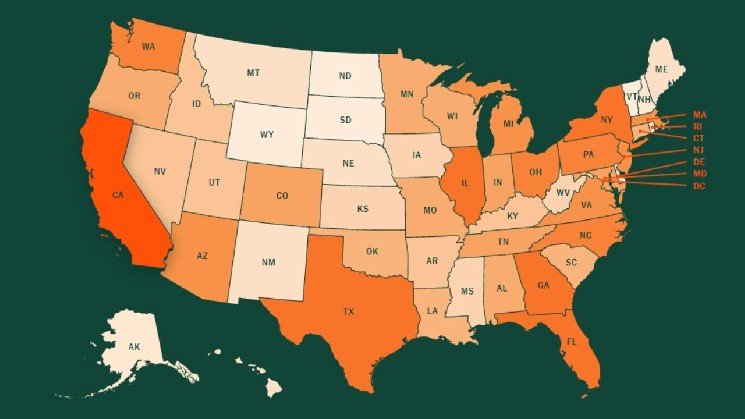
An interactive map estimates where 67 million American crypto holders live, providing figures for all 50 states, Washington, D.C., and the 435 U.S. House districts of the 119th Congress. The National Cryptocurrency Association (NCA), a nonprofit crypto education organization, presents the data through a map hub with state and district views, allowing users to explore individual geographic areas. Breaking the figures out by congressional district gives lawmakers and their staff a localized view of how many constituents hold digital assets, at a time when Congress is weighing crypto market structure and stablecoin legislation.
Ripple Chief Legal Officer and NCA President Stuart Alderoty highlighted the maps in an Aug. 24 post on X, stating: “67 million Americans hold crypto. 232,000 American jobs are supported by the industry. The National Cryptocurrency Association built two maps so you can see the data by state and district.”
California leads the state estimates with approximately 9.5 million crypto holders, followed by Texas with 5.94 million, Florida with 4.71 million, New York with 4.66 million, and Illinois with 2.64 million. The underlying 2026 State of Crypto Holders Report found that roughly one in four American adults owns cryptocurrency.
Regionally, the state-level distribution broadly tracks the U.S. population. The South accounts for 38% of holders, while the West represents 27%. The Midwest and Northeast each account for 18%, indicating that ownership is spread across the country rather than concentrated exclusively around major technology and financial centers.
Figures Reflect Modeled Estimates, Not Verified Counts
The map’s figures are statistical estimates rather than exact counts of identified crypto owners. Its methodology combines a national demographic model based on a sample of 10,000 U.S. crypto holders with district-level signals to produce a posterior mean and a 95% credible interval for every covered geographic area.
A posterior mean is the model’s central estimate once the available evidence has been incorporated. The credible interval represents the range within which the model calculates the actual figure is likely to fall. California’s estimate, for example, ranges from approximately 9.09 million to 9.92 million holders.
The broader ownership estimate came from an online survey conducted by The Harris Poll for NCA between Feb. 12 and March 3. Researchers weighted the survey findings behind the 67 million estimate and extrapolated them to the broader U.S. crypto-owning population. The sample data is accurate to within 0.7 percentage points at a 95% confidence level. Because no public registry identifies crypto owners by name or location, modeled estimates of this kind are the standard way researchers approximate geographic ownership patterns.
Separate research offers a narrower comparison focused specifically on bitcoin. A July study estimated that 49.6 million Americans hold bitcoin, representing 18.6% of the adult population. The NCA figure covers cryptocurrency generally, while the bitcoin estimate measures ownership of a single digital asset.
Crypto ownership may include assets held through software wallets, hardware devices, or accounts controlled by centralized platforms. A broader explanation of how to create a crypto wallet outlines the different arrangements holders can use to store and access their digital assets.
Crypto Supports Nearly 232,000 American Jobs
A separate NCA dataset measures the crypto industry’s economic footprint across individual states. Nationwide totals include 231,845 crypto-supported jobs, $55.4 billion in economic activity, and $30.8 billion in worker income, according to the Pragmatic Policy Group analysis of crypto employment commissioned by the association.
The employment figure comprises about 34,000 direct positions at crypto companies, 75,000 indirect jobs at suppliers, and 123,000 induced jobs supported by worker spending. The analysis calculates that each direct crypto position supports roughly six other roles across industries such as professional services, health care, insurance, food service, and logistics. The direct-plus-indirect-plus-induced framework mirrors the input-output methodology commonly used in economic impact studies for other industries, which measure ripple effects beyond a sector’s own payroll.
NCA launched in March 2025 with a $50 million grant from Ripple to support cryptocurrency education and public awareness. At the time, Alderoty described the association’s purpose as providing Americans with facts, resources, tools, and support for engaging with crypto. The Ripple funding is a reminder that the association’s materials come from an industry-backed source, even though its stated mission is education.
On the employment map, California also leads with approximately 57,600 crypto-supported jobs, $16.9 billion in economic impact, and $7.7 billion in worker income. New York follows with 53,800 jobs, while Texas supports 26,500, Washington accounts for 15,100, and North Carolina has approximately 9,500.
