Intel Beats Revenue Forecasts by $1.7 Billion Yet Stock Drops 11%; Cramer Turns Bullish
Key Takeaways
- •Intel reported Q2 revenue of $16.1 billion, up 25% year over year and exceeding analyst consensus by $1.7 billion, with its data center and AI unit growing 59% to $6.3 billion.
- •Intel's stock declined 10.88% after management signaled increased capital spending on factory equipment, pushing its RSI to 29.07, below the 30 threshold typically considered oversold territory.
- •AMD fell 5.49% despite recently announcing a 2-gigawatt chip supply deal with Anthropic backed by a $5 billion investment, indicating the selloff was unrelated to company-specific news.
- •The SOXX chip fund trades approximately 15.7% below its June high, with Citadel Securities' Scott Rubner describing the pattern as a rare chip signal.
- •Rising 10-year Treasury yields and geopolitical risks including Middle East tensions appear to be driving sector-wide capital outflows that override strong company fundamentals in the short term.
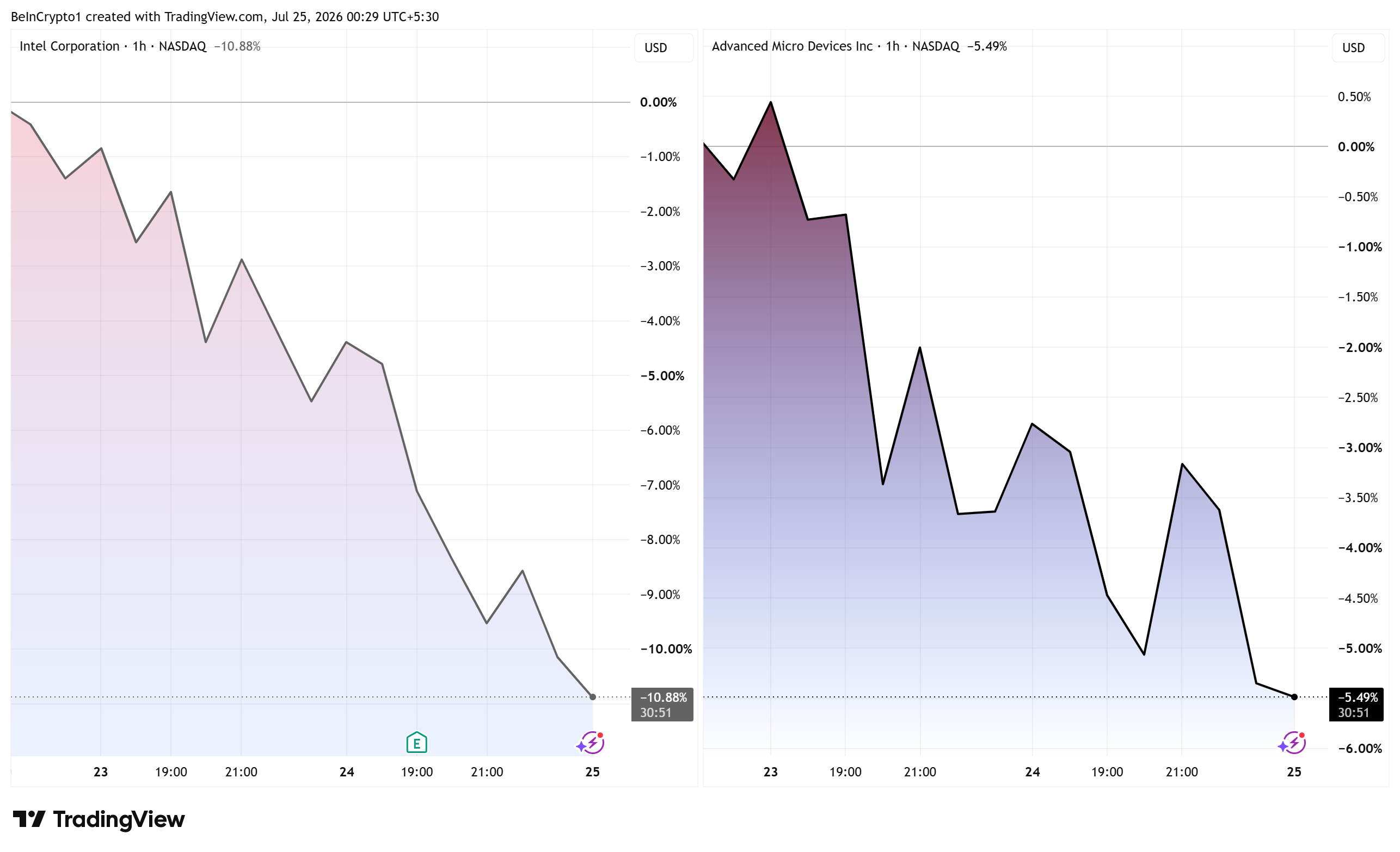
Intel exceeded revenue expectations by $1.7 billion and delivered its strongest growth in over fifteen years. Yet the stock still fell 11%.
AMD also posted positive developments but declined 5.5%. When both semiconductor giants fall simultaneously, the underlying cause is typically capital flowing out of the sector rather than company-specific issues. Semiconductor stocks are historically cyclical, and investors often react to near-term capital expenditure signals even when revenue growth is accelerating.
Intel Stock Fell Through Its Own Earnings Beat
Intel reported Q2 revenue of $16.1 billion, up 25% year over year, against analyst consensus of $14.42 billion. The company's data center and AI unit grew 59% to $6.3 billion. Adjusted earnings reached 42 cents per share.
"Our Q2 results represent our strongest revenue growth in more than fifteen years…," said Lip-Bu Tan, Intel chief executive, in the earnings release.
Finance chief Dave Zinsner indicated the company would increase spending on factory equipment and materials. Then the selling began. Intel has dropped 10.88% since the results were announced.
For a company pursuing an ambitious manufacturing buildout, higher capital spending is central to that strategy — but it can also pressure near-term free cash flow, a tension that has weighed on Intel shares in recent years.
The stock's RSI, a momentum indicator, sits at 29.07 — below the 30 threshold typically considered oversold territory and associated with heavy selling pressure.
AMD Fell Too, on Opposite News
AMD entered the period with positive momentum. The company had recently pledged 2 gigawatts of chips to an Anthropic supply deal, backed by a $5 billion investment. AMD still lost 5.49%, with its RSI at 40.99.
The broader sector was already under pressure. The SOXX chip fund trades approximately 15.7% below its June high. Scott Rubner, head of equity derivatives strategy at Citadel Securities, called it a rare chip signal.
That two of the largest U.S. chipmakers posted strong results and still sold off underscores how macro-level capital allocation — driven by rising yields and geopolitical risk — can override company fundamentals in the short term.
The Inverse Cramer Effect Does Not Scale
Following the results, Jim Cramer posted "Intel's the one" on X:
Intel's the one. — Jim Cramer (@jimcramer) July 23, 2026
The so-called inverse-Cramer effect drew immediate attention, but research suggests the opposite. A Management Science study found that Cramer's picks rise an average of 2.4% overnight, with those gains fading over subsequent months. The effect is strongest in small, illiquid stocks.
Scale is the limiting factor. That average overnight move was worth approximately $77.1 million. Intel, by contrast, lost 10.88%.
Cramer had also reduced tech exposure before earnings season, turning cautious on the broader market that same morning.
"I'm struggling to have reasons to buy, and I certainly have a lot of reasons to sell," Jim Cramer said.
He cited oil prices, interest rates, and the Middle East as contributing factors — not chip fundamentals. The 10-year Treasury yield reached its highest level since January.
Monday's open will settle it.

