HSC Conference Ho Chi Minh City: Smart Capital Bets on Infrastructure Over Hype in AI and RWA
Key Takeaways
- •Panelists said institutional investors are more concerned about regulatory ambiguity than regulation itself.
- •The investment focus has shifted from narrative-driven fundraising to execution, margins, burn rate, and exit strategy.
- •Alice Truong said institutional-grade infrastructure must provide risk control, fallback planning, and multi-jurisdiction reporting.
- •The panel viewed AI as most durable in operational tasks such as transaction monitoring and compliance automation.
- •For RWAs, the most convincing near-term use cases were tokenised deposits, trade finance, and cross-border settlement.
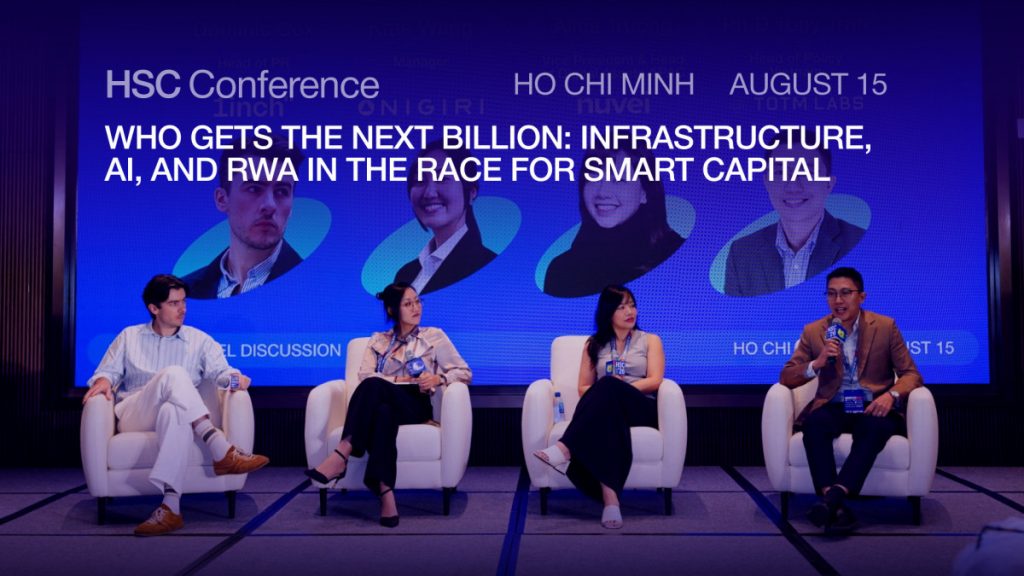
On August 15, HSC Conference held its latest edition in Ho Chi Minh City, drawing senior voices from financial institutions, technology companies, and the venture capital world to debate blockchain infrastructure, digital assets, and the future of on-chain financial markets. The setting carries its own weight: Vietnam has consistently ranked at or near the top of Chainalysis' Global Crypto Adoption Index, one of the most-cited measures of grassroots crypto usage, which has long made the country a natural stage for debates about where the industry goes next.
Among the standout sessions was "Who Gets the Next Billion: Infrastructure, AI, and RWA," moderated by Dominic Cox of 1inch, the decentralised exchange aggregator. The panel brought together Kate Wang of Oniiri Capital, a Singapore-based blockchain fund backed by Japanese credit giant Credit Saison; Alice Truong, VP of Digital Assets at global payments processor Nuvei; and Tony Tran, Ph.D., of TOTM Labs, an AI and blockchain venture builder active across Southeast Asia.
The discussion was no straightforward optimist's roadmap. Instead, the panel interrogated what is still blocking institutional capital from entering crypto, why the investment checklist has fundamentally changed since 2021, and where the real value of AI and RWA tokenisation lies beneath the hype. Their conclusion: infrastructure is the answer to almost every question the industry is asking right now.
Ambiguity, Not Regulation, Blocks Institutional Entry
The panel broadly agreed that the current environment is defined by a crisis of confidence rather than a shortage of capital. Kate described a "VC winter" driven less by bad projects than by increasingly selective LPs. "There's no lack of capital," she said. "It's really about the institutional trust." Alice drew a sharp line between innovation and operational reality, expressing a preference for projects that build bridges between legacy infrastructure and the aspirational future rather than for the future itself. Tony offered perhaps the sharpest observation of the session: investors are not afraid of regulation, they are afraid of not knowing what it will be. "They don't afraid of the regulation. They really afraid of the ambiguity."
That wariness tracks the broader record: according to industry trackers such as Galaxy Research, crypto venture funding hit a 2021 record of roughly $30 billion and fell to about a third of that level by 2023 — a stretch bookended by the collapses of Terra/Luna and FTX in 2022.
The New Checklist: Execution Over Narrative
The panel agreed that the era of narrative-driven investing is firmly over. Kate noted that in 2021, startups could raise enormous sums on pitch decks alone; today, Oniiri Capital scrutinises team experience, gross margin, burn rate, and realistic exit multiples. Alice added a dimension she argued founders consistently overlook: the exit strategy. From an institutional perspective, any capital deployment requires a clear path to recovery — whether through integration, acquisition, or extraction.
Institutional-Grade Infrastructure Means Risk Control and Reporting
When pressed to define "institutional-grade infrastructure" — a phrase that has become a marketing staple — Alice offered a grounded reframe: it is not primarily a technology question. "Technology can be built. You can use AI today to build any infrastructure." What institutions actually need is risk control and reporting. Risk control means fallback planning: if a custody API fails, what happens to a company that has already left traditional finance behind? Reporting means seamless integration with compliance dashboards across multiple jurisdictions. "If your product cannot resolve that reporting, it's going to be very challenging for me to convince my operation team to use the product." Such expectations have become more explicit as regimes like the EU's Markets in Crypto-Assets (MiCA) framework, fully applicable since the end of 2024, turn compliance and disclosure into formal requirements.
AI: Build the Boring Stuff
On AI, the panel converged on a similar message. Alice cautioned against chasing flashy applications: "Build the boring stuff. The boring stuff is not boring. The boring stuff can make you a lot of money." Infrastructure-level AI — improving transaction monitoring, automating compliance, and enhancing operational efficiency — is where she sees durable returns. Tony raised the accountability challenge of agentic AI: who is responsible when an AI agent makes a damaging financial decision? He pointed to Vietnam's AI law, effective this year — the Law on Digital Technology Industry, in force since January 1, 2025 — as a notable regional development that places legal responsibility on developers and founders.
RWAs: Institutional Use Cases First
RWAs generated the most divergence on the panel. Alice was the most sceptical, identifying two unresolved problems — accessibility and interoperability — that she believes undermine the broader tokenisation narrative. The one use case she found genuinely compelling was tokenised deposits for institutions: intraday liquidity management between financial counterparties, essentially a modernised repo market. That narrow path has precedent: JPMorgan launched its JPM Coin tokenised-deposit system in 2019 and has said it processes roughly $1 billion in daily transactions. The wider tokenisation wave is also real — BlackRock and Franklin Templeton have both launched tokenised funds, and Boston Consulting Group has projected as much as $16 trillion in tokenised assets by 2030 — but none of that resolves the accessibility, interoperability, and distribution questions the panellists flagged. Kate agreed that distribution remains the central unsolved problem in RWAs. Tony saw near-term viability primarily in trade finance and cross-border settlement, with more complex consumer-facing tokenisation coming later.
The $1 Billion Question
Asked where they would allocate a hypothetical billion dollars, all three panellists chose infrastructure — the invisible layer that makes everything else possible. Alice's answer was the most specific: the next wave of agentic AI needs two things builders have not yet provided — rule-based transaction controls, and the ability to reverse AI-made errors. "Then the end user feels safe, and there would be a boom of agentic AI." The panel's consensus was clear: before the next billion flows into crypto's most exciting applications, the foundational layer needs to be built, trusted, and made compliant. By the panel's own logic, the indicators to watch are unglamorous ones: working custody failover, cross-jurisdiction reporting integrations, and whether rule-based controls and reversal mechanisms for AI agents actually ship.
This article originally appeared on Metaverse Post.

