U.S. Markets Face a Packed Week: Inflation Data, Fed Independence Questions, and AI Earnings
Key Takeaways
- •The S&P 500 closed at record highs on Friday, with the Nasdaq, S&P 500, and Dow each posting their strongest weekly performance since April following a robust jobs report.
- •Economists forecast both headline and core CPI to rise 0.2% in July, and Bank of America's Stephen Juneau warned that an in-line reading would reinforce the case for a September rate hike.
- •The White House indicated it is considering removing Federal Reserve Governor Lisa Cook, following a Supreme Court opinion that opened the door to such actions and raising concerns about Fed independence.
- •AI infrastructure companies show sharply divergent results, with Nebius Group up 122% year-to-date and CoreWeave up 25%, while Cerebras Systems has fallen 35% since its IPO.
- •Super Micro Computer and Applied Materials are among the major semiconductor firms reporting earnings this week, with Super Micro having already disclosed preliminary figures showing profit margin growth and a record order backlog.
U.S. financial markets are entering one of the most eventful weeks of the summer, with a heavy slate of inflation data, escalating Federal Reserve political drama, and a wave of AI-related corporate earnings all converging on the calendar.
Markets Rally on Strong Jobs Report
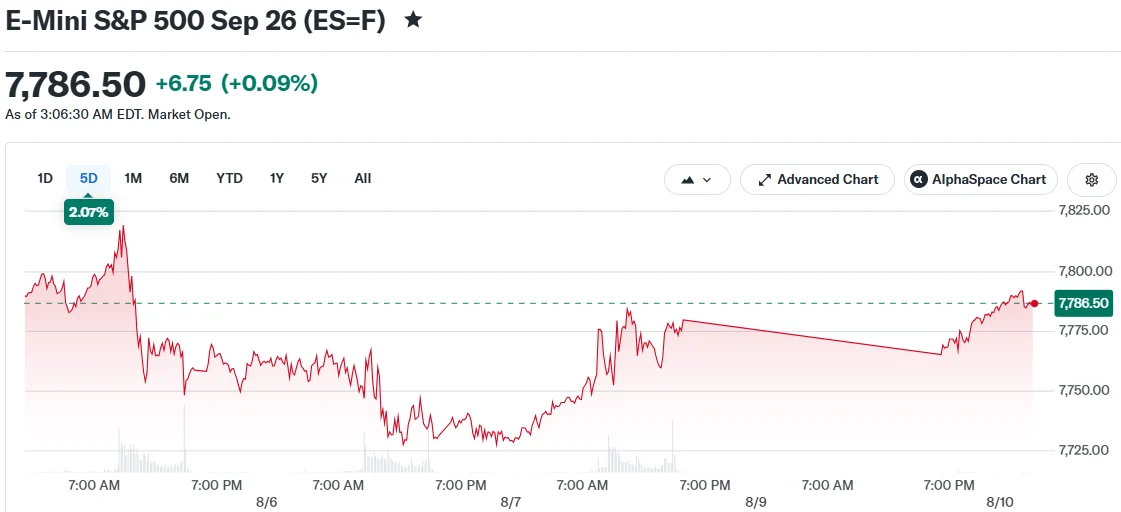
The S&P 500 closed at record highs on Friday, gaining 0.6% on the day. For the week, the Nasdaq surged 5.2%, the S&P 500 added 3.6%, and the Dow Jones Industrial Average rose 3%. It marked the strongest weekly performance for all three major indexes since April.
Friday's rally was driven by a robust jobs report. Strong employment figures alleviated investor concerns that the Federal Reserve would raise interest rates in the near term.
Inflation Data Takes Center Stage
The July Consumer Price Index (CPI) report is scheduled for release Wednesday at 8:30 a.m. ET. Economists forecast both headline and core inflation to rise 0.2%. CPI is the most closely watched monthly inflation gauge, and the core reading strips out volatile food and energy costs to reveal underlying price trends.
CPI declined in June, but conditions have since shifted. Conflict in the Middle East has disrupted oil shipments, driving energy prices upward.
The Producer Price Index (PPI), which tracks wholesale inflation and often foreshadows future consumer price movements, follows on Thursday. The PPI dipped in June after a sharp increase in May.
Bank of America economist Stephen Juneau said last month's lower CPI reading was likely an anomaly. He noted that a figure in line with expectations would reinforce the argument for a September rate hike.
Friday rounds out the week with retail sales data and the University of Michigan consumer sentiment survey. Consumer spending rose 0.2% in June, though the savings rate fell to a four-year low, a signal that households may be drawing down buffers to sustain spending.
Fed Independence Under Scrutiny
The White House sent a letter last week indicating the president was considering removing Federal Reserve Governor Lisa Cook. The move follows a Supreme Court opinion issued in late June that opened the door to such actions. The Fed has operated under a decades-long norm of policy independence from the executive branch, a framework markets have relied upon to anchor expectations for stable, long-term monetary policy.
White House National Economic Council Director Kevin Hassett stated publicly that potential Fed Chair candidate Kevin Warsh and the president regularly discuss the economy. Such direct contact between a sitting president and a Fed official is highly unusual.
Bond markets responded to the developments. A rise in yields last week reflected concerns that some observers attributed to questions surrounding Federal Reserve credibility.
AI Earnings Present a Mixed Picture
Three AI infrastructure companies are reporting earnings this week, each telling a different story. Nebius Group (NBIS), a provider of cloud computing infrastructure for AI workloads, has surged 122% year to date. CoreWeave (CRWV), which specializes in GPU-based cloud computing for AI training, has gained 25%. Cerebras Systems (CBRS), which designs wafer-scale AI chips as an alternative to conventional GPUs, has fallen 35% since its initial public offering.
#earnings for the week of August 10, 2026 $NBIS $SMCI $RKLB $CRWV $LITE $AMAT $ASTS $FLY $CSCO $PLUG $QUBT $HIMS $INFQ $COHR $GCTS $CBRS $SE $BRK.B (Saturday) $ARCO $CAVA $BETA $MLCO $CEVA $FIGR $LUNR $GPRO $ENVX $EAT $CAH $FRMI $B $AIT $BGS $TRMB $FNV … pic.twitter.com/GN5RVs0i2o — Earnings Whispers (@eWhispers) August 7, 2026
The divergent returns underscore that enthusiasm for AI spending does not uniformly benefit all companies in the sector.
CoreWeave and Nebius both joined the Nasdaq 100 this summer. Nvidia has invested in both firms. Cerebras exceeded expectations in its first quarterly report as a publicly traded company in June.
Super Micro Computer (SMCI) reports on Tuesday, having already released preliminary figures showing profit margin growth and a record order backlog. Applied Materials (AMAT), a leading supplier of equipment used in semiconductor manufacturing, reports Thursday, capping a pivotal week for the semiconductor and AI hardware space.

