Infinix GT 50 Pro Brings Data-Center-Grade Liquid Cooling to Mobile Gaming
Key Takeaways
- •Nvidia, Google, and Oracle have moved AI data centers away from air cooling toward liquid-cooling architectures as heat, rather than power, becomes the primary limit on performance.
- •The Infinix GT 50 Pro features the HydroFlow Liquid Cooling System, described as the industry's largest micro-pump liquid-cooling setup, covering 100% of the core heat source and pairing a vapor chamber plate with active coolant circulation.
- •Thermal throttling typically degrades smartphone gaming performance after roughly 15 minutes of heavy use, as devices slow themselves to protect hardware once temperatures exceed safe thresholds.
- •The optional GT Magcharge Cooler 2.0 extracts heat externally and uses wireless bypass charging to route power directly to the phone's system, reducing battery strain during extended sessions.
- •The MediaTek Dimensity 8400 Ultimate chipset supports native 144FPS gameplay across six major titles, including Call of Duty: Mobile, Mobile Legends: Bang Bang, and Blood Strike.
The rapid adoption of artificial intelligence has pushed a familiar engineering constraint into the spotlight: heat. The data centers that power everyday AI workloads are running into a thermal wall that traditional air cooling can no longer service, and without top-tier cooling systems in place, both performance and stability suffer. In response, industry leaders such as Nvidia, Google, and Oracle have moved away from air cooling and embraced sophisticated liquid-cooling architectures as a new fundamental requirement.
The industry-wide takeaway is clear: performance today is not limited by power, but by heat. In less than two decades, smartphones have evolved into pocket-sized computers capable of console-level gaming, AI processing, and sustained high-performance workloads. That leap in pint-sized computing power carries the same fundamental cooling constraint as large-scale data centers — keeping handheld devices cool under pressure while maintaining performance.
That same cooling upgrade is now making its way into handheld devices. The Infinix GT 50 Pro, a gaming-focused smartphone, is built on enterprise-level thermal management principles, adapting them to cutting-edge cooling technology in the palm of the hand. By the company's framing, cooling logic good enough for the xAI “Colossus” supercomputer is more than capable of taking gaming sessions further.
Why smartphone performance breaks down
A familiar scenario plays out on many smartphones: gaming runs smoothly at high frame rates with responsive controls, but after about 15 minutes, things begin to change. Frame drops appear, FPS becomes inconsistent, and the device feels less stable as heat builds. This is thermal throttling in real time, and it is the ultimate barrier to peak performance.
Once device temperatures rise beyond a safe threshold, the system automatically slows itself down to protect the hardware. Long sessions expose the gap between what a chip is capable of and what it can actually maintain without proper cooling technology.
The GT 50 Pro's engineering breakthrough is the HydroFlow Liquid Cooling System, which brings the same large-scale active-circulation logic used in AI data centers into a smartphone. It features the industry's largest micro-pump liquid-cooling system, covering 100% of the core heat source to remove heat for sustained high performance during heavy usage. Where a vapor chamber passively spreads heat, a micro-pump loop actively circulates coolant — the same shift from passive airflow to active liquid cooling that data centers have already made. The device combines a vapor chamber plate with its liquid cooling module as part of this architecture.
Extra cooling with the GT Magcharge Cooler 2.0
In addition to its built-in liquid cooling, the GT 50 Pro can be paired with the GT Magcharge Cooler 2.0, an external cooling accessory and charger that extracts heat from the phone during extended gaming sessions. Used together with the original charger and cable, the accessory employs wireless bypass charging to reduce battery strain, routing power directly to the phone's system instead of constantly cycling through the battery.
The dual approach works internally and externally to draw heat away from the smartphone's core, enabling stable performance without slowdowns or hiccups. The cooler's fan is aligned with the phone's liquid membrane design to improve heat transfer and overall thermal efficiency.
Performance and design beyond cooling
Cutting-edge cooling sits at the core of the GT 50 Pro's innovation, but it is the stability that cooling enables which defines overall performance. By pushing past thermal wall constraints, the device takes full advantage of its hardware and software, delivering a gaming experience that typical smartphones struggle to sustain.
Competitive gaming advances
The GT 50 Pro aims to set a new benchmark for competitive gaming through refined software updates, including a more immersive, updated esports mode and a suite of AI-driven enhancements that improve stability, responsiveness, and the overall gameplay experience.
With a single tap, esports mode engages a focused environment that blocks notifications and switches to a specialized interface for elite-level play, optimizing the phone's resources for consistent performance during extended sessions.
At the phone's core, the MediaTek Dimensity 8400 Ultimate chipset supports native 144FPS gameplay across six major titles, including Call of Duty: Mobile (CODM), Mobile: Bang Bang (MLBB), and Blood Strike, delivering ultra-smooth, power-efficient performance for a sustained competitive advantage. Infinix's self-developed N1 Network Chip further supports this experience by improving signal stability, even in challenging network environments.
Hardware controls add another layer. The Open-Cut, Pressure-Sense GT Trigger supports faster reaction times that go beyond the limits of a standard touchscreen, allowing players to tap, press, and swipe on a single key for complete control over gameplay. Customizable shoulder keys offer 10 adjustable sensitivity levels to tailor the phone to individual needs.
On the software side, XOS 16 introduces AI gaming enhancements for faster, more consistent gameplay. The Smart Trigger recognizes in-game images to perform preset operations, such as reward collection, keeping players focused during high-pressure moments, while AI voice prompts deliver vocal cues for advanced strategies.
All of these features are wrapped in a Kevlar-inspired texture with a sleek hypercar aesthetic. The textured 3D finish is available in three colorways — black abyss, red blaze, and silver glacier — and the mechanical light wave design supports up to eight styles and eight colors for personalization. A transparent window on the back panel allows the GT 50 Pro's liquid-cooling architecture to be viewed in action.
A milestone for the GT series
The GT 50 Pro marks a clear milestone in the evolution of the GT series. What began as a bold, cyberpunk-inspired, gaming-centric smartphone with the GT 10 has evolved into a refined smartphone gaming experience. Across generations, the series has prioritized sustained performance by balancing power, thermal control, and gaming features.
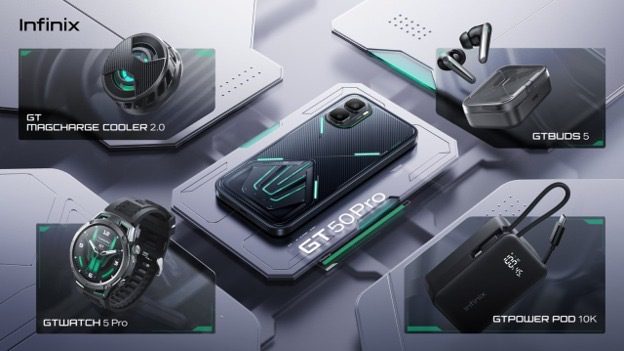
Infinix is now focused on cultivating a new GT ecosystem designed as an esports sanctuary of hardware, accessories, and AI-powered peripherals. The GT 50 Pro, GT Magcharge Cooler 2.0, GTWATCH 5 Pro, GTBUDS 5, and GTPOWER POD 10K form a continually expanding lineup aimed at the hardcore gaming community. Through its GT Gaming Co-Lab, Infinix is collaborating with global game publishers to optimize its software and deliver user-centric designs, addressing real user pain points and building flagship-level products accessible to gamers everywhere. For readers following mobile gaming hardware, that continually expanding ecosystem — and what the Co-Lab's publisher collaborations yield — are the threads worth watching as thermal engineering migrates from the data center into everyday devices.
Cooling as the new benchmark
Liquid cooling architecture is becoming a defining requirement for sustained performance across the tech ecosystem, not just in large-scale AI data centers. Mobile performance hits the thermal wall when it relies exclusively on traditional air cooling, cutting its true capabilities short. Infinix positions the GT 50 Pro ahead of that curve, using liquid-cooling principles to improve performance and allow its software to operate more consistently under pressure.
As hardware continues to evolve, the argument goes, liquid cooling is poised to be the rule rather than the exception — even the most powerful chips lose their punch without the cooling capability to support sustained output. The GT 50 Pro reflects this broader shift and the closing gap between data-center engineering and consumer devices. Future performance, in this view, will not be determined by who has the fastest chip alone, but by who can stay cool under pressure and sustain performance when it matters most.
Source: TechNext24

