Ball State Research Finds Utility-Scale Solar and Wind Have No Effect on Nearby Indiana Home Values
Key Takeaways
- •Ball State CBER researchers analyzed Indiana home sales from 2004 through 2024 and found no statistically significant negative effect on residential prices near wind or utility-scale solar projects.
- •The wind study covered commercial turbines in three Indiana regions, while the solar study examined multiple distances, project sizes, rural versus urban locations, brownfield proximity, and power-provider type.
- •Event studies found no sustained decline in home prices after renewable-energy projects became operational.
- •The researchers note the findings are average effects and do not rule out negative impacts on individual properties, suggesting local permitting and siting processes may mitigate harm.
- •The brief is part of a Ball State CBER series for the Indiana R-STEP Collaborative, and the findings will be presented in a free Sept. 16 webinar hosted by Purdue Extension and the American Planning Association's Indiana Chapter.
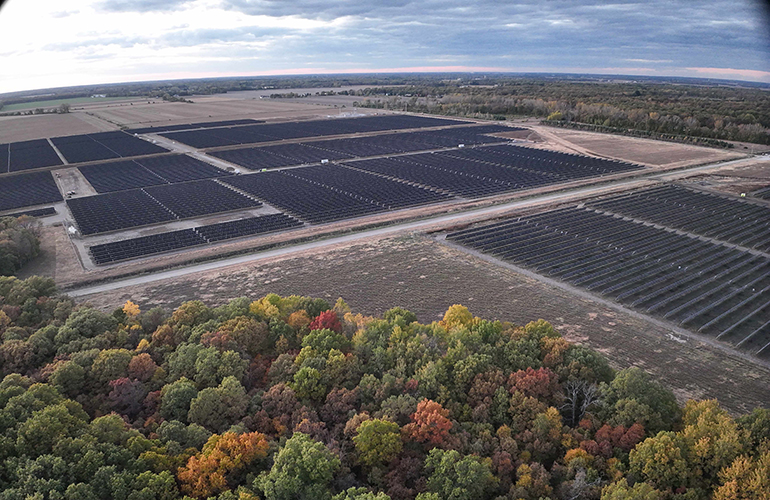
A new research brief from Ball State University's Center for Business and Economic Research (CBER) finds no statistically significant negative effects on residential property values associated with proximity to large wind or utility-scale solar projects in Indiana.
Concerns about nearby home values are among the most frequently raised objections when communities weigh renewable-energy development, and the Indiana findings add to a body of research examining the question using actual sales data.
The brief, "Indiana Renewables and the Residential Real Estate Market," summarizes findings from two larger CBER studies examining wind and solar developments and nearby home values across Indiana. Researchers drew on home sales data from 2004 through 2024 to compare residential property prices before and after renewable-energy projects became operational, and at varying distances from those projects.
"This research provides Indiana-specific data on an issue that often arises when communities are considering renewable-energy projects," said Dr. Dagney Faulk, director of research at CBER. "Property values are understandably an important consideration for homeowners and local officials. Our analysis allows those discussions to be informed by what we have observed in housing markets around existing wind and solar developments across the state."
In the wind analysis, researchers examined residential sales near commercial wind turbines in three regions of Indiana. The models found no statistically discernible negative effect on the sale prices of nearby homes.
The solar analysis likewise found no statistically significant negative effect on home prices. Researchers examined sales at several distances from utility-scale solar projects and conducted additional analyses based on project size, rural or urban location, proximity to brownfields, and type of power provider.
Event studies tracking home prices over time similarly found no evidence of a sustained decline in residential sale prices after wind or solar projects became operational.
"The advantage of looking at many years of actual home-sale data is that we can examine what happened in communities before and after these projects were developed," said Dr. Paul Niekamp, assistant professor of economics in Ball State's Miller College of Business. "Across the different approaches we used, the overall results do not indicate widespread negative effects on residential property values near solar projects in Indiana."
The researchers caution that their findings represent average effects across the properties studied and do not rule out the possibility that an individual property could experience a negative effect. They also suggest that local permitting and siting processes designed to mitigate impacts on neighboring properties may help explain the absence of widespread negative effects.
The new brief is part of a broader series of research produced by Ball State CBER for the Indiana Renewable Energy Siting through Technical Engagement and Planning (R-STEP) Collaborative. Earlier this year, CBER published research examining economic patterns associated with county-level restrictions on utility-scale wind and solar development in Indiana. Such county-level restrictions have been a recurring feature of renewable-energy debates in the state, and the research series is intended to inform those local policy discussions.
Together, the studies are intended to provide state and local officials, residents, and other stakeholders with Indiana-specific data as communities consider issues related to renewable-energy planning and development.
The wind study was conducted by Dr. Faulk, retired CBER Director Dr. Michael Hicks, and Seth Payton, a former CBER research associate. The solar study was conducted by Drs. Niekamp, Faulk, and Hicks.
The Indiana R-STEP Collaborative connects local communities with research-based resources to support informed planning for utility-scale renewable-energy projects. The initiative is part of the U.S. Department of Energy's Renewable Energy Siting through Technical Engagement and Planning program.
Drs. Faulk and Niekamp will discuss the findings during a Sept. 16 webinar organized by Purdue Extension and the Indiana Chapter of the American Planning Association. The Zoom webinar is free and open to the public, though registration is required.
Source: Ball State University, via Solar Power World.

