Air Pollution Is a Growth Killer for India, Economists Argue
Key Takeaways
- •The November 1, 2026 special issue of Outlook Business presents air pollution in India as a barrier to economic growth, not merely a public health problem.
- •Economist Alex Tabarrok argues that pollution undermines India's demographic dividend by lowering workers' cognitive scores, increasing respiratory illness, and shortening working lives.
- •Tabarrok contends that major Indian pollution sources, such as rice stubble burning, garbage burning, road dust, unscrubbed coal plants, and household wood and dung cooking, contribute little to economic output and could be cleaned up at low cost.
- •Anumita Roychowdhury of the Centre for Science and Environment cites estimates putting pollution's economic cost at roughly 9.5% of GDP per a Lancet study, around 6% per the World Bank, and about 3% per Dalberg.
- •Severe pollution episodes in Delhi have reportedly reduced consumer footfall and raised concerns that skilled professionals and businesses may relocate from highly polluted locations.
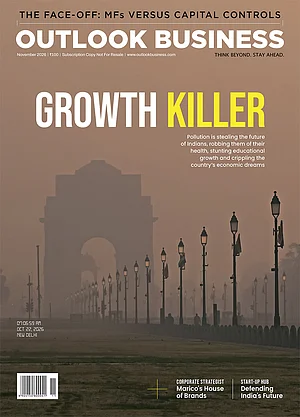
Air pollution in India is not just a public health emergency — it is increasingly a drag on the country's economic growth. That is the central argument of the November 1, 2026 special issue of Outlook Business, which examines pollution not only as a "people killer" but as a "growth killer." The reframing matters: it turns dirty air from a health statistic into a line on the growth ledger.
Among the contributors is economist Alex Tabarrok, who writes at the economics blog Marginal Revolution and was interviewed by the magazine. Tabarrok has long emphasized on his blog that pollution reduces both wealth and health, a point he also explores in a video.
Asked in the interview whether India's demographic dividend — the economic boost a country gets when its working-age population is large relative to its dependents — argues for prioritizing growth first, Tabarrok pushed back on the premise:
"The demographic dividend is people. If you poison the people, you shrink the dividend. A young workforce with lower cognitive scores, more respiratory illness and shorter working lives is a smaller asset than the headcount suggests, and the damage to today's children shows up as lower productivity in future decades."
He also disputed the assumption that India's pollution is primarily a byproduct of economic growth:
"Much of it isn't. Farmers burning rice stubble in Punjab and Haryana produce more smoke than GDP. Burning garbage, road dust and old coal plants running without scrubbers are not engines of the economy. Families cooking with wood and dung are polluting because they are poor. Cleaning up these sources costs very little output, and some of the fixes would raise it."
For readers parsing that list: stubble burning is the post-harvest burning of leftover rice stalks to clear fields, and scrubbers are pollution-control devices fitted to plant exhausts.
"Bad air is a tax on talent," he added. "And not just Indian talent. Who wants to visit Delhi in November? Foreign skilled professionals, firms and tourists all have options. Clear skies are a selling point for incredible India."
Quantifying the cost
The issue also features Anumita Roychowdhury, executive director of research and advocacy at the Centre for Science and Environment, who argues that air pollution is actively undermining India's economic activity:
"The evidence increasingly shows that air pollution is imposing significant economic and health costs on India. Several studies from credible institutions have estimated the scale of these losses. For instance, a Lancet study estimated that air pollution was costing India roughly 9.5% of its GDP. The World Bank has put the figure at around 6% of GDP, while a Dalberg [a consultancy] study highlighted substantial losses to Indian businesses, estimating the costs at around 3% of GDP."
"The economic impact is visible in several ways. When people fall ill, there is a significant loss of productivity. We have also seen reports of reduced consumer footfall during periods of severe pollution in Delhi. There are also concerns about people shifting their base and businesses, raising questions about operating in highly polluted locations such as Delhi."
"So, the evidence increasingly suggests that pollution is undermining economic activity. We may talk about economic growth, but if a significant part of that growth is being eroded by pollution-related health and productivity losses, the gains are not being fully realised."
The estimates differ across the three institutions — Lancet, the World Bank and Dalberg — but they converge on losses large enough to register in national output. Set beside Tabarrok's claim that much of India's pollution sits outside the growth engine and that cleaning it up would cost little output, the two arguments reinforce each other: dirty air with a GDP-scale price tag, cleanup with a small one.
This article is based on a post published on November 5, 2026 on Marginal Revolution.

