IMF: El Salvador's Recent Bitcoin Additions Involved No Public Funds
Key Takeaways
- •IMF staff concluded that El Salvador's additional Bitcoin holdings came from private donations, not government funds, keeping the country compliant with its US$1.4 billion loan program.
- •The staff-level agreement, announced September 3, 2026, covers the combined second and third reviews of the 40-month Extended Fund Facility approved in February 2025.
- •If the IMF Executive Board approves the reviews, El Salvador would receive about US$140 million (SDR 101.96 million), adding to SDR 172.32 million already disbursed.
- •IMF staff said no further Bitcoin accumulation is expected beyond the documented donations, and the statement did not identify donors or the exact amount received.
- •El Salvador adopted Bitcoin as legal tender in 2021, and the IMF arrangement requires limits on public-sector Bitcoin activity, including winding down the state-backed Chivo wallet role.
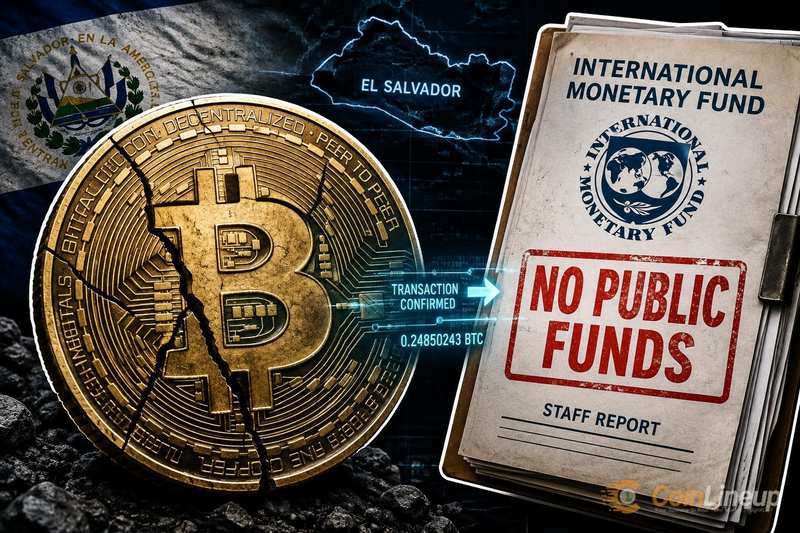
The International Monetary Fund has determined that El Salvador used no public money for its recent Bitcoin accumulation. According to IMF staff, the country's additional Bitcoin came from private donations rather than government funds — a finding that matters because it clears El Salvador of suspicions that it quietly violated the terms of its US$1.4 billion loan program.
What the IMF said
On September 3, 2026, IMF staff released a statement after reaching a staff-level agreement with El Salvador (IMF press release). Staff said no public resources had been used to build up the country's Bitcoin holdings.
The IMF stated that Salvadoran documentation showed Bitcoin added since the first review reflected private donations. In plain terms, the coins were given to the country; the government did not buy them with taxpayer money.
Staff also said no further Bitcoin accumulation is expected beyond those documented donations. A newswire report from AFP framed the same finding: the IMF was satisfied the inflows came from donations rather than state cash.
One caution on wording: while headlines have used the word "purchases," the IMF describes accumulation explained by donations, not confirmed government buying. The statement did not name the donors or specify the exact amount of Bitcoin received.
Why the funding source matters
El Salvador's loan comes with strict Bitcoin rules. When the IMF approved the 40-month Extended Fund Facility on February 26, 2025, it set access of SDR 1,033.92 million — about US$1.4 billion — made accepting Bitcoin voluntary, and limited public-sector Bitcoin activity.
An Extended Fund Facility (EFF) is a multi-year IMF loan tied to reforms. If a country buys Bitcoin with state money, it could break those loan terms. That is why the funding source, rather than the coins themselves, is the substance of the story.
The tension is rooted in El Salvador's history: the country adopted Bitcoin as legal tender in 2021, making it the first nation to do so, and its government began accumulating coins under President Nayib Bukele. The IMF arrangement two years later required the country to reconcile that policy with fiscal discipline.
Pressure had been building over time. On May 27, 2025, IMF staff said the total Bitcoin held across all government wallets should remain unchanged, and that the public sector should unwind its role in the Chivo wallet, the state-backed Bitcoin app. When the wallets grew anyway, the IMF required an explanation — and the donation finding is that explanation. It allows El Salvador to remain compliant without reversing its Bitcoin stance.
How the statement fits El Salvador's broader Bitcoin program
The money at stake is concrete. If the IMF Executive Board approves the combined second and third reviews, El Salvador would receive about US$140 million, equal to SDR 101.96 million.
That would add to what the country has already drawn. The IMF completed the first review on June 27, 2025, releasing SDR 86.16 million and bringing total disbursements to SDR 172.32 million.
Taken together, the timeline shows why the Bitcoin clarification carries weight: actual loan disbursements depend on El Salvador adhering to the Bitcoin limits, and the donation finding keeps that money flowing.
At the time of the statement, Bitcoin traded at $80,941, up about 4.15% over 24 hours, while the Fear & Greed Index sat at 74, in "Greed" territory.
El Salvador's approach still stands apart from how major financial institutions are embracing Bitcoin. Traditional players now offer regulated access, such as Standard Chartered's institutional spot Bitcoin trading and Hargreaves Lansdown's plan to open Bitcoin ETN trading. Others simply hold, as seen when Remixpoint sold other tokens but kept its Bitcoin.
What to watch next
The key signal from this news concerns compliance rather than price: El Salvador is working within its IMF arrangement rather than against it. The next milestone is the IMF Executive Board vote, which will decide whether the roughly US$140 million tranche is released. Beyond that, further reviews under the 40-month program will test whether the commitment to no additional public-sector Bitcoin accumulation holds through the arrangement's end.
Disclaimer: This article is for informational purposes only and does not constitute financial or investment advice. Cryptocurrency and digital asset markets carry significant risk. Always do your own research before making decisions.

