IHS Nigeria Revenue Surges 34.1% to $359.4 Million in Q3 2026, Accounting for 73% of Group Revenue
Key Takeaways
- •IHS Nigeria's third-quarter 2026 revenue surged 34.1% year-on-year to $359.4 million, contributing 73.3% of IHS Towers' total revenue of $490.5 million.
- •Group adjusted EBITDA increased 26.8% to $215.0 million at a 59.8% margin, even as power generation costs in Nigeria rose to $38.8 million, an increase IHS linked partly to higher global power prices caused by the Middle East conflict.
- •IHS Towers posted a quarterly loss of $8.2 million, down 105.6% from $147.4 million in income a year earlier, due to deal-related expenses including accelerated share-based payments connected to the proposed MTN Group acquisition.
- •The proposed $2.2 billion acquisition of IHS Towers by MTN is expected to close in 2026, pending approvals from ECOWAS, CEMAC, and the South African Competition Tribunal.
- •The Naira's appreciation to an average of ₦1,352 per dollar lifted non-core income 15.2% to $40.7 million, while tower tenants grew by 120 year-on-year despite 378 churn.
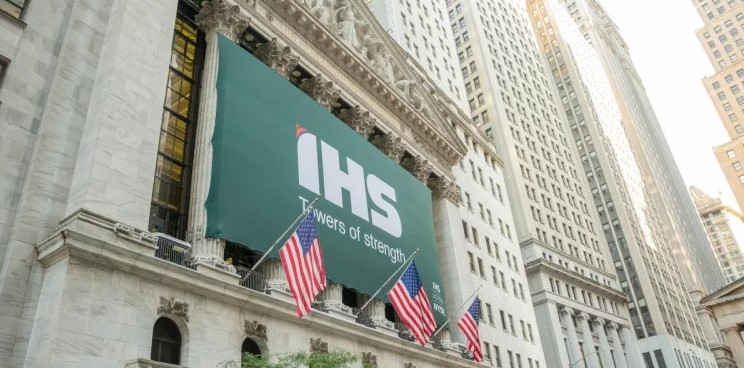
Leading tower infrastructure company IHS Holdings has reported revenue of $359.4 million in Nigeria for the third quarter ended September 2026, a 34.1% surge from $268 million a year earlier. The Nigerian market is the group's biggest, with IHS Nigeria's latest earnings contributing 73.3% of IHS Towers' total revenue of $490.5 million during the quarter.
Growth in revenue and adjusted EBITDA
According to a corporate filing with the United States Securities and Exchange Commission (SEC) containing the group's third-quarter 2026 financial report, adjusted EBITDA increased 26.8% year-on-year to $215.0 million, producing an adjusted EBITDA margin of 59.8%. The year-on-year increase in adjusted EBITDA reflected the higher revenue, although it was partially offset by rises in cost of sales and administrative expenses included within adjusted EBITDA.
Power generation costs drive operating expenses
Operating costs in the Nigerian market surged during the quarter, driven primarily by a year-on-year increase in power generation costs to $38.8 million. The average retail price of diesel in Nigeria currently ranges between ₦1,800 and ₦1,900 per litre, showing how heavily companies spend to power their infrastructure amid an unreliable grid supply. For tower companies and telecom operators, running base stations 24/7 — the majority of those hours on diesel — consumes tens of millions of litres of fuel monthly, and operators routinely spend 30% to 40% of their total operational budget just to keep base stations powered. When diesel prices spike, the multi-billion-dollar fuel bills eat into profitability, restricting the capital available for routine network upgrades, maintenance, and expansion.
IHS attributed the fuel price increase to "higher global power prices due to reasons including the conflict in the Middle East."
For IHS Nigeria, the impact of rising fuel prices was offset by higher revenue generated through the company's power pass-through and indexation mechanisms.
Other sources of the increase in operational costs were a year-on-year surge in staff costs ($3.8 million) and tower repair and maintenance costs ($2.4 million). The increase was enhanced by the appreciation of the Naira, the currency used to translate the results of the group's Nigeria operations.
On the positive side, the Naira's appreciation — to an average rate of ₦1,352 to $1.00 in the third quarter of 2026, compared with an average of ₦1,523 to $1.00 in the third quarter of 2025 — led to a 15.2% non-core increase to $40.7 million.
Tower tenants increased by 120 year-on-year, with growth of 497 from colocation and 1 from new sites, partially offset by 378 churn. Lease amendments also rose by 5,768 during the quarter.
Quarterly loss tied to deal-related expenses
The group reported a loss of $8.2 million for the third quarter of 2026, compared with income of $147.4 million in the third quarter of 2025. The 105.6% decrease was attributed to a $48.2 million increase in cost of sales and an $88.4 million increase in administrative expenses, stemming from accelerated share-based payments and long-term employee benefits payments towards the company's proposed acquisition by MTN Group.
Revenue from continuing operations nonetheless increased 21.4% to $490.5 million, which excludes revenue of $17.6 million for the Latam segment presented within discontinued operations, despite a 3.5% inorganic revenue headwind resulting from the sale of the Rwanda division.
"We delivered a strong third-quarter performance, with revenue growth and higher Adjusted Levered Free Cash Flow (ALFCF) underpinned by operational and financial discipline and the strength of our business model," said Sam Darwish, IHS Towers Chairman and Chief Executive Officer.
MTN acquisition advances
Darwish said the proposed $2.2 billion acquisition of IHS Towers by MTN continued to advance during the quarter and that the company currently expects the transaction to close in 2026, subject to the remaining closing conditions.
In its 9M 2026 financial statement, MTN said it awaits regional regulatory approvals from the Economic Community of West African States (ECOWAS) and the Economic and Monetary Community of Central Africa (CEMAC). In addition to those regional organisations, the South African Competition Tribunal is also reviewing the deal's impact on competition in South Africa.

