ICE and OKX Plan 24/7 Trading Venue for 63 Tokenized U.S. Securities
Key Takeaways
- •ICE, the parent company of the New York Stock Exchange, and crypto exchange OKX have jointly filed a notification with the SEC for a trading venue covering 63 tokenized U.S. securities.
- •The proposed venue would enable around-the-clock trading every day of the week, moving beyond the traditional weekday session that runs roughly from 9:30 a.m. to 4:00 p.m. Eastern time.
- •The SEC has not approved the proposal, and securities venue reviews typically take months, so none of the 63 instruments can trade until regulatory clearance is granted.
- •The 63-asset figure defines only the scope of the requested approval and does not guarantee that any of the instruments will ultimately launch.
- •If the venue is approved, continuous trading could reduce price gaps that form when conventional markets reopen after overnight news, and tokenized stocks would be expected to carry their own tax reporting requirements.
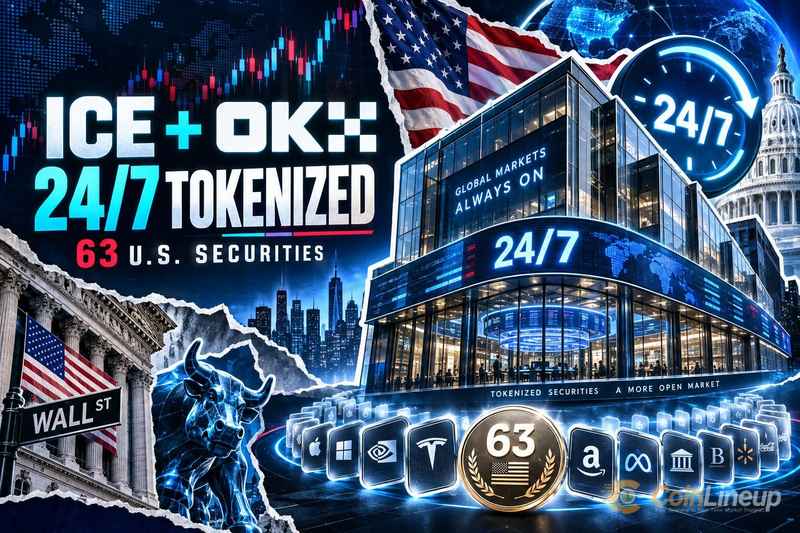
Intercontinental Exchange (ICE), the owner of the New York Stock Exchange, and cryptocurrency exchange OKX have jointly notified the U.S. Securities and Exchange Commission of a planned trading venue that would allow investors to buy and sell 63 tokenized U.S. securities around the clock, every day of the week.
Tokenization converts ownership of a traditional security, such as a stock, into a digital token recorded on a blockchain. The token represents the same underlying asset but can move and trade like a cryptocurrency, free from the restrictions of conventional market hours.
What ICE and OKX Disclosed to the SEC
Intercontinental Exchange, the parent company of the New York Stock Exchange, and OKX, a major international crypto exchange, filed the notification together. The document describes a planned venue rather than a live market, and its submission is a required step before any such platform could be opened to the public. The pairing is notable in its own right: it places an operator of traditional market infrastructure and a crypto-native trading platform inside the same SEC review process.
The SEC has not approved the proposal. The Securities and Exchange Commission oversees U.S. securities markets and must review any venue that intends to trade regulated instruments, and any launch would require the agency's sign-off. Because tokenized stocks remain securities, the proposal falls squarely under SEC jurisdiction, and regulatory reviews for securities venues typically take months. For readers tracking the filing, that review is the timeline to watch, since it will determine whether — and in what form — the venue can move toward launch.
The 63 Tokenized U.S. Securities in Scope
The proposal covers exactly 63 tokenized U.S. securities. Each would be a digital-token version of an existing U.S. security, meaning investors would hold a blockchain-based representation of the underlying asset rather than a traditional share.
The notice does not guarantee that all 63 instruments will launch, or that any of them will. The SEC could request changes, impose conditions, or decline the proposal. The 63-asset figure defines the scope of what ICE and OKX are seeking approval for, not what has been cleared to trade. The distinction matters: any approval would apply to the instruments named in the filing, not to tokenized U.S. securities as a category. Until such approval is granted, none of the listed instruments could trade on the proposed venue.
Why a 24/7 Tokenized-Securities Venue Matters
Traditional U.S. stock markets operate roughly from 9:30 a.m. to 4:00 p.m. Eastern time on weekdays and close on weekends and public holidays. The proposal directly addresses the fixed schedule of conventional equity markets, letting investors in different time zones trade U.S. securities at hours that suit them rather than only when Wall Street is open.
Continuous trading could also reduce the price gaps that form when markets reopen after major news breaks overnight; under the current system, investors cannot react until the next session begins. The SEC will need to determine how to supervise liquidity and investor protection across non-traditional hours, all of which are active areas of regulatory debate, while broader questions over federal oversight of crypto and digital asset exchanges are running in parallel as regulators update their frameworks.
For everyday investors, nothing changes at this stage since the filing is an early-stage proposal. If the SEC approves the venue and it launches, it could eventually give retail investors more flexible access to familiar U.S. stocks in tokenized form. Parallel debates, including ongoing discussions in Europe over stablecoin reserve rules, illustrate how complex these regulatory frameworks can become before they reach consumers.
Tax treatment is another consideration. Tokenized securities would likely carry their own tax reporting requirements, and the October 15 crypto tax extension deadline is a reminder that the IRS already treats digital asset gains seriously. Tokenized stocks would be expected to follow similar rules once any such venue goes live.
Disclaimer: This article is for informational purposes only and does not constitute financial or investment advice. Cryptocurrency and digital asset markets carry significant risk. Always conduct your own research before making any investment decisions.

