BlackRock's IBIT Led US Spot Bitcoin ETF Rebound With $665.2 Million Inflow on October 19
Key Takeaways
- •IBIT accounted for $665.2 million of inflows on October 19, exceeding the entire spot Bitcoin ETF market’s net result.
- •FBTC and GBTC recorded combined redemptions of $138.5 million, lowering the industry total to $526.7 million.
- •The October 19 result was the strongest single-day inflow for US spot Bitcoin ETFs since September 22.
- •The rebound followed weekly outflows of roughly $229 million and $681 million in the two preceding weeks.
- •October’s running ETF flow total remained about $88 million negative after the October 19 trading session.
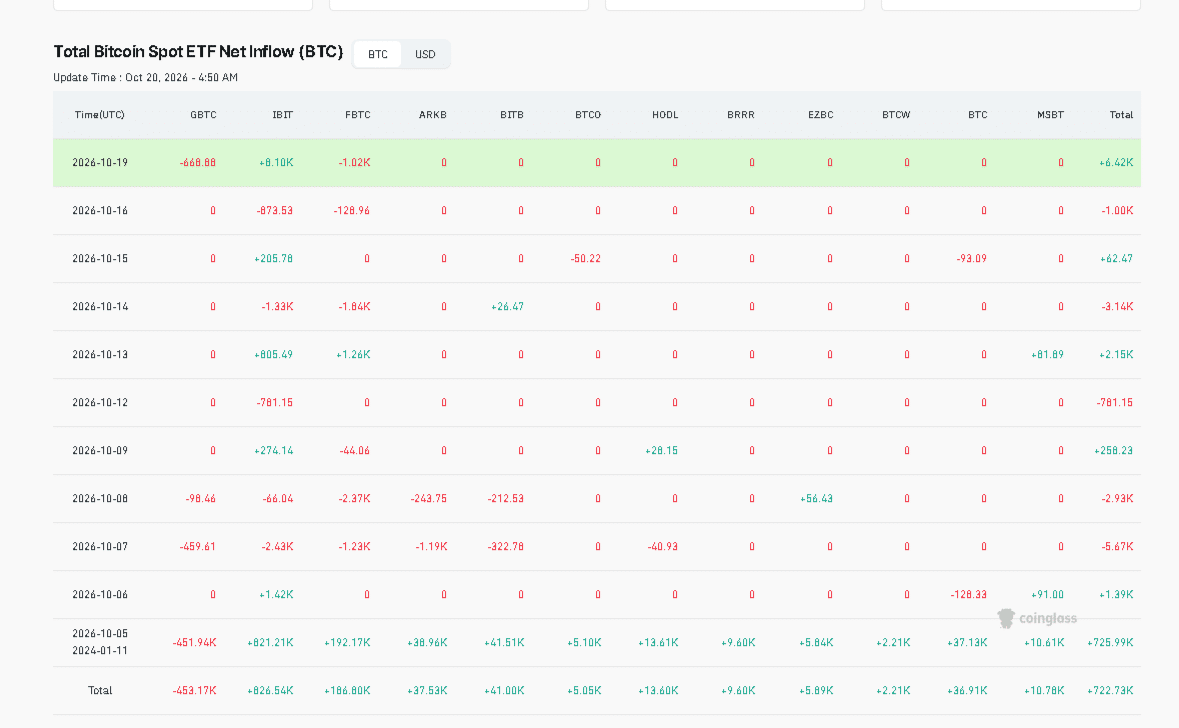
BlackRock's iShares Bitcoin Trust (IBIT) took in $665.2 million on October 19, yet US spot Bitcoin ETFs collectively recorded a smaller $526.7 million net inflow for the day. Withdrawals from Fidelity's FBTC and Grayscale's GBTC erased $138.5 million of IBIT's haul, shifting attention away from the eye-catching fund-level figure and toward how concentrated the rebound actually was.
According to data from CoinGlass, the industry total marked the strongest single-day inflow since September 22, when the funds attracted $714.7 million. It also reversed the $82.4 million net outflow recorded on October 16. The central tension in the data: a strong day for Bitcoin ETF inflows, driven overwhelmingly by a single fund.
That concentration matters when assessing whether buying is spreading across the market or gathering in one product. Because issuers report creations and redemptions every trading day, these net-flow tallies serve as a regularly published gauge of demand for spot Bitcoin products — which is why the distribution behind a headline number can matter as much as its size. Bitcoin ETF inflows are often viewed alongside demand across other crypto funds, but October 19's fund-level figures make the narrow distribution especially clear.
Why IBIT's Inflow Exceeded the Market Total
The $526.7 million industry figure is a net total: it combines money flowing into funds with redemptions from others. A single fund can therefore post a larger inflow than the group's final result when withdrawals elsewhere reduce its contribution.
That is exactly what happened on October 19. IBIT's $665.2 million inflow was offset by $83.6 million in withdrawals from FBTC and $54.9 million from GBTC. Together, those redemptions reduced the combined result by $138.5 million, leaving the sector with $526.7 million in net inflows.
The primary report said other funds recorded no net flows that day. The headline figure therefore belongs to IBIT, while the smaller aggregate captures the result after the reported withdrawals from Fidelity and Grayscale were netted against it.
A Rebound After Two Weeks of Net Withdrawals
October 19's positive result followed a volatile stretch. US spot Bitcoin ETFs posted net weekly withdrawals in each of the two preceding weeks: roughly $229 million in the week before October 19 and $681 million in the week before that, according to the report.
The funds also recorded $483.9 million in outflows on October 7, their largest daily withdrawal since June. The October 19 inflow reversed the previous session's $82.4 million outflow, but the month's running total remained about $88 million negative after Monday's trading.
That sequence puts the rebound in context: the strongest daily inflow since September 22 followed consecutive weeks of net withdrawals and a sharp single-day sell-off earlier in October. A useful way to read the figures is to separate Monday's session strength from the month's broader flow pattern — earlier outflow streaks show why a single session fits into a longer-running flow picture.
Fidelity's Wise Origin Bitcoin Fund trades under the ticker FBTC, while GBTC refers to Grayscale Bitcoin Trust. Their October 19 redemptions are not incidental to the aggregate; they explain why the market's net intake came in lower than IBIT's standalone inflow.
How Broad Was the October 19 Rebound?
The largest Bitcoin ETF (Blackrock) just had its biggest inflow since the start of 2026. The only recent IBIT net inflow this large was a few months ago in August. bitcoin:native rallied +20% from $69k to $87k in the weeks that followed. pic.twitter.com/4fkwDML4F8
— Luke Martin (@VentureCoinist) October 20, 2026
The day was positive for the ETF group as a whole, but the positive flow was concentrated. IBIT's $665.2 million exceeded the $526.7 million net total across all funds, with reported withdrawals from FBTC and GBTC accounting for the difference. As the post above notes, IBIT is the largest Bitcoin ETF — a scale that allows a single session from one fund to effectively set the group's direction, as it did here.
For Bitcoin, ETF flows offer a clear measure of activity in investment products holding spot BTC. But this session's distribution tells a more specific story than a broad-based surge: one BlackRock fund supplied the inflow, while Fidelity and Grayscale moved in the opposite direction.
That distinction is why the headline requires qualification. IBIT delivered a standout day, and the wider ETF complex finished positive — but the flows were not evenly distributed across providers. The figures worth tracking from here are the coming daily disclosures: whether inflows broaden beyond a single issuer, and whether the remaining October sessions trim the month's roughly $88 million net shortfall.
Data: CoinGlass. Source: 99Bitcoins.

