Hyundai Motor to launch more than 100 vehicle models by 2030
Key Takeaways
- •Hyundai plans more than 100 model launches globally by 2030, including 58 in North America, about 49 in South Korea and around 41 in Europe.
- •The company raised its 2030 annual sales target to 5.55 million units and expects electrified vehicles to make up 60 percent of sales.
- •Hyundai is targeting an operating profit margin above 9 percent by 2030 and plans to reduce its cost of goods sold ratio by 3 percentage points.
- •In Europe, Hyundai expects annual EV sales to increase from 116,000 to more than 420,000 units and may expand manufacturing capacity to about 580,000 units.
- •Hyundai will begin supplying Ioniq 5 robotaxis to Waymo in the fourth quarter and aims to deploy Boston Dynamics’ Atlas robot on production lines by 2028.
Hyundai Motor Co. unveiled its most ambitious product expansion to date, targeting more than 100 model launches worldwide by 2030 across North America, South Korea and Europe.
Supported by improving profitability, the automaker said the broad rollout will help drive its transition into a physical AI-driven technology company.
At a CEO Investor Day event in Seoul on Wednesday, Hyundai Motor Co. President and CEO Jose Munoz said 58 of the new models will be launched in North America, including 22 Genesis models. Korea is set to receive about 49 model launches, while Europe will see around 41.
Hyundai is also preparing new vehicle introductions in India and China, while planning to enter additional market segments with more than 18 new models, including pickups, light commercial vehicles and large SUVs.
Over the next eight months, seven new or upgraded vehicles will debut globally, among them the all-new Elantra sedan, the all-new Ioniq 3 SUV, the Tucson Hybrid SUV, the Santa Fe Extended Range Electric Vehicle, a new A-segment SUV EV for India and European B-segment SUVs. The near-term slate underscores how Hyundai is spreading launches across internal combustion, hybrid and electric models rather than relying on one powertrain as it pushes into more segments and regions.
The aggressive product push follows a temporary slowdown caused by months of labor disputes. On Tuesday, however, the automaker reached a tentative agreement with its union.
Munoz also reiterated Hyundai’s updated operating profit margin target, calling for a move from the 8 to 9 percent range to above 9 percent by 2030. Chief Financial Officer Lee Seung-jo said the company plans to cut its cost of goods sold ratio by 3 percentage points over the same period through vehicle lifecycle cost innovation, material cost reductions and localization.
Hyundai has also raised its annual sales target from an initial 4.1 million units to 5.55 million units by 2030. Electrified vehicles are expected to account for 60 percent of total sales, and global market share is projected to reach 6 percent.
To support that expansion, Munoz said Hyundai will increase global production capacity by 1.27 million units, with growth led by North America, India, Korea, Saudi Arabia, Vietnam and Algeria. The company also plans to broaden its global sales footprint beyond Korea and North America.
Under its “build where you sell” localization strategy, Hyundai will raise US vehicle localization from 60 percent to 80 percent by 2030 and add more than 275 local partners. Hybrid sales are projected to continue rising, reaching 50 percent of total sales, up from 25 percent this year.
In Europe, Hyundai is focusing its EV strategy on the high-demand B- and C-segments, which account for more than 60 percent of regional sales. Munoz said EV sales are expected to rise from 116,000 to more than 420,000 units annually. To meet demand, European manufacturing capacity could expand to about 580,000 units, with full-electric EVs such as the Ioniq 3 making up more than half of output.
The company is also positioning India, its second-largest production hub outside Korea, as a key export base. Hyundai said the country offers more than a 15 percent global cost advantage and ships 30 percent of local production to more than 70 countries. With the opening of the Pune plant, annual production capacity will increase to 1.1 million units, supported by more than 90 percent local sourcing across 1,400 supplier partners.
Referring to Korea as Hyundai’s heart of manufacturing, Munoz said the new EV plant in Ulsan will begin operations in the second half of this year, starting with production of the recently launched Genesis GV90.
The facility is designed as a software-defined factory and integrates 108 advanced control systems, AI-driven quality inspection and manufacturing AI agents. Beginning in 2027, Hyundai will modernize Ulsan Plants 1 and 4 as part of its record 125 trillion won ($90.3 billion) domestic investment.
In China, the world’s largest and most competitive auto market, Hyundai plans to use group-wide resources to stabilize profitability and restore sales to more than 500,000 units by 2030. Its three-pillar strategy calls for relaunching the Ioniq EV lineup, expanding the dealer network to 484 locations and working with major local technology partners.
Munoz described China as a critical proving ground for Hyundai as it seeks to counter the growing global influence of Chinese automakers. He said the company will draw on the group’s deep vertical integration, expand in next-generation areas such as software-defined vehicles, robotics and robotaxis, and maximize its scale as the world’s third-largest automaker.
On future mobility and physical AI initiatives, Hyundai said it will begin supplying Ioniq 5 robotaxis produced at Hyundai Motor Group Metaplant America in Georgia to Waymo in the fourth quarter of this year. Its Motional joint venture plans to commercialize the robotaxi by late this year.
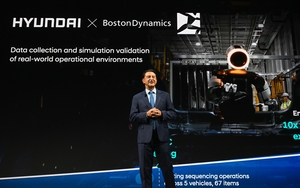
Hyundai is also advancing manufacturing AI with Boston Dynamics through its newly opened Robot Metaplant Application Center in the US, with a goal of deploying the Atlas humanoid robot directly onto HMGMA production lines by 2028.
To accelerate its software-defined vehicle strategy, the company is building a closed-loop “Data Flywheel” system that continuously collects data, optimizes AI models and deploys updates over the air.

