Hyundai chief eyes wider uses for Louisiana steel, from Atlas robots to SpaceX rockets
Key Takeaways
- •The $5.8 billion Louisiana electric arc furnace mill is Hyundai Steel's first US production base and is being developed jointly with Posco, Hyundai Motor and Kia.
- •Commercial operations are set to begin in 2029, with annual capacity of 2.7 million metric tons, including 1.8 million tons of automotive steel sheet.
- •Chung Euisun said the mill's steel could eventually be used in Boston Dynamics' Atlas humanoid robots and rockets for companies like SpaceX.
- •Chung stated that avoiding US steel tariffs was not the primary goal, emphasizing instead producing better products and improving vehicle quality in the US.
- •Hyundai Motor Group plans to deploy Atlas robots across its US vehicle plants in 2028 and is reorganizing to strengthen capabilities in actuators and grippers.
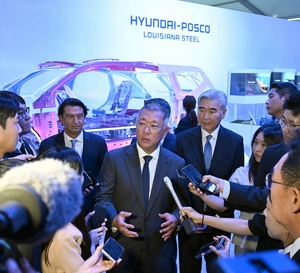
DONALDSONVILLE, Louisiana -- Hyundai Motor Group Executive Chair Chung Euisun said steel produced at Hyundai Steel's planned Louisiana mill could eventually serve purposes far beyond automobiles, potentially finding its way into Atlas humanoid robots and even SpaceX rockets.
"I think it should certainly be used," Chung told reporters Friday after the ceremonial groundbreaking event for Hyundai-Posco Louisiana Steel, when asked whether the steel could be used for Atlas, the humanoid robot developed by Hyundai Motor Group subsidiary Boston Dynamics, the US robotics company the group acquired majority control of in 2021.
"I hope that as we continue our work here, we will be able to supply steel for rockets for companies like SpaceX," he added.
His remarks signal a long-term vision for the Louisiana mill, which will initially focus on automotive steel before expanding to supply a wide range of industries.
The $5.8 billion electric arc furnace plant -- a technology that melts scrap steel using electricity rather than coke-fired blast furnaces, and is associated with lower carbon emissions -- will be Hyundai Steel's first production base in the US and is being developed jointly with Posco, Hyundai Motor and Kia. Once commercial operations begin in 2029, the plant will have an annual production capacity of 2.7 million metric tons, including 1.8 million tons of automotive steel sheet and 900,000 tons for other applications.
Chung's remarks come as Hyundai Motor Group plans to deploy Atlas, a humanoid designed for industrial work, across its US vehicle manufacturing operations in 2028 before expanding its use to other plants. The company is one of several major players, alongside Tesla, Figure AI and others, racing to commercialize humanoid robots for factory work.
Asked whether Atlas could eventually work inside the Louisiana steel mill itself, Chung was more cautious.
"That's something we will first test extensively, and if it looks feasible, we will move forward with it," he said. "Since Atlas is ultimately intended to take on tasks that are difficult for humans, we plan to deploy robots in demanding or hazardous environments to help improve worker safety."
Chung also offered a glimpse into the group's efforts to accelerate Atlas' development. He said Hyundai Motor Group has been reshaping its organization and management structure to adopt new technologies more quickly as competition in humanoid robots intensifies. The group is also strengthening its capabilities in key components such as actuators, which generate robotic movement, and grippers, which function as robotic hands.
"We are reorganizing so that we do not fall behind competitors in areas such as actuators and grippers," Chung said, noting that development could accelerate once the new organizational structure is in place.
Beyond robotics, Chung emphasized that the Louisiana mill represents an important step in Hyundai Motor Group's effort to secure a local supply of high-quality steel for its expanding US manufacturing operations. He said the US imports roughly 20 million tons of steel annually, with about half consisting of higher-value products, including specialty and lower-carbon steel. Producing more of those materials domestically could benefit both the US economy and Hyundai Motor Group as it seeks to improve the quality of vehicles manufactured in the country, Chung said.
Chung, however, played down suggestions that avoiding US steel tariffs was the primary reason for the investment. The US currently imposes a 50 percent tariff on foreign steel.
"Tariffs were not our goal," he said. "What is more important is producing better products here and improving the quality of the vehicles we manufacture."
When asked how much Hyundai Motor Group stands to save on tariffs by producing locally, Chung said it was hard to put a precise figure on it because trade policies continue to change.
The Louisiana project also marks a rare partnership between South Korea's two biggest steelmakers, Hyundai Steel and Posco, which traditionally competed in the domestic market. Chung said Posco's technological capabilities and global standing made it a natural partner for the project.
"Posco is one of the world's leading steelmakers, and we have worked together in many areas," Chung said. He said the companies have also held discussions on future steel technologies and next-generation batteries. By combining their expertise in Louisiana, the companies could develop higher-quality and more technologically advanced materials, he said.
"I believe it can be a win-win," Chung said.
For now, Hyundai Motor Group's priority is ensuring the success of the Louisiana project rather than pursuing another overseas steel mill.
"We have only just started in Louisiana, so the most important thing is to make this project successful," said Chung. "At this point, we are not considering another region."
