Hyundai E&C Tests Water-Spraying Drone for Dust Suppression at Demolition Site
Key Takeaways
- •Hyundai E&C successfully tested a tethered water-spraying drone for dust suppression at the Gwacheon Jugong Complexes 8 and 9 redevelopment project in Gyeonggi Province.
- •The drone can spray up to 50 liters of water per minute across a 12-to-15-meter radius and operates without flight time or water capacity limitations due to its tethered connection to a power cable and water hose.
- •The technology is expected to improve worker safety and efficiency by replacing conventional dust-control methods that carry risks such as slips, electric shock, and collisions with heavy machinery.
- •The drone test is part of broader smart construction research at the HMG Construction Technology Research Institute, which is developing AI, robotics, automation, and digital systems as one of its four core priorities.
- •Hyundai E&C's expansion into site robotics aligns with a wider trend among South Korean construction firms responding to an aging workforce and stricter environmental and safety regulations under laws such as the Clean Air Conservation Act.
Published Aug 4, 2026, 2:40 pm KST
Hyundai Engineering & Construction (Hyundai E&C) announced it is expanding the deployment of unmanned robots for environmental and safety management at construction sites after successfully completing a field test of a water-spraying drone designed to suppress dust during demolition operations.
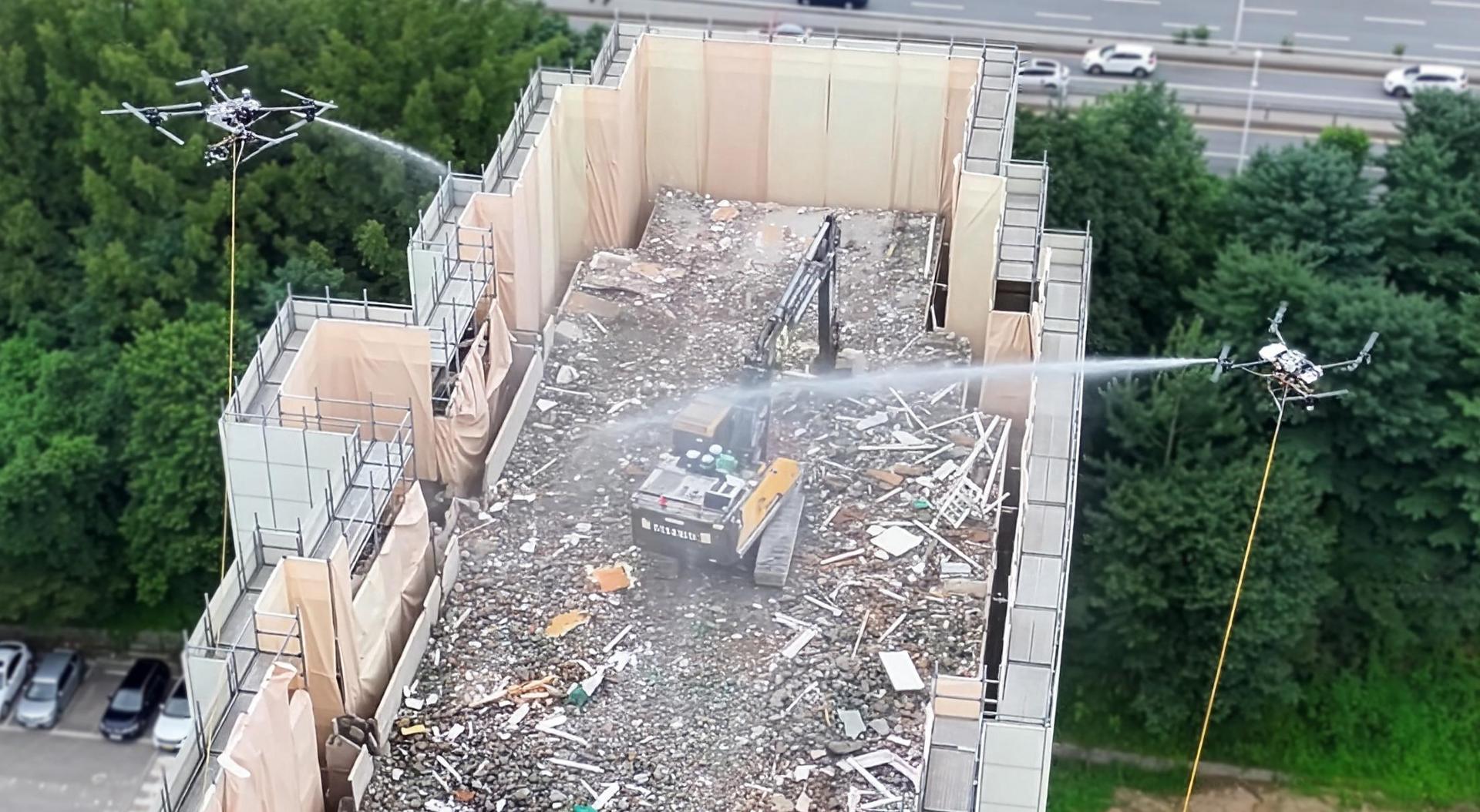
The test was carried out at the Gwacheon Jugong Complexes 8 and 9 redevelopment project in Gwacheon, Gyeonggi Province. Hyundai E&C evaluated the drone's performance, flight stability, and operational compatibility alongside demolition workers in an active work environment.
Demolition sites face a dual challenge of reducing airborne dust while maintaining worker safety. Dust suppression is a critical component of environmental management at such locations, yet conventional water-spraying methods can introduce their own hazards, including slip risks, electric shock, and collisions with heavy machinery. These dangers are amplified in hard-to-reach areas such as upper floors or structurally unstable sections where workers and conventional equipment face difficulty operating.
During the test, Hyundai E&C deployed the drone over dust-generating zones, spraying up to 50 liters of water per minute across a radius of 12 to 15 meters under windless conditions. Because the drone is tethered directly to a power cable and water hose, it is not constrained by flight time or water capacity. Operators can adjust the spray location and range in real time to target shifting dust sources as demolition progresses, enabling flexible operations throughout the work cycle.
The company said it expects the drone to improve both safety and efficiency compared to conventional dust-control methods such as water trucks or fixed suppression equipment, given that it can be operated remotely with minimal worker proximity and is not restricted to a fixed location.
"This test confirmed the drone's potential for use at demolition sites, and we plan to apply it at a range of sites and demolition processes going forward," a Hyundai E&C official said.
"Hyundai E&C is actively introducing smart construction technologies, including wearable robots, material transport robots and cleaning robots, while continuing to run field tests. Based on this, we will lead the way in creating a safer, more sustainable construction environment," the official added.
The water-spraying drone test forms part of broader research underway at the HMG Construction Technology Research Institute, the integrated research and development organization established by Hyundai E&C and Hyundai Engineering. The institute has identified "smart construction that improves safety and quality and prevents human error through AI and robotics" as one of its four core research priorities and is developing technologies across AI, robotics, automation, and digital systems.
Its additional smart construction technologies include a ground-operated tower crane, the four-legged robot Spot, and unmanned drone stations, all designed to enhance worker safety and site efficiency.
Hyundai E&C's push into site robotics aligns with a broader trend among major South Korean construction firms responding to an aging workforce and tightening environmental and safety regulations. Dust generated during demolition and construction is subject to controls under South Korea's Clean Air Conservation Act, and operators face growing pressure to reduce both particulate emissions and workplace hazards. Tethered drone platforms, which address the flight-time limitations that have restricted battery-powered drones in sustained industrial tasks, are being explored for applications ranging from aerial inspection to firefighting worldwide.
As the R&D arm consolidating the construction-sector capabilities of Hyundai Motor Group, the institute said it plans to serve as a hub for construction and infrastructure technology, supporting the group's vision of becoming a "smart mobility solutions provider."

