Big Tech on Track to Spend $735 Billion on AI Data Centers in 2026
Key Takeaways
- •The four largest hyperscalers are expected to spend roughly $735 billion on AI data center infrastructure in 2026.
- •Goldman Sachs estimates global AI infrastructure capital expenditure could approach $1 trillion this year, with US spending between $630 billion and $745 billion.
- •Amazon, Alphabet, Microsoft and Meta are the main spenders, and their combined buildout has exceeded $1 trillion since 2023.
- •Industrial suppliers, semiconductor firms and electricity producers are positioned to benefit from the data center expansion.
- •More than $130 billion in AI data center projects were blocked or delayed in the first quarter of 2026 amid local opposition.
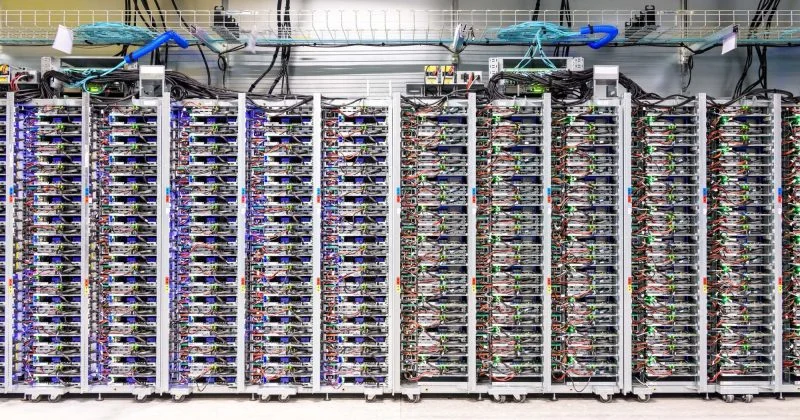
The four largest hyperscalers are on course to collectively pour roughly $735 billion into AI data center infrastructure in 2026 alone, according to projections for the year, as they compete to build out the compute capacity needed to train and run large-scale AI models.
Goldman Sachs estimates that global capital expenditure on AI infrastructure could approach $1 trillion this year. The US portion of that spending falls between $630 billion and $745 billion, with Big Tech companies responsible for the majority of it.
Where the money is coming from
Amazon leads the group, with plans to deploy approximately $200 billion in capital spending. Alphabet follows closely, targeting between $175 billion and $205 billion. Microsoft is expected to surpass $120 billion, while Meta, which had previously guided toward $70 billion, has raised its spending ambitions considerably.
The budgets span land acquisition, building construction, power and cooling systems, and the racks of AI servers that ultimately fill the facilities. Taken together, the top four hyperscalers will have spent more than $1 trillion on this buildout since 2023.
The industrial suppliers behind the buildout
A range of lesser-known industrial firms sits squarely in the supply chain. Vertiv specializes in cooling and power management for data centers. Quanta Services handles the electrical infrastructure and grid connections that every new facility requires, while Comfort Systems provides HVAC solutions for the climate-control demands of compute-dense environments.
The biggest single line item inside each facility, though, is the AI accelerators and servers themselves, which has pulled semiconductor suppliers into the boom alongside the construction and engineering firms.
Power producers also stand to gain. Vistra, one of the largest US electricity generators, is positioned to benefit as data centers consume ever-larger portions of the grid. Data centers accounted for roughly 4% of US electricity use in 2023, according to federal energy analysts, who project that share could climb as high as 12% by 2028. Hyperscaler executives, for their part, have repeatedly identified power availability, rather than chip supply, as a leading constraint on how quickly new capacity can come online.
Community pushback
Not every community welcomes the expansion. More than $130 billion worth of AI data center projects were blocked or delayed in the first quarter of 2026 amid local opposition. Residents and municipalities have pushed back against the noise, water usage, and energy demands that massive compute facilities bring to their neighborhoods.
Responses vary by jurisdiction: some have imposed moratoriums on new data center construction, while others are fast-tracking approvals in hopes of capturing economic benefits. How that balance between local opposition and economic incentive resolves will help shape where, and how quickly, the projected spending can actually be deployed.
Implications for crypto mining
The AI infrastructure boom also carries significant implications for crypto mining operations, which compete for many of the same resources, including cheap electricity, cooling capacity, and grid access. Several publicly traded mining companies have already pivoted partially toward AI hosting, citing the recognition that renting out GPU capacity for AI workloads can be more profitable per megawatt than mining Bitcoin.
For the buildout as a whole, the next checkpoints are quarterly updates to company capital-spending guidance and how quickly AI-related cloud revenue grows relative to the outlays that support it.

