Hyperliquid Whale Wallets Stake More Than $204M in HYPE Within 24 Hours
Key Takeaways
- •Two whale wallets collectively staked more than $204 million in HYPE tokens on Hyperliquid within 24 hours, locking the tokens into network validation rather than liquid trading.
- •One whale operating across 19 wallets staked 2.93 million HYPE worth approximately $172 million, representing tokens acquired nine months earlier at an average entry price of $44 with nearly $44.5 million in unrealized profit.
- •A second whale staked $32.87 million worth of HYPE received through institutional prime brokerage FalconX, directing the entire amount into staking without any intermediate trading activity.
- •HYPE was trading at $57.92 with weakening technical indicators, including a broken ascending trendline, an RSI of 38.97, and price positioning below both the Ichimoku Tenkan-sen and Kijun-sen lines.
- •Neither staking wallet showed on-chain activity indicating plans to unstake or sell in the near term, potentially tightening available sell-side liquidity for a token with declining daily trading volume.
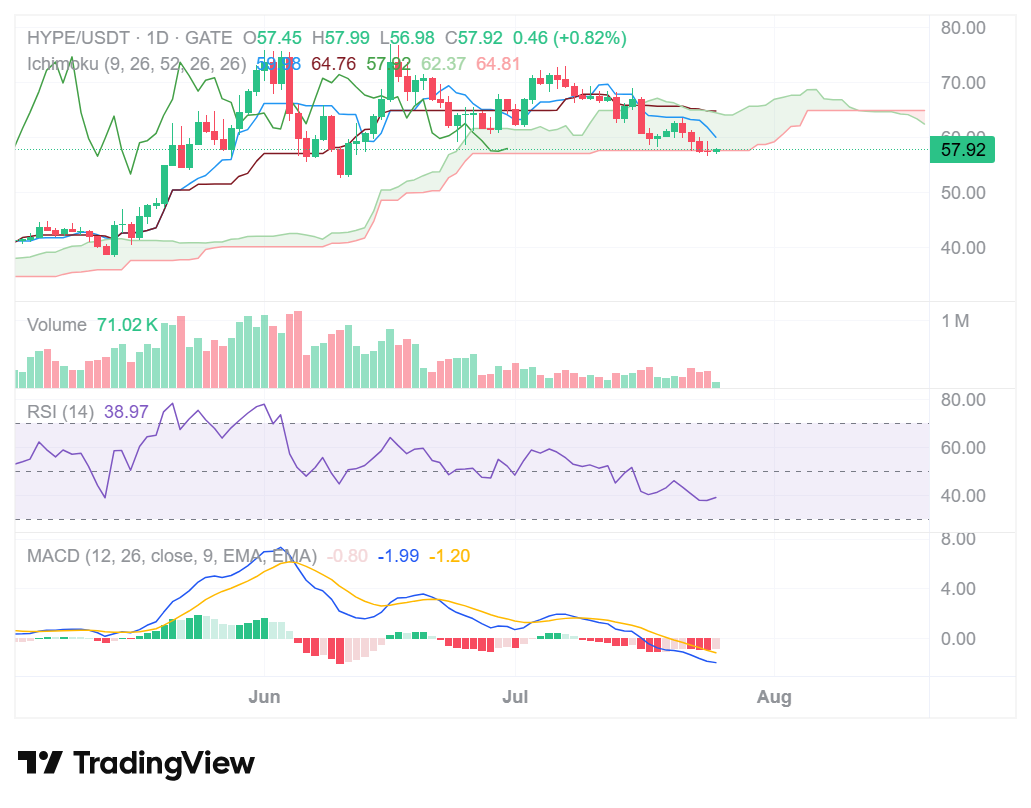
Whale wallets associated with Hyperliquid staked more than $204 million worth of HYPE tokens within a 24-hour period, while the token traded near a key support area around $57. The activity stands out because it comes during a period of weakening price structure, creating a contrast between large-holder conviction and short-term bearish technical signals.
Hyperliquid is a decentralized perpetual futures exchange operating on its own Layer 1 blockchain. HYPE serves as the network's native token, and staking it helps secure the Hyperliquid Layer 1 through its proof-of-stake consensus mechanism, meaning the whales' decision to stake rather than sell directly participates in network validation while locking tokens out of liquid trading.
One whale, spread across 19 separate wallets, staked 2.93 million HYPE valued at roughly $172 million. The tokens were acquired nine months ago at an average entry price of $44, leaving the position with nearly $44.5 million in unrealized profit at the time of the report. Rather than selling, the wallet moved the full position into staking.
A second whale contributed another $32.87 million in staking activity after receiving 557,902 HYPE through FalconX, an institutional digital asset prime brokerage, and staking the entire amount on Hyperliquid.
Hyperliquid Whale Wallets Choose Staking Instead of Selling
On-chain trader Wise Crypto flagged the activity on X, saying the size of the staking was notable because of the unrealized gains involved. The first whale's use of 19 wallets indicates the holdings were distributed across multiple addresses rather than concentrated in a single wallet.
Whale conviction on $HYPE just hit another level. A single whale (spread across 19 wallets) staked 2.93M $HYPE worth $172M on Hyperliquid over the last 24 hours. What's even crazier? Those tokens were accumulated 9 months ago at an average entry of $44 and are now sitting on… pic.twitter.com/Xbd8BlfXrZ — Wise Crypto (@WiseCrypto_) July 25, 2026
The source X post is available at https://x.com/WiseCrypto_/status/2080890053069513152?ref_src=twsrc%5Etfw.
The nine-month holding period through market swings, followed by a move into staking rather than selling, was presented by Wise Crypto as evidence of continued positioning in the token. The second wallet's activity occurred shortly after it received funds through FalconX, with the tokens sent directly into staking and no trading activity in between.
Together, the two wallets accounted for more than $204 million in new staking activity in one day. Wise Crypto described the pattern as "smart money" adding to positions rather than exiting them.
Staking removes tokens from immediate circulating supply, which can reduce available sell-side liquidity on exchanges. For a token whose daily trading volume has been declining, the removal of over $200 million worth of HYPE from circulation through staking represents a notable shift in available supply. According to the report, neither wallet had shown on-chain activity indicating plans to unstake or sell in the near term.
HYPE Price Structure Weakens After Trendline Break
Chart analyst The Boss said HYPE had broken below an ascending trendline that had supported the token's recovery in recent weeks. According to the analysis, the break shifted the short-term market structure in favor of sellers.
🔷️ $HYPE 's chart has entered a different phase after losing one of its most important structural supports. 📉 The ascending trendline that guided the recovery has now been broken, shifting the short-term market structure in favor of sellers. Since that breakdown, every… pic.twitter.com/xVIqdn5Opr — The Boss (@CryptoTheBossX) July 25, 2026
The source X post is available at https://x.com/CryptoTheBossX/status/2080877076794458159?ref_src=twsrc%5Etfw.
Since the breakdown, each rebound has struggled to hold, while a broader descending resistance line has continued to limit attempts to move higher. The analysis said HYPE buying pressure had weakened compared with the previous rally phase.
The Boss also noted that a horizontal demand area was being tested. If buyers defend that zone, the pullback could develop into consolidation rather than a deeper decline. If HYPE fails to reclaim the broken trendline, the analysis said the market would remain exposed to further weakness until a new accumulation base forms.
The divergence between whale staking inflows and the deteriorating price structure highlights the tension between on-chain accumulation signals and chart-based momentum. Whether the staked supply reduction meaningfully tightens available liquidity will depend on overall trading volume and whether additional holders follow a similar path.
HYPE Price Analysis: Support and Resistance Levels
HYPE was trading at $57.92 at the time of the report, extending a short-term downtrend after failing to move through the $65 to $70 resistance zone. The daily chart showed lower highs and lower lows over the previous two weeks.
The token's price was below the Ichimoku Tenkan-sen at $59.08 and the Kijun-sen at $64.76, which the report said indicated bearish momentum. Immediate support was identified at $57 to $58, with secondary support at $55 and a major support zone at $52 to $53.
The RSI stood at 38.97, below the neutral 50 level and approaching oversold territory. A move back above the 45 to 50 range would strengthen the case for a bounce, according to the analysis.
The MACD line remained below its signal line, although narrowing histogram bars suggested that downside momentum may be slowing. Trading volume had declined steadily since the rally toward $70, and the report said a sustained recovery would likely require stronger volume along with a break above nearby resistance.

