Hyperliquid Revenue Tops $1.4 Billion as $HYPE Momentum Weakens
Key Takeaways
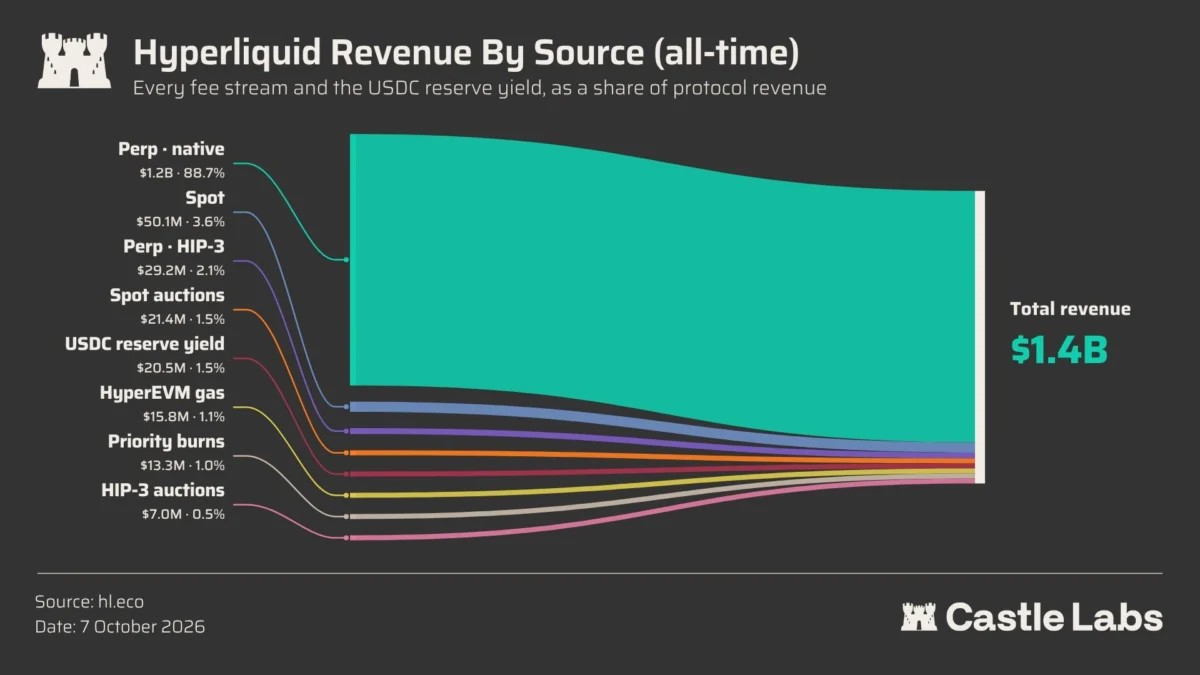
- •Hyperliquid has generated over $1.4 billion in cumulative protocol revenue and spent more than $1.26 billion on open-market $HYPE repurchases, according to an October 8 Castle Labs report.
- •Approximately 95% of fees from HyperCore trading, Builder Codes, and HIP-3 markets are directed toward $HYPE repurchases, and Hyperliquid is estimated to control more than 56% of the onchain perpetual futures market by open interest.
- •Builder Codes have produced more than $25 million in cumulative revenue for Phantom and over $10.5 million for MetaMask, giving third-party wallets a commercial incentive to route order flow to Hyperliquid.
- •$HYPE trades around $84.41, down roughly 13% from its late-September peak near $97, while aggregate derivatives open interest of about $2.4 billion declined 1.95% over 24 hours.
- •OpenETF launched a testnet on October 6 for tokenized investment funds trading portfolios on Hyperliquid, but it currently uses test assets and has not announced a mainnet launch date.
Hyperliquid Revenue Tops $1.4 Billion as $HYPE Momentum Weakens
Hyperliquid has generated more than $1.4 billion in cumulative protocol revenue, reinforcing its position in decentralized derivatives even as its native $HYPE token retreats from recent highs. An October 8 research report from Castle Labs found that the protocol has spent over $1.26 billion on open-market $HYPE repurchases, and the same report estimates that Hyperliquid controls more than 56% of the onchain perpetual futures market by open interest.
The figures arrive alongside a less favorable short-term trading picture. $HYPE was quoted at $84.41 on October 10, while derivatives open interest fell 1.95% over the preceding 24 hours. In a separate development, OpenETF's October 6 testnet launch shows how Hyperliquid's infrastructure is being adapted for tokenized investment products rather than direct derivatives trading alone.
A Buyback Model That Extends Beyond the Exchange
Castle Labs attributes much of Hyperliquid's growth to a combination of trading infrastructure, third-party distribution and token economics. According to the report, approximately 95% of fees collected through activities including HyperCore trading, Builder Codes and HIP-3 markets are directed toward $HYPE repurchases, creating a direct relationship between fee generation and purchases of the native token.
Even so, the cumulative buyback total does not reveal how much buying demand the protocol is generating at present. The distinction matters, because a historical spending figure cannot establish whether current purchases are sufficient to offset market selling.
The distribution side of the model offers a clearer indication of how the protocol has expanded its commercial reach. Through Builder Codes, third-party applications can route trades to Hyperliquid and collect additional fees on eligible orders. Hyperliquid's documentation confirms that these fees are processed onchain and require user authorization, with builder fees capped at 0.1% for perpetual futures and users able to revoke their approvals.
Castle Labs identifies two major beneficiaries of this arrangement:
- Phantom: more than $25 million in cumulative Codes revenue
- MetaMask: more than $10.5 million in cumulative Builder Codes revenue
These earnings are significant because they demonstrate an established commercial incentive for wallets to distribute Hyperliquid's trading products. Rather than requiring every user to interact with its native trading interface, Hyperliquid can receive order flow from applications that already command their own audiences. For wallet providers, derivatives trading becomes an additional source of transaction-based revenue.
The resulting competition is increasingly about distribution as well as execution quality. Hyperliquid benefits when integrated applications attract traders, but its position also depends on those applications continuing to route activity through the protocol.
$HYPE Retreats as Derivatives Exposure Contracts
The protocol's revenue milestone has not prevented a correction in $HYPE's market price. On the Coinbase daily chart, $HYPE trades at approximately $84.41, down about 13% from its late-September peak near $97. An early-October recovery approached $95 before losing momentum, leaving the token below its previous high.
The 14-day Relative Strength Index (RSI) stands at 44.82, compared with its displayed moving average of 52.35. With the indicator below 50, recent price momentum favors sellers; however, the reading remains above the conventional oversold threshold of 30. The chart shows a pullback and weakening momentum, but it does not establish a confirmed support test or reversal.
Derivatives positioning provides additional evidence of changing market participation. The October 10 snapshot places aggregate $HYPE open interest at approximately $2.4 billion, down 1.95% over 24 hours. Hyperliquid accounts for the largest share of that exposure, followed by Binance and Bybit. The exchange represents roughly 70% of the listed $HYPE derivatives exposure, making it the dominant venue for trading leveraged positions in its own token.
That concentration differs from Castle Labs' broader market-share estimate, which measures open interest across onchain perpetual futures markets rather than $HYPE contracts specifically. The decline in aggregate open interest indicates that outstanding positions have contracted, but it does not by itself identify whether traders are closing long positions, reducing shorts or adjusting hedges. A more conclusive assessment would require funding-rate and liquidation data alongside the price chart.
OpenETF Tests Tokenized Portfolio Management
Beyond the exchange's existing derivatives business, developers are experimenting with products that use Hyperliquid as underlying financial infrastructure. According to information from Binance, OpenETF launched a testnet on October 6 that allows managers to create tokenized investment funds backed by portfolios traded on Hyperliquid. According to the launch report, each fund includes publicly defined terms and ERC-20-compatible share tokens held in investors' wallets.
The architecture separates fund ownership from portfolio execution. On HyperEVM, smart contracts issue shares and handle subscriptions, redemptions and related payments, while on HyperCore the corresponding vault operates as the account used to trade the fund's portfolio. Managers direct trading activity without receiving the vault's trading keys.
The initial design sets a minimum subscription of 100 $USDC, although managers can establish a higher threshold. Managers must also purchase at least 100 $USDC in fund shares and commit to a minimum 5% ratio. Performance fees can range from 0% to 50%, with a 20% default, while annual management fees range from 0% to 2%, with a default of zero. Both rates become fixed after share issuance.
The testnet also includes a redemption adjustment fee that starts at 0.1% and rises with notional leverage, capped at 1%, with these fees remaining within the fund.
The model introduces a potential use case for Hyperliquid's trading infrastructure: investment products in which token holders own fund shares while designated managers execute the underlying strategy. The distinction between a working testnet and a live financial product remains essential, however. OpenETF currently uses test assets without monetary value and explicitly warns against depositing real funds, and the project has not announced a mainnet launch date. There is consequently no basis to attribute live fund inflows, assets under management or additional protocol revenue to OpenETF at this stage.
What Matters After the Revenue Milestone
Hyperliquid's reported financial performance shows that it has established a substantial fee-generating derivatives business, supported by a distribution network that includes major wallet applications. The more immediate question for $HYPE is whether current trading activity can sustain the pace of token repurchases while market positioning remains weaker.
Three indicators will help clarify that relationship: the rate of new protocol revenue, the value of ongoing buybacks and whether derivatives open interest stabilizes alongside price. OpenETF adds another potential source of future activity, although its economic contribution cannot be assessed until a live deployment attracts users and capital.
For now, Hyperliquid's cumulative revenue is established, its distribution model is producing measurable results, and $HYPE's recent price action shows that those achievements have not eliminated short-term selling pressure.
Source: CryptoNewsNet

