Hyperliquid's HYPE Targets $115 as Tokenized Asset Trading Gains Momentum
Key Takeaways
- •HYPE has gained 274% since the start of the year, ranking among the strongest-performing large cryptocurrencies amid rising demand for decentralized derivatives and tokenized real-world assets.
- •Hyperliquid's HIP-3 permissionless perpetual futures markets processed a monthly volume peak of approximately $115 billion in June, with open interest climbing to nearly $4 billion the following month.
- •CFTC Chairman Michael Selig said the agency is preparing markets for large-scale tokenization and 24/7 trading, but his remarks did not constitute regulatory approval for Hyperliquid or confirm US market access.
- •The SEC's temporary Innovation Exemption permits eligible platforms to test certain tokenized securities products under defined conditions, indicating US regulators are moving toward concrete frameworks for tokenized markets.
- •Analysts cited a medium-term HYPE price target of about $115, with the $88 area flagged as key support if profit-taking emerges near the $100 resistance level.
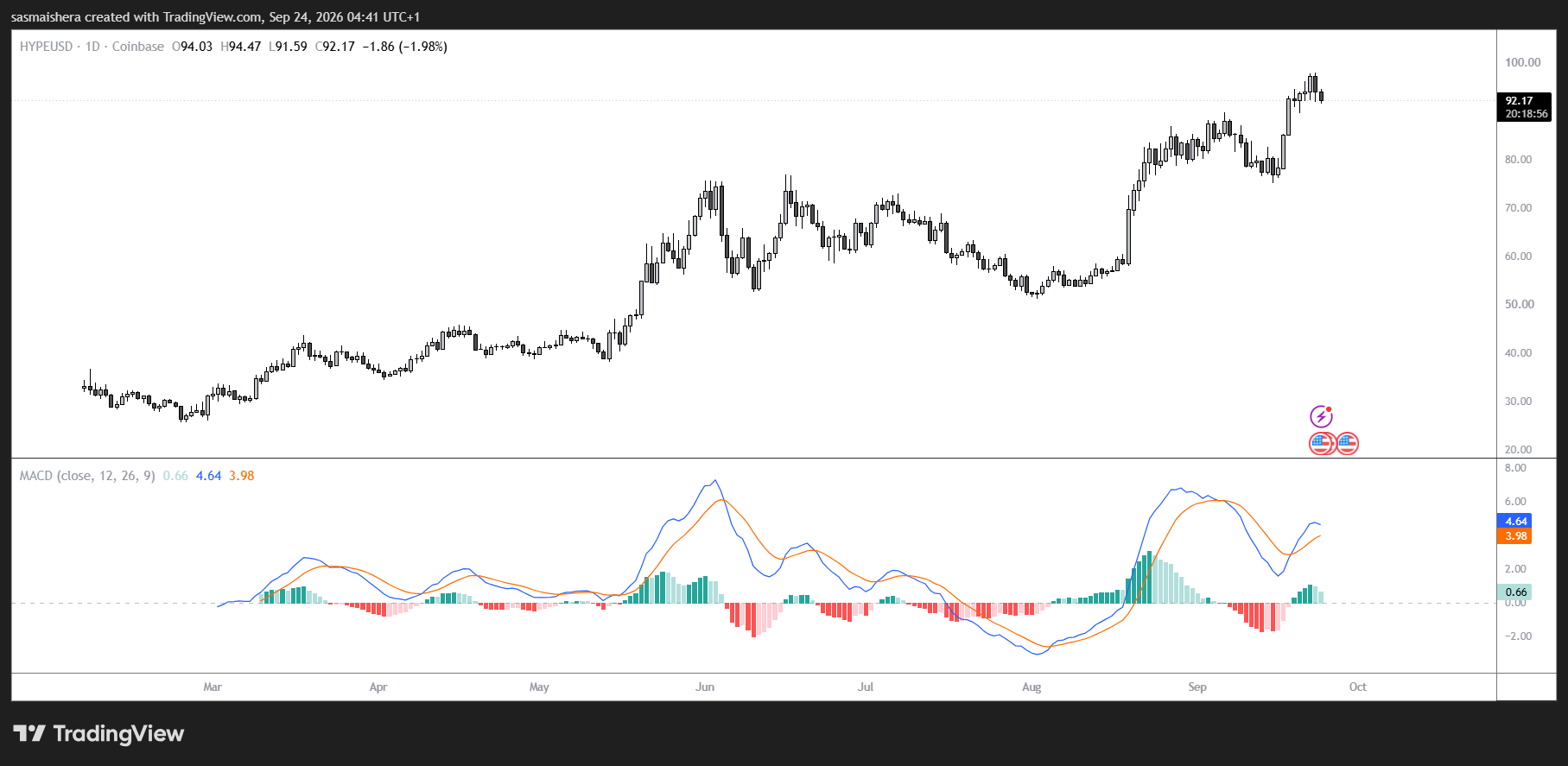
Hyperliquid's native token, HYPE, has risen 274% since the start of the year, ranking among the strongest-performing large cryptocurrencies as demand grows for decentralized derivatives and tokenized real-world assets.
The token recently approached the psychological $100 mark, a level underpinned by expanding activity across Hyperliquid's HIP-3 markets, which allow developers to deploy permissionless perpetual futures — including contracts tied to real-world assets. Commentary from Commodity Futures Trading Commission (CFTC) Chairman Michael Selig has further reinforced expectations that tokenization and round-the-clock markets will play a larger role in the US financial system. His remarks, however, did not constitute regulatory approval for Hyperliquid or confirm that the platform will be permitted to serve US customers.
US regulators for tokenized markets
Speaking at the 2026 Treasury Market Conference, Selig addressed the potential impact of tokenization, saying the CFTC is preparing financial markets for the arrival of large-scale tokenization, onchain finance, and 24/7 trading. He drew a parallel with the shift from floor-based hand signals to electronic markets.
“Just as the transition from hand signals to electronic trading advanced our financial system, I believe tokenization can do the same for all asset classes,” Selig said.
He added that the regulator is committed to developing clear, principles-based rules designed to support innovation while protecting market integrity.
The comments underscore growing interest among US regulators in blockchain-based markets. The Securities and Exchange Commission recently introduced a temporary Innovation Exemption that permits eligible platforms to test certain tokenized securities products under defined conditions. Taken together, the two efforts indicate that US regulators are moving from broad statements toward concrete frameworks for tokenized markets, even as final rules remain in development.
Tokenization converts ownership rights in assets such as stocks, bonds, or commodities into blockchain-based digital tokens. Proponents argue the technology can deliver faster settlement, fractional ownership, and continuous trading. Regulatory support could open opportunities for platforms offering real-world asset markets, but general statements backing the technology do not guarantee market access for any specific decentralized protocol. Hyperliquid would still need to satisfy applicable derivatives, securities, and customer-protection requirements before directly offering regulated services in the United States.
HIP-3 volume reaches $115 billion
HIP-3 has become a key growth driver for the Hyperliquid ecosystem. According to Hyperliquid Analytics, HIP-3 markets processed a recent monthly peak of approximately $115 billion in volume in June, and open interest continued climbing afterward, reaching nearly $4 billion last month.
Open interest measures the value of outstanding derivatives positions that have not been closed. Its increase suggests traders are maintaining sustained exposure to HIP-3 markets rather than generating only short-lived transaction volume. The combination of high volume and rising open interest points to deeper participation, and it may also create additional demand for HYPE, which plays a central role in the broader Hyperliquid ecosystem.
CoinMarketCap data cited in the original analysis gives Hyperliquid an 18% share of the decentralized trading segment, positioning it among the largest venues competing for the expansion of onchain derivatives.
Real-world asset perpetuals have broadened the platform beyond cryptocurrency markets, allowing traders to gain price exposure to traditional assets without directly owning them. While these products can increase accessibility, they also carry risks: perpetual contracts use leverage, do not necessarily grant ownership rights, and may depend on external price feeds to track the underlying asset accurately.
Can HYPE reach $115?
HYPE recently moved close to the long-standing $100 price target, bringing a major psychological resistance level into focus. Round-number thresholds often attract profit-taking because traders place sell orders around prominent levels. As a result, HYPE could experience a pullback after testing or briefly exceeding $100.
In such a correction, the former resistance area near $88 may provide the first meaningful support. A successful retest would indicate that buyers remain willing to enter at higher levels and could establish a foundation for the next advance.
The medium-term upside target cited in the analysis is approximately $115. The projection applies the length of HYPE's previous rally to estimate the possible size of its next move. A climb from $100 to $115 would represent a further gain of 15%. Reaching that level would require the token to absorb profit-taking and maintain demand as its year-to-date increase approaches 300%.
If HYPE falls below $88, the immediate bullish structure would weaken, and the market could enter a longer consolidation. Rising open interest also introduces liquidation risk should highly leveraged traders crowd into long positions.
Away from the price chart, regulatory developments offer a second thread to monitor: the CFTC's planned principles-based rules and the defined conditions of the SEC's temporary Innovation Exemption could shape the terms under which platforms such as Hyperliquid may eventually offer regulated services to US customers.
For now, HIP-3's expanding volume, growing open interest, and broader momentum behind tokenized markets underpin the bullish outlook. The decisive near-term test is whether HYPE can convert $100 from resistance into support and extend its advance toward $115.
Source: CoinJournal

