Hyperliquid (HYPE) Hits New All-Time High as Manual Borrowing Goes Live
Key Takeaways
- •HYPE reached a fresh all-time high on Friday of $92.01 before settling near $91.81, with daily gains reported between 10.57% and 12.29% and weekly volume growth of 10.50% to $1.65 billion.
- •Manual borrowing went live on Hyperliquid's HyperCore infrastructure, allowing users to pledge HYPE or BTC as collateral for USDC or USDT loans, with $269 million borrowed on day one against over $400 million in supplied liquidity.
- •Institutional access to the token expanded through a physically backed HYPE exchange-traded product listed on the Warsaw Stock Exchange and Payward, Kraken's parent company, announcing plans for U.S. distribution.
- •Hyperliquid's total open interest reached $14.3 billion, which the article presents as evidence the price move was supported by genuine trading and lending activity rather than pure speculation.
- •CoinMarketCap data indicates holding above the $88–$90 breakout zone could push HYPE toward $100, while a fall below risks a pullback toward $78, with a core-contributor token unlock scheduled for October 6, 2026 as the next catalyst.
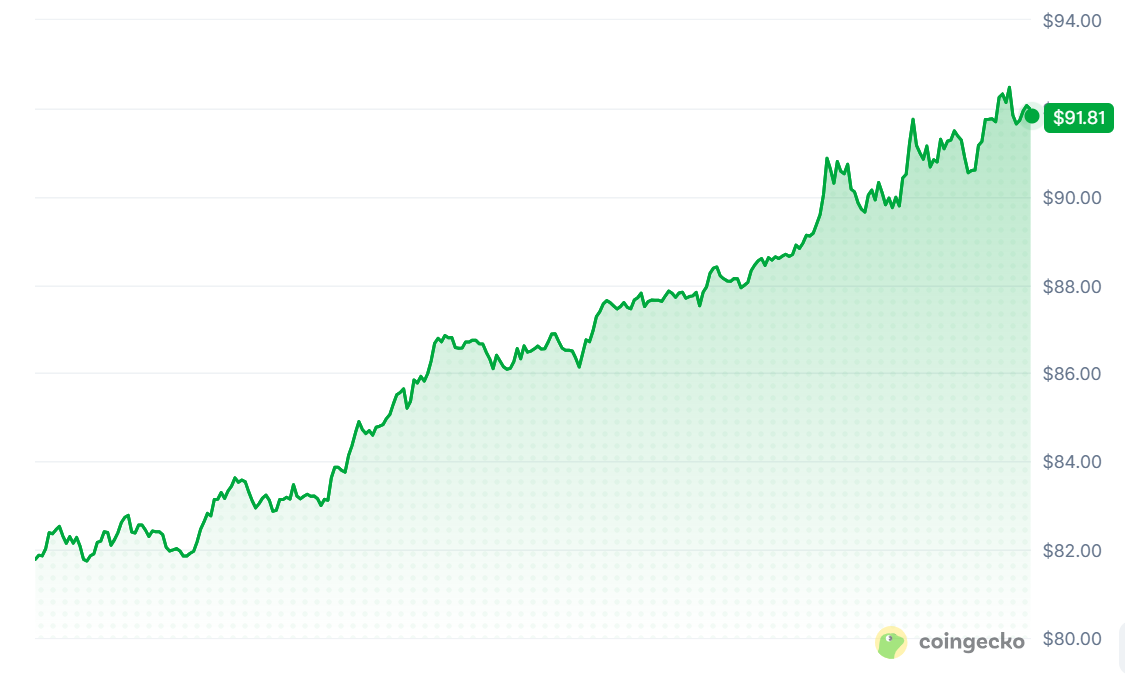
Hyperliquid's HYPE token climbed to a new all-time high on Friday, touching $92.01 before settling near $91.81, according to CoinGecko as of this writing.
The altcoin is up 10.57% for the day, while trading volume hit $1.65 billion, having risen 10.50% over the past week. Per CoinMarketCap, HYPE has outperformed the broader crypto market, which places the daily gain even higher, at 12.29%.
The rally is not happening in isolation. It coincides with the launch of a major new feature on Hyperliquid's network, along with a string of institutional developments that have put the platform back in the spotlight. Hyperliquid, a decentralized trading platform offering perpetual futures — derivative contracts without expiration dates that let traders take leveraged long or short positions — and spot markets, has increasingly positioned borrowing and lending as core parts of its on-chain infrastructure.
Institutional News and Heavy Platform Activity Converge
Two forces are driving the surge.
The first is institutional news. A physically backed HYPE exchange-traded product — a listed wrapper whose shares are backed by the underlying token held in reserve — has been listed on the Warsaw Stock Exchange, and Payward, the parent company of exchange Kraken, announced plans for U.S. distribution. Both moves signal growing mainstream financial interest in the token, giving traditional market participants more direct channels to gain exposure.
The second is elevated platform activity. Hyperliquid's total open interest — the combined value of derivative positions that have been opened but not yet closed — has reached $14.3 billion, reflecting heavy trading and lending activity across the exchange. That level of utility gave the price move fundamental backing rather than pure speculation.
Manual Borrowing Goes Live on HyperCore
The immediate catalyst, however, was a product launch: manual borrowing went live on Hyperliquid's HyperCore infrastructure. The feature runs on the same underlying infrastructure as the platform's portfolio margin system, tying the new borrow function directly into Hyperliquid's margin engine.
Users can now supply HYPE or BTC as collateral to borrow USDC or USDT directly on the platform. On day one, borrowers pulled $269 million in assets, with more than $400 million in supplied liquidity already available.
Manual borrows are live on Hyperliquid Portfolio margin and manual borrows use the same underlying HyperCore infrastructure, with $269M in assets borrowed today. Users can supply HYPE and BTC as collateral to borrow quote assets (USDC and USDT). Borrowed quote assets pay… pic.twitter.com/C3crESxaM0
— Hyperliquid (@HyperliquidX) September 18, 2026
Post source: https://x.com/HyperliquidX/status/2100838194317312446?ref_src=twsrc%5Etfw
How the Borrowing Mechanism Works
Unlike most platforms, which handle portfolio margin by simply marking to market value with a loan-to-value haircut, Hyperliquid built borrowing as its own standalone primitive. Every borrowed asset comes from an actual supplier, so risk stays contained within the lending system instead of spreading across the whole platform.
Hyperliquid founder Jeff described the approach as similar to how Amazon separated AWS from its retail business. He said the model lets infrastructure serve many applications instead of building everything as one tangled product. Portfolio margin, perpetual futures, and spot trading all now plug into the same underlying borrow and lend layer.
Most tech giants in the 2000s built their infrastructure and product as one entangled unit. Amazon had the foresight to separate out AWS as an API layer, of which Amazon retail was the first of many users. Today, AWS generates more profit than all of Amazon's other business lines…
— jeff.hl (@chameleon_jeff) September 18, 2026
Post source: https://x.com/chameleon_jeff/status/2100892325547504016?ref_src=twsrc%5Etfw
Trader Axel Bitblaze, analyzing the launch, pointed out that supplying $10,000 in HYPE currently unlocks up to roughly $6,500 in borrowing capacity, depending on caps and available liquidity. Suppliers of USDC or USDT, meanwhile, earn interest from borrowers, with rates that adjust based on how heavily the supplied assets are utilized. Lending markets of this kind are standard infrastructure across both centralized and decentralized exchanges, where they underpin leverage, hedging, and yield strategies.
Why It Matters for HYPE Holders and Traders
The design lets holders access cash without selling their HYPE, and lets idle stablecoins earn yield automatically, even for users who are not actively trading perpetuals. That combination gives participants more reasons to keep capital on Hyperliquid rather than moving it elsewhere.
According to CoinMarketCap data, if HYPE holds above the $88–$90 breakout zone, the altcoin could push toward $100. A drop below that range risks a pullback toward $78. The next scheduled catalyst is a core-contributor token unlock set for October 6, 2026, which could test whether the current momentum holds. The day-one borrowing figures now provide a baseline for tracking whether the feature sustains adoption past its launch window.
All in all, HYPE's rally is being fueled by a composable lending system that turns borrowing, margin, and trading into interconnected building blocks. It is not a single new feature, but an extension of infrastructure built to let all of Hyperliquid's financial primitives work together.

