Hyperliquid HIP-4 Testnet Goes Live as HYPE Tests $53 Support
Key Takeaways
- •Developers can register as testnet deployers by staking 100 HYPE, with limits of 10 active outcomes and 50 deployments per day.
- •Proposed mainnet requirements include a 500,000 HYPE stake, a six-month lock period, and validator-controlled slashing for poorly managed markets.
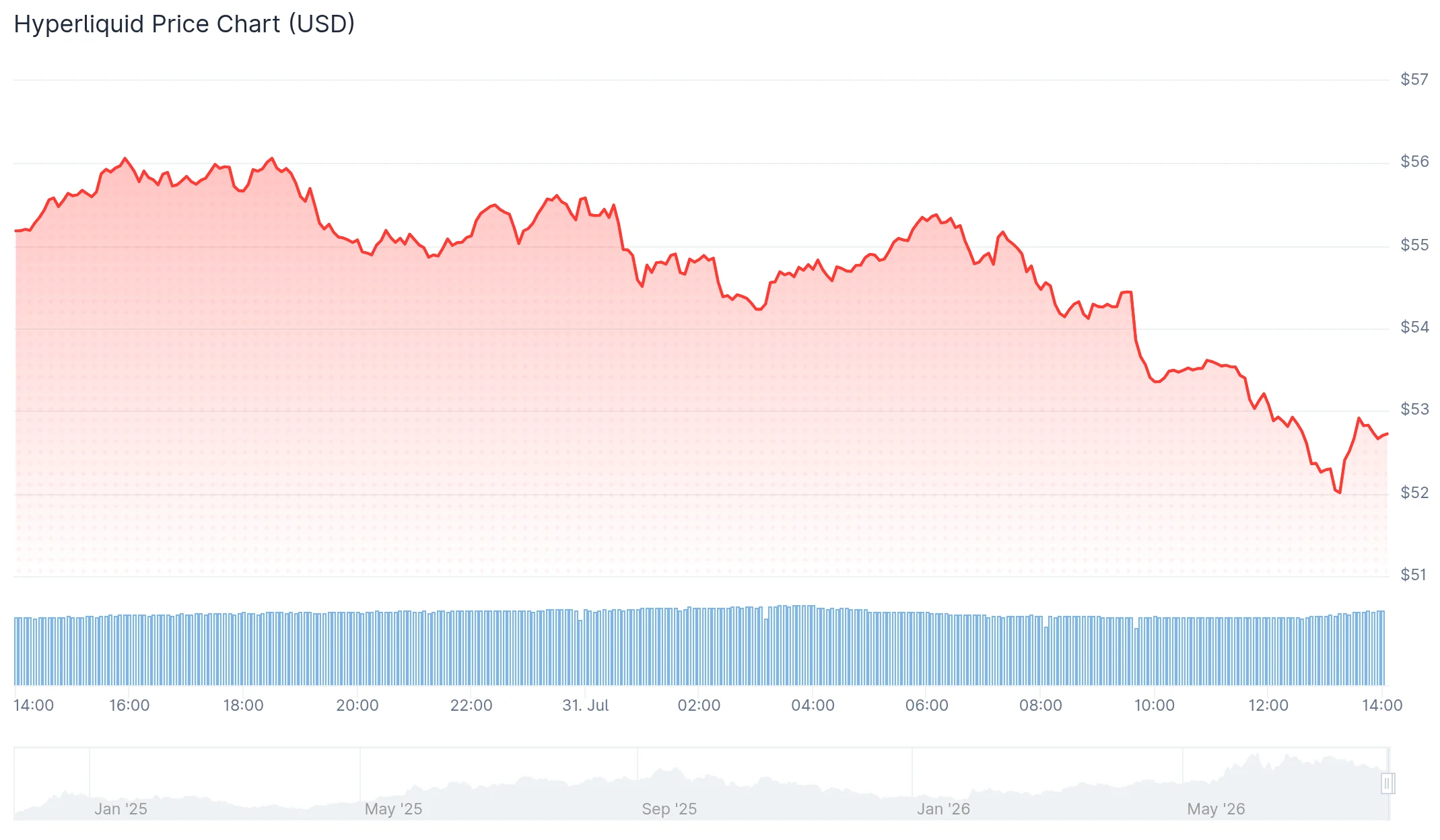
- •The HYPE token has formed a pattern of lower highs and lows, trading near $53.50 with the $52 to $54 support band under pressure.
- •Large token transfers to institutional platforms such as Coinbase Prime and FalconX have raised supply concerns, though some movements were attributed to wallet rotation rather than selling.
- •Hyperliquid has burned approximately 46.05 million HYPE, representing about 4.6% of the original one-billion-token maximum supply, while generating roughly $1.47 million in daily protocol fees.
Hyperliquid's HIP-4 proposal has entered a new testnet phase, enabling developers to deploy standardized outcome markets through validator-approved templates. The expansion broadens Hyperliquid's prediction-market framework beyond validator-created contracts while maintaining standardized settlement rules, positioning the derivatives-focused Layer 1 to capture demand in a prediction-market category that has attracted growing attention across decentralized finance.
Under the testnet model, developers stake 100 HYPE to register as deployers and can launch markets without auctions or gas charges. The update arrives as HYPE trades near $53.50 after losing the $55 level, with large token transfers to institutional trading platforms raising supply concerns.
Permissionless Testnet Market Expansion
Hyperliquid HIP-4 allows registered builders to select validator-approved templates and then define an underlying asset, target level, and expiry. Each template fixes critical wording, side names, and keywords, reducing the proliferation of duplicate markets with slightly different language or settlement conditions.
The current testnet limits each deployer to 10 active outcomes and 50 deployments per day. Hyperliquid plans to introduce configurable fees and additional templates after developers test market creation and settlement workflows. Updated documentation now exposes outcome metadata through a testnet-only application programming interface.
Hyperliquid first introduced HIP-4 outcome contracts as fully collateralized products that settle within a fixed range. They do not employ leverage or liquidations. Initial contracts focused on recurring binary outcomes tied to HyperCore mark prices.
The broader permissionless design follows a preliminary framework announced on July 20. For mainnet deployers, Hyperliquid proposed a 500,000 HYPE stake, a six-month lock, and validator-controlled slashing. Validators could penalize poorly defined markets, incorrect settlements, or contracts left unsettled beyond one week. Those mainnet terms remain preliminary and differ significantly from the lower testnet requirement.
HIP-4 activity has remained modest after sports-related contracts lost demand following the World Cup. Market data placed open interest near $182,000 and notional volume around $881,000. Permissionless creation could broaden listings toward economic data releases, elections, cryptocurrency prices, and other measurable events — a model that has driven volume growth on competing prediction-market platforms such as Polymarket, which reported billions in trading volume during 2024 election cycles.
HYPE Price Action and Whale Transfers
The HYPE token has formed a pattern of lower highs and lower lows after retreating from the $60 region. Trading near $53.50, the token has placed the $52 to $54 support band under pressure — an area that also corresponds to a June swing low.
A four-hour close below $52 would weaken the current market structure. A failed recovery above that level could expose the $48 to $50 range. Further selling could draw attention to the earlier $44 to $46 demand zone. Conversely, a rebound above $58 to $60, followed by a higher low, would reduce immediate downside pressure.
Large token transfers have added complexity to the short-term price setup. Lookonchain previously recorded institutional unstaking and exchange-related movements during July, including deposits to Coinbase Prime. The tracker also reported 1.96 million HYPE unstaked across three Multicoin Capital wallets. Multicoin subsequently stated that wallet rotation, rather than selling, motivated at least part of its activity.
Separate wallet movements included HYPE deposits to FalconX and Coinbase Prime. Transfers to brokerage or custody platforms can support over-the-counter execution, asset rotation, or sales, though blockchain movements alone cannot confirm a disposal.
Burn Metrics and Fee Revenue
Hyperliquid's fee system continues to remove tokens from circulating supply. According to a tracker reading of the protocol's assistance-fund address on July 27, approximately 46.05 million HYPE had been sent to the burn address, representing roughly 4.6% of the original one-billion-token maximum supply.
The latest reported daily burn added approximately 26,080 HYPE, valued near $1.43 million at the recorded price. Protocol fees reached about $1.47 million during the same period. Sustained daily fee generation at that level reflects active usage of Hyperliquid's perpetuals trading infrastructure, which underpins the revenue stream funding the burn mechanism.
Hyperliquid Daily
Hyperliquid burned 26.08K $HYPE ($1.43M) over the last 24 hours. The protocol generated $1.47M in fees during the same period.
All-time burn: 46.16M $HYPE ($2.47B), or 4.62% of the 1B max supply. @HyperliquidX pic.twitter.com/jHlLYRv68A
— Onchain Lens (@OnchainLens) July 31, 2026
The burn mechanism reduces circulating supply, while whale transfers increase the amount potentially available for institutional execution. Mainnet still lacks a confirmed launch date, leaving broader developer participation dependent on future testnet results and validator feedback.

