Hyperliquid HIP-3 Open Interest Crosses $4 Billion as Weekend Trading Surge Continues
Key Takeaways
- •Hyperliquid's HIP-3 open interest exceeded $4 billion for the first time on August 8, growing 1,454% from $259.33 million at the start of the year.
- •The record was set on a weekend when both Nasdaq and CME were closed, demonstrating trader demand for continuous leveraged exposure to traditional asset classes.
- •A single deployer identified as xyz controlled $4.01 billion of the $4.03 billion total open interest, leaving minimal distribution across other operators.
- •Talos research indicates that nearly half of S&P 500 perpetual volume and over 60% of oil perpetual volume already occurs outside regular US market hours.
- •Intercontinental Exchange CEO Jeff Sprecher has formally approached the CFTC seeking regulatory parity, raising questions about how derivatives oversight applies to permissionless on-chain market creation.
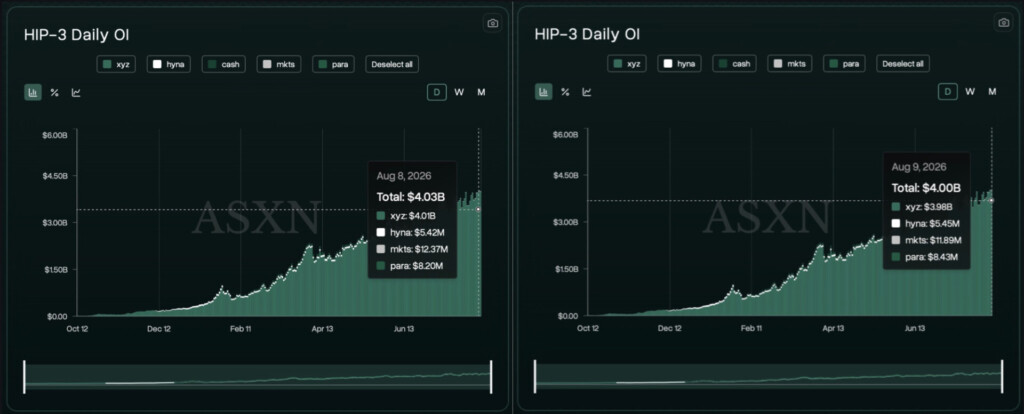
Hyperliquid's HIP-3 markets have expanded sharply in both volume and open interest since launching on mainnet in October of last year. Over the weekend, HIP-3 markets reached a new milestone, closing above $4 billion in open interest for the first time. A month earlier, the figure stood at $3.67 billion, representing a 9.8% increase over the trailing four weeks. At the start of the year, open interest was just $259.33 million — a 1,454% gain in a little over seven months.
Source: ASXN Hyperliquid Dashboard
The timing of the milestone is central to the story. Both Nasdaq and the CME were closed over the weekend, meaning anyone holding a leveraged position in equities, indices, or commodities during that period was doing so on a venue that does not observe a traditional opening bell — which is effectively the core value proposition of HIP-3. Perpetual futures, a derivative instrument that originated in crypto and carries no expiry date, have become the dominant form of leveraged trading in digital assets. HIP-3 extends that mechanism to non-crypto assets on-chain, connecting decentralized market infrastructure to asset classes that have historically been accessible only through registered exchanges during set hours.
Positions Stayed Open While Nasdaq and CME Did Not
HIP-3 permits any builder who stakes 500,000 HYPE to launch perpetual futures markets for crypto, individual stocks, indices, commodities, and FX on Hyperliquid. The weekend open interest record is notable because both data points landed on days when Nasdaq and CME were closed.
Talos identified a similar pattern in its June report, finding that nearly half of S&P 500 perpetual volume and over 60% of oil perpetual volume already occurs outside US market hours. This indicates traders were actively using these markets well before this weekend. The $4 billion open interest figure reflects a sustained ramp-up in behavior rather than an isolated event.
One Deployer Accounts for 99.4% of Total Open Interest
Of the $4.03 billion recorded on August 8, the deployer known as xyz accounted for $4.01 billion. The remaining deployers split roughly $26 million between them: mkts held $12.37 million, para held $8.20 million, and hyna held $5.42 million.
That distribution has barely shifted as the total has grown. What appears to be a diversified ecosystem is, in practice, a single deployer's order book with a marginal remainder. Deployer risk, market design, oracle selection, and listing decisions for virtually all HIP-3 exposure rest with one operator. A failure at that level would not be diluted across multiple venues, because no comparable alternatives exist at scale.
Growth at this pace typically attracts additional serious participants. Ten months in, that has not materialized in any meaningful way.
CFTC Faces Pressure From an Incumbent
Intercontinental Exchange CEO Jeff Sprecher has already approached the CFTC requesting a level playing field. ICE owns the New York Stock Exchange, meaning the complaint originates from the operator with the most direct competitive exposure to a venue that lists equity products, operates around the clock, and carries none of the registration requirements that NYSE does.
The CFTC has previously pursued enforcement actions against crypto derivatives venues operating without registration, including settlements with BitMEX in 2021 and charges against Binance in 2023. Those cases involved centrally operated exchanges. HIP-3 introduces a structurally different variable: markets are deployed by individual builders staking HYPE rather than offered directly by Hyperliquid itself, raising questions about how existing derivatives regulation applies to permissionless market creation.
That argument is likely to resonate. The contention is not that on-chain perpetuals are inherently dangerous. It is that two venues offering economically similar exposure are operating under vastly different regulatory frameworks — and one of them just surpassed $4 billion in open interest without a registered exchange behind it.
Demand has been clearly demonstrated. HIP-3 has shown that traders want leveraged exposure to equities and commodities at 2 a.m. on a Sunday. The unresolved question is how long a single unregistered operator will remain the sole provider of that access.

