Hyperliquid Policy Center Urges CFTC to Allow Perpetual Futures in Commodity Markets
Key Takeaways
- •The Hyperliquid Policy Center urged the CFTC in an August 7 submission to expand access to perpetual futures and explore public blockchain infrastructure for derivatives market operations.
- •Perpetual futures lack fixed expiration dates, potentially benefiting companies with ongoing commodity exposure by removing the need to repeatedly roll positions into new contracts.
- •The CFTC is also examining longer trading schedules, but thin overnight liquidity could lead to wider spreads and inferior execution compared to peak-hour trading.
- •The Hyper Foundation committed 1 million HYPE tokens to fund the Hyperliquid Policy Center, which positions itself as an independent organization pursuing a regulated US framework for onchain finance.
- •JPMorgan has warned that regulated US perpetual futures products could erode Hyperliquid's competitive edge, compounding pressure from weakening HYPE ETF demand.
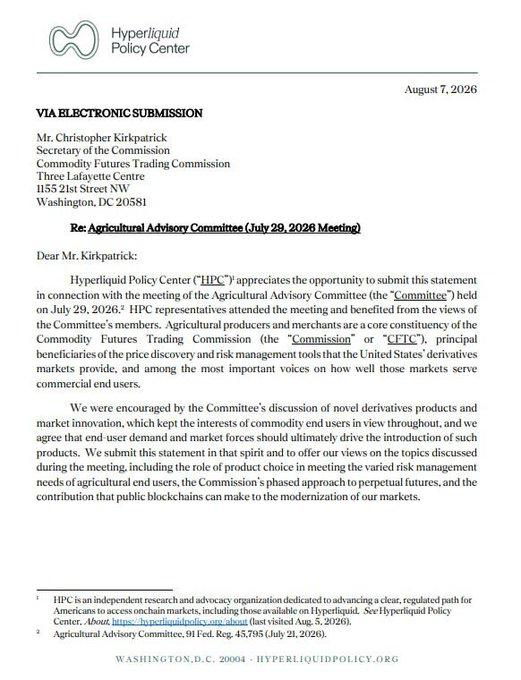
In an August 7 submission connected to the Commodity Futures Trading Commission's July 29 Agricultural Advisory Committee meeting, the Hyperliquid Policy Center advocated for expanded product choice in derivatives markets, addressing the CFTC's gradual approach to perpetual futures and the potential role of public blockchains in market infrastructure.
The Agricultural Advisory Committee represents agricultural producers, merchants, and other businesses that rely on derivatives to manage costs and revenues tied to their operations. Its July meeting examined risk-management tools for agricultural users, along with 24-hour trading and newer derivatives products. Introducing perpetual futures into that discussion places a contract structure that originated in cryptocurrency markets — first launched by BitMEX in 2016 and now accounting for the majority of crypto derivatives trading volume — before businesses whose needs differ significantly from those of crypto traders. The central question for regulators is whether perpetuals can serve as a viable hedging alternative in markets where derivatives are used to protect operating margins.
Perpetual Futures as a Hedging Tool
Traditional futures contracts carry fixed expiration dates. A farmer, commodity merchant, or food producer seeking protection against price changes beyond a contract's life must close or roll the position into another maturity.
A perpetual future eliminates the fixed expiry. The position can remain open indefinitely while a funding mechanism helps keep its price aligned with the underlying market. This structure could suit companies with continuous commodity exposure — for instance, a business that regularly purchases energy, grain, or other inputs and wants to maintain price protection over an extended period without repeatedly rolling into new contracts.
Traditional futures remain effective when their expiration dates align with specific operational events such as a harvest, shipment, or scheduled purchase. A December contract, for example, naturally fits an exposure that also ends in December. Perpetuals would provide an additional option when the risk being managed does not conform neatly to a fixed maturity schedule.
Extended Trading Hours and the Liquidity Question
The CFTC is also examining longer trading schedules. In his remarks to the Agricultural Advisory Committee, CFTC Chairman Michael Selig emphasized the importance of giving farmers and producers efficient tools for managing price uncertainty.
Commodity prices can shift while US exchanges are closed. Weather events, geopolitical developments, energy shocks, and overseas trading sessions can all affect markets outside normal domestic hours. Longer trading windows could allow companies to adjust hedges sooner when such events occur.
Liquidity, however, remains a significant complication. Thin overnight trading can result in fewer counterparties, wider spreads, and larger price moves triggered by relatively small orders. Under those conditions, a 24-hour perpetual contract could deliver worse execution than a traditional future during peak trading hours. Keeping a market open around the clock only benefits participants if sufficient depth exists — commercial users, market makers, and other counterparties must all be present.
Public Blockchain Infrastructure in Derivatives
Derivatives markets depend on collateral transfers, position reconciliation, and settlement of gains and losses between participants. Public blockchains could handle some of these processes on infrastructure that operates continuously and can be independently verified.
Faster collateral movement and systems available outside traditional banking hours could benefit commercial participants. This may be particularly relevant for perpetual contracts, where positions remain open and collateral requirements fluctuate as prices move.
The Hyperliquid Policy Center has also argued that regulators should distinguish between public blockchain infrastructure and financial businesses that take custody of customer assets or intermediate transactions. Agricultural derivatives present a practical setting in which to test that argument. Any tangible advantage would need to materialize in areas businesses already prioritize: collateral efficiency, settlement speed, and reliable access during volatile periods.
Strategic Context for Hyperliquid
Hyperliquid itself has a direct stake in how regulators approach perpetual futures and onchain derivatives. The Hyperliquid Policy Center describes itself as an independent research and advocacy organization focused on creating a regulated US path for onchain finance. When it launched, the Hyper Foundation committed 1 million HYPE tokens to support its work, according to the organization's official launch announcement.
The CFTC has previously approved crypto-linked derivatives on regulated US exchanges, including Bitcoin futures in 2017 and Ether futures in 2021, establishing precedent for instruments rooted in digital asset markets to enter the traditional framework. A regulatory pathway that extends to perpetual futures and public blockchain infrastructure could similarly open new competitive opportunities for platforms built around those technologies. The policy effort also comes at a time of growing competitive pressure on Hyperliquid. JPMorgan has recently argued that regulated US perpetual products could narrow the platform's advantage, while HYPE ETF demand has weakened.
Expanding the regulatory role of perpetual futures could broaden the number of markets where onchain derivatives platforms are positioned to compete with established venues.
Whether Businesses Will Adopt Perpetual Futures
Perpetual futures have a long trading history in cryptocurrency markets. What remains uncertain is whether companies managing commodity and other commercial exposures would find the same structure practical.
Farmers, merchants, and producers will evaluate these products based on hedging costs, liquidity, collateral requirements, and their ability to respond when markets move. If perpetual futures deliver improvements in those areas, they could earn a place alongside established derivatives instruments. If not, regulatory approval may expand where the contracts can trade without generating meaningful demand from the businesses the CFTC's Agricultural Advisory Committee represents.
Methodology: This article draws on the Hyperliquid Policy Center's August 7 submission relating to the CFTC Agricultural Advisory Committee's July 29 meeting, official CFTC meeting materials, and Hyperliquid Policy Center disclosures.
Disclaimer: This article is provided for informational and educational purposes only and does not constitute financial, legal, or investment advice. Regulatory policy and derivatives-market rules may change as the CFTC considers new products and public comments.

