HYPE Tests Breakout Toward $60 Despite 13 Consecutive ETF Outflow Sessions
Key Takeaways
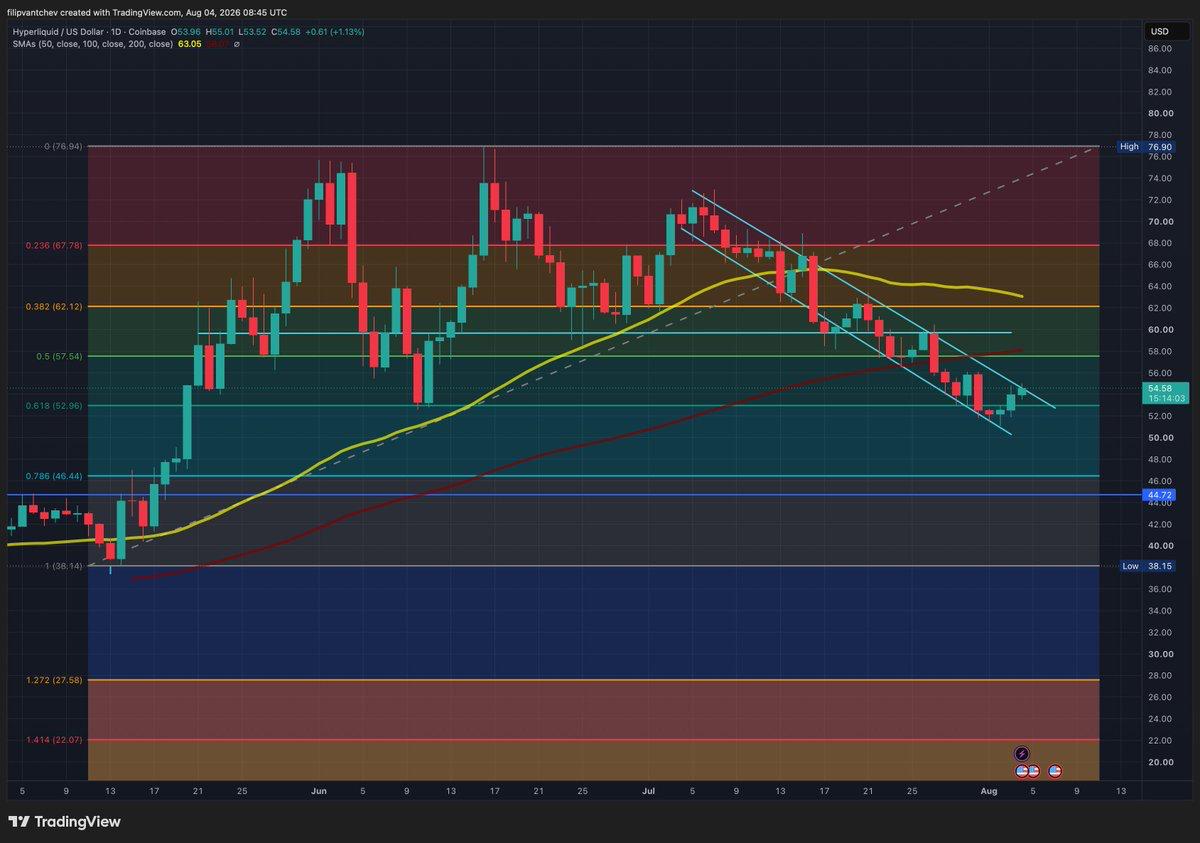
- •HYPE is testing the upper trendline of a descending channel near $55, and a daily close above this boundary would mark the first structural break from the downtrend that began after prices exceeded $70 in early July.
- •The token's recovery remains technically valid as long as it holds above the 0.618 Fibonacci retracement near $53, with a daily close below that level shifting focus to the lower channel boundary around $51.
- •U.S. HYPE spot products recorded no positive net inflows across thirteen trading sessions from July 16 through August 3, with outflows totaling approximately $29.76 million during that period.
- •Tokyo Stock Exchange-listed Eole Inc. purchased approximately 1,078 HYPE for roughly $66,000 on July 28 and intends to expand its total allocation to about $611,000 by the end of August as part of its broader digital-asset treasury strategy.
- •Eole's planned allocation is financially modest relative to the institutional outflows from U.S. spot products, and the current price advance has not been confirmed as a breakout on a daily closing basis.
HYPE Tests the Channel Ceiling Near $55
HYPE, the native token of Hyperliquid—a Layer 1 blockchain and decentralized exchange specializing in on-chain perpetual futures trading—is testing the upper boundary of a month-long descending channel near $55, with the recovery pattern remaining intact as long as price holds above the 0.618 Fibonacci retracement level at $53.
Coindoo owner Filip Vantchev highlighted the technical test, stating: "Price is testing the top of the descending channel once again."
Since trading above $70 in early July, HYPE has established a pattern of lower highs and lower lows. The latest advance has reached the upper trendline that has contained previous recovery attempts throughout the decline.
A daily close above the channel would represent the first structural break from this pattern. The next resistance level sits at the 0.5 Fibonacci retracement near $57.50. Beyond that, HYPE would face a wider resistance zone spanning approximately $60 to $63, which includes the 0.382 Fibonacci retracement near $62, the declining 50-day simple moving average, and price levels that previously provided support during the July downturn.
As of August 4, the intraday move had reached the channel boundary but had not yet confirmed a breakout.
Recovery Hinges on Support at $53
Should HYPE be rejected from the upper trendline, the rebound would remain technically valid as long as the token stays above the 0.618 Fibonacci retracement near $53. Price recently bounced from that level before returning to test the top of the channel.
A pullback that holds above $53 would preserve the current recovery structure without requiring an immediate breakout. However, a daily close below $53 would weaken the rebound and shift focus to the lower channel boundary near $51. If that support fails as well, the next notable levels are the 0.786 Fibonacci retracement around $46 and a prior horizontal support zone between $44 and $45.
The chart currently remains compressed between established support at $52.96 and the channel boundary near $55. At this stage, additional intraday tests carry limited significance unless price achieves a daily close outside this range.
U.S. Spot Products Show No Net Inflow for 13 Sessions
The recent price recovery has not been accompanied by renewed inflows into U.S. HYPE spot products. According to SoSoValue data, there were no positive net inflows across the 13 trading sessions from July 16 through August 3.
Nine of those sessions recorded outflows, while four ended with no net movement. The outflow sessions removed approximately $29.76 million from the products. The August 3 session alone recorded an additional $964,320 in net outflows, and the largest single-day withdrawal during the period was $8.78 million on July 29.
These figures do not establish that fund activity directly caused HYPE's price decline. Investors can trade existing shares without triggering creation or redemption of fund units, and the market impact of redemptions depends on each product's operational structure and timing. However, the data confirms that U.S. spot products were not contributing net demand during the period.
Nasdaq documentation for the 21Shares Hyperliquid ETF states that the trust holds HYPE and tracks its spot-market value. When assets leave such products, holdings may eventually decline through the creation and redemption process. While the precise market impact cannot be determined from daily flow totals alone, the sustained absence of inflows removes a potential source of demand support as HYPE tests resistance. The 13-session streak comes amid the broader expansion of U.S. spot crypto ETFs, which have given traditional investors regulated exposure to digital assets without requiring direct custody. Whether HYPE spot products can attract renewed allocations will be one signal to monitor alongside the technical structure.
Eole Adds HYPE to Corporate Treasury Strategy
Tokyo Stock Exchange Growth Market-listed Eole Inc. disclosed that it purchased approximately 1,078.25 HYPE on July 28 for ¥10.08 million, equivalent to roughly $66,000 at the time of transaction.
The company plans to make additional purchases and expand its total HYPE allocation to ¥100 million, approximately $611,000, by the end of August. Eole stated that the timing of further acquisitions would depend on market conditions and available liquidity.
Eole described the transaction as the first publicly disclosed HYPE purchase by a Japanese listed company, based on its review of domestic corporate announcements as of July 28. This assertion stems from Eole's own research rather than a comprehensive registry tracking every listed company's digital-asset holdings. Japan was among the first major economies to establish a licensing regime for cryptocurrency exchanges under its Payment Services Act, and its public markets have seen gradual corporate engagement with digital assets.
The purchase forms part of Eole's broader "Neo Crypto Bank" strategy. The company believes blockchain infrastructure could eventually enable autonomous AI agents to execute payments, contracts, and other financial transactions without relying on conventional bank accounts. Eole identified Hyperliquid's onchain trading infrastructure, execution speed, and programmable environment as potentially valuable components of that model. The firm also indicated it may explore lending, hedging, and connections between its digital-asset holdings and future service offerings.
Eole already held Bitcoin, meaning HYPE represents an expansion of an existing corporate crypto treasury strategy rather than an entirely new initiative. The move fits a broader—if still limited—trend of public companies diversifying digital-asset holdings beyond Bitcoin into tokens tied to specific protocols and platforms.
Corporate Purchase Is Strategically Noteworthy but Financially Limited
Eole's plans remain a corporate thesis at this stage. The company has not yet demonstrated that its AI agent initiatives will generate users, transactions, or revenue through Hyperliquid's infrastructure.
While the planned allocation would create direct demand for HYPE, the full ¥100 million target is considerably smaller than the $29.76 million withdrawn from U.S. spot products during the same 13-session period. This comparison should not be interpreted as a direct measure of price pressure, as fund flows and corporate treasury purchases interact with the market through different mechanisms. Nevertheless, it illustrates that Eole's planned position alone is insufficient to offset the recent institutional outflow total.
The initial acquisition occurred on July 28 and was announced the following day, meaning it cannot independently account for the August 4 price rebound. The primary significance lies in the fact that a publicly listed Japanese company has added HYPE to a treasury strategy that was previously focused exclusively on Bitcoin. The development would carry greater weight if Eole completes its full allocation and other public companies follow with similar purchases.
Current Move Remains a Technical Rebound
The available evidence does not indicate that regulated fund demand or Eole's corporate purchase is responsible for driving HYPE through resistance. Price has recovered from $53 and returned to the top of its descending channel, but the broader downtrend structure has not been broken on a daily closing basis.
A close outside the channel would provide stronger evidence that the month-long decline is losing momentum. Until such confirmation occurs, the current advance remains a rebound within the existing structure, driven by price dynamics rather than a visible restoration of institutional inflows.
Methodology: Technical analysis is based on the HYPE/USD Coinbase daily chart dated August 4, 2026, including descending channel patterns, Fibonacci retracement levels, and moving averages. Spot-product figures reference SoSoValue history through August 3. The corporate-purchase section is based on Eole Inc.'s official July 29 disclosure. Technical commentary includes public analysis shared by Coindoo owner Filip Vantchev.
Disclaimer: This article is for informational purposes only and does not constitute financial or investment advice. Technical patterns, corporate purchases, and spot-product flows do not guarantee future price performance.

