HYPE Hits All-Time High Above $90 After SEC Exemption and Hyperliquid Borrowing Launch
Key Takeaways
- •HYPE surpassed its previous record from September 6, trading above $90 after a two-day rally of more than 15%, and ranks as the best-performing asset year to date among the ten largest cryptocurrencies with gains over 250%.
- •On September 17, the SEC issued a five-year conditional 'Innovation Exemption' allowing Tokenized Securities Venues to trade tokenized National Market System stocks, though the order excludes synthetic products such as equity perpetuals.
- •Hyperliquid launched manual borrowing on HyperCore on September 18, letting users pledge HYPE or BTC as collateral to borrow USDC or USDT, with roughly $269 million borrowed on the first day.
- •NEAR now offers confidential-by-default perpetual futures on near.com powered by Hyperliquid's engine, which supplies the order book, matching, more than 50 markets, and leverage of up to 40x for users holding assets across more than 30 chains.
- •Payward, Kraken's parent company, stated on September 16 that it intends to bring onchain perpetual futures to US clients starting with Hyperliquid and HIP-3 markets, subject to regulatory approval.
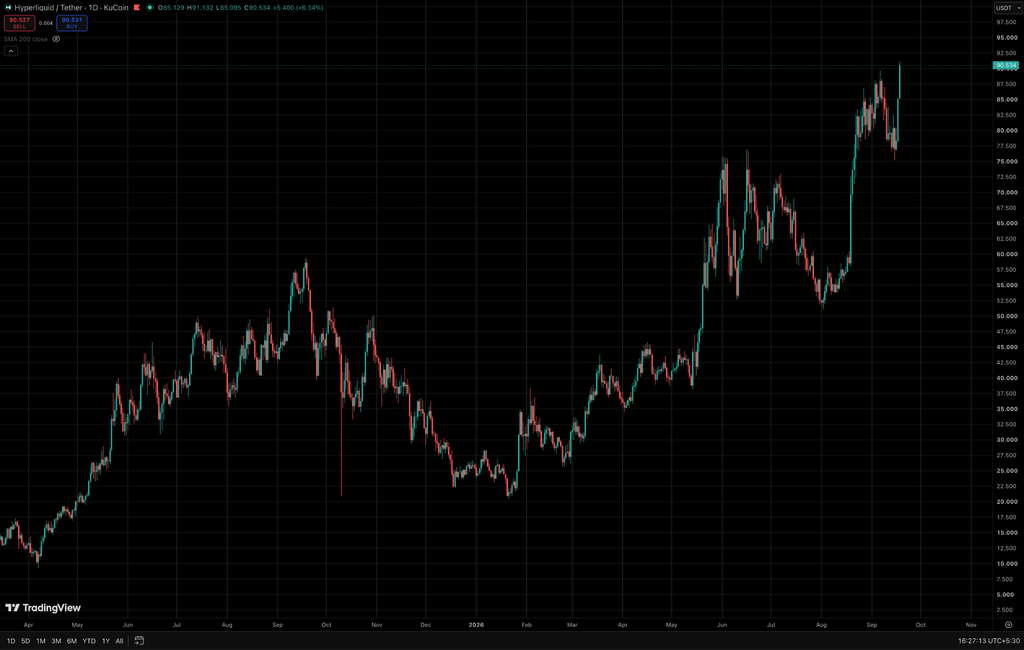
HYPE, the native token of decentralized perpetuals exchange Hyperliquid, has set a new all-time high, surpassing the previous record set on September 6. The token is now trading above the $90 mark after a rally of more than 15% over the past two days. Among the ten largest cryptocurrencies by market capitalization, HYPE is the best-performing asset year to date, with a return of more than 250% at the time of writing.
Three separate developments landed within a 48-hour window and appear to have propelled the token higher.
SEC Opens a Door to Onchain Stock Trading
On September 17, the US Securities and Exchange Commission (SEC) issued an order it calls the “Innovation Exemption”. The measure gives Tokenized Securities Venues a temporary, conditional five-year exemption from the definition of an “exchange” under the Securities Exchange Act of 1934, allowing them to trade tokenized National Market System stocks through permissioned automated market makers and liquidity pools.
Hyperliquid stands to benefit substantially because it is positioned precisely for this kind of flow. Its HIP-3 framework is designed to let builders stake HYPE and launch their own perpetual markets on Hyperliquid's order book, and trade.xyz has used it to list tokenized equity perps. That business line has grown fast. For context, in January of this year, real-world asset (RWA) markets made up around 2% of Hyperliquid's overall volume; that share now stands at roughly half.
The order itself is narrower than the headline suggests. It covers only tokenized stocks in which holders retain the rights of an ordinary shareholder, including dividends and voting. Synthetic products, including tokenized security, are left out, and equity perps sit on the wrong side of that line. Even so, the SEC sent a clear signal to traders that US regulators now want stock trading on public chains, and that alone is hugely beneficial for a platform where a large share of that activity already thrives. How that boundary is treated over the five-year window is worth watching, since the exemption's terms will define what tokenized-stock venues can actually offer during that period.
Borrowing Goes Live With $269 Million Drawn on Day One
Hyperliquid announced on September 18 that manual borrows are now live on HyperCore. Users can supply HYPE or BTC as collateral to borrow USDC or USDT, with a 65% loan-to-value (LTV) for HYPE and 50% LTV for BTC. HYPE positions liquidate at 82.5% and BTC positions at 75%. According to Hyperliquid's official X account, roughly $269 million was borrowed on day one.
Manual borrows are live on Hyperliquid Portfolio margin and manual borrows use the same underlying HyperCore infrastructure, with $269M in assets borrowed today. Users can supply HYPE and BTC as collateral to borrow quote assets (USDC and USDT). Borrowed quote assets pay… pic.twitter.com/C3crESxaM0
— Hyperliquid (@HyperliquidX) September 18, 2026
The change matters most to large holders of HYPE rather than to active traders. These holders can now keep their HYPE positions intact while taking out stablecoins, removing one reason for anyone to sell into the bid. Collateralized stablecoin borrowing is a long-standing primitive across decentralized finance, and bringing it natively onto HyperCore places the mechanic inside the same venue where users already trade.
NEAR Routes Its Perps Desk Through Hyperliquid
NEAR has made perpetual futures on near.com confidential by default, with Hyperliquid running the engine underneath. Perpetual futures are derivative contracts with no expiry date, letting traders hold leveraged positions for as long as margin requirements are met. Hyperliquid supplies the order book, the matching, more than 50 markets and leverage of up to 40x, while NEAR handles the front end and lets users trade from assets held across more than 30 chains. In practice, it is a distribution deal: flow that starts on NEAR settles into Hyperliquid's books.
Kraken's Parent Picks Hyperliquid as Its Route Into US Perps
On September 16, Payward, Kraken's parent company, said in a press release that it intends to bring onchain perpetual futures to US clients, starting with Hyperliquid and HIP-3 markets.
Payward 🤝 @HyperliquidX We're building permissioned Hyperliquid HIP-3* markets for US clients. pic.twitter.com/D9WwRgVaK0
— Payward (@Payward) September 16, 2026
The initiative remains subject to regulatory approval, but it sends a clear signal that regulated US firms are treating HIP-3 as the rails they want to build on. Regulatory approval is the gating step to watch here: until it is granted, the plan remains a stated intention rather than a live US offering.
All in all, HYPE is being priced in as derivatives infrastructure rather than as a DEX governance asset, with a lending market, an outside distribution channel and a regulatory tailwind all arriving in the same week.
Source: Cryptopolitan

