Hunter Biden's LAPTOP Memecoin Faces an On-Chain Check
Key Takeaways
- •On-chain data confirms the SafeProxy contract cited by Hunter Biden holds 300 million LAPTOP tokens, or 30% of total supply, with no outgoing transfers recorded since launch roughly 29 days ago.
- •The blockchain record does not identify the wallet's owners, prove it contains all founder allocations, or enforce the claimed six-month lockup and two-year vesting schedule.
- •A Groom Lake report commissioned by the project found a market maker deposited about $5,200 into a pool holding fewer than 30,000 LAPTOP, which helps explain the token's extreme launch-day price volatility.
- •Thinly seeded automated market maker pools can produce fully diluted valuations based on last trade prices, even when available liquidity could not support large sales at those levels.
- •Biden said the project will burn most unclaimed tokens from its first airdrop next week, a step expected to generate a publicly verifiable on-chain record.
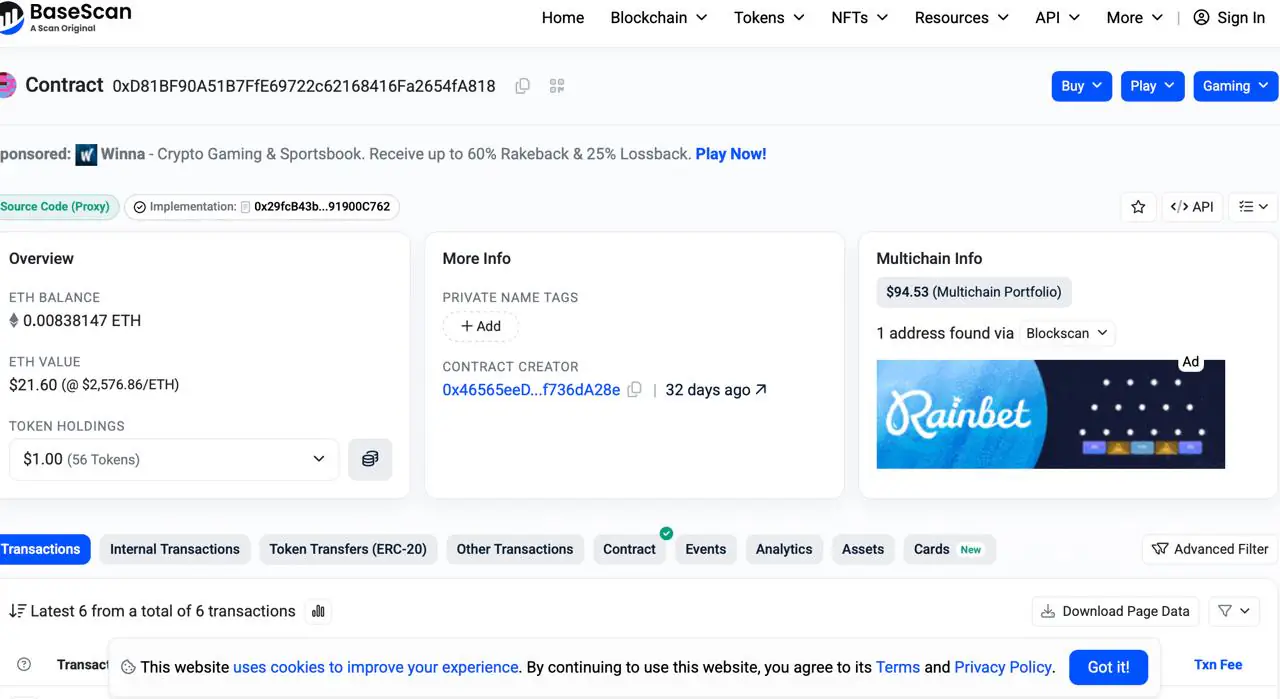
Hunter Biden published an October 7 thread on X presenting what he called a “full independent accounting” of the first day of trading for LAPTOP, the memecoin his project launched on Base, an Ethereum layer-2 network. The post followed the token's sharp launch-day spike and collapse — a debut roughly a month earlier, covered at the time by Coindoo, in which the planned distribution and early liquidity setup had already attracted scrutiny. An on-chain review of the address he cited confirms a large, unmoved balance, but verifies little else.
A month ago we launched $LAPTOP. Within minutes, we had a chart that looked like every celebrity rug ever. Completely broken. I promised you a full independent accounting. Here it is. 1/
— Hunter Biden (@HunterBiden) October 7, 2026
The linked contract has retained its LAPTOP balance
In the same thread, Biden wrote that “all founder coins sit in one wallet and haven't moved since launch.” The address he linked is a SafeProxy contract on Base, a smart-wallet structure that can be configured to require approvals before funds move. Safe, the smart-account framework that grew out of the Gnosis Safe multisig, is among the most widely used formats for holding project treasuries in crypto, which is why the configuration of this particular Safe matters so much to the claims in Biden's thread.
For the LAPTOP contract cited in the thread, BaseScan lists a balance of 300 million tokens, or 30% of the total supply. Its filtered transfer history contains two incoming transactions — one for 299,999,999 LAPTOP and another for a single token — both made about 29 days ago. No outgoing LAPTOP transfers appear in that history.
The transfer record supports a narrow finding: the address Biden identified has retained the LAPTOP it received. The linked BaseScan overview does not identify the Safe's owners, establish that it contains every founder allocation, or show any agreement governing those tokens.
Visible on BaseScan:
- 300 million LAPTOP in the linked contract.
- Two incoming transfers into that contract.
- No outgoing LAPTOP transfer in its filtered history.
Not shown in this record:
- The Safe's owners and approval threshold.
- The claimed lock-up and vesting terms.
- Market-maker agreements and trading decisions.
A SafeProxy contract does not prove a lock-up
Biden said his coins are locked for six months and then vest over two years. The transfer history shows what has happened so far; it does not itself set the terms of what can happen later.
Safe contracts can be configured in many ways. The linked explorer page does not show whether the address carries a time-lock, who can approve a transfer, or whether another agreement restricts the signers. A public vesting contract would make the release conditions visible in code. Until then, the stated schedule can be assessed only through later wallet activity and further documentation from the project.
The transfer record answers whether the identified balance has moved. It cannot explain how LAPTOP's launch price became so volatile — the question Biden's account addresses by turning to the liquidity pool and the market makers.
Thin liquidity can turn last trade into a misleading headline
According to Biden, a Groom Lake report commissioned by the project found that one market maker put about $5,200 into a pool holding fewer than 30,000 LAPTOP. In an automated-market-maker pool that shallow, a modest purchase can push the quoted price sharply higher. Multiplying that last trade price by a token's full supply can then produce an enormous implied market capitalization, even though there may be nowhere near enough liquidity for major holders to sell at that valuation.
That is why a headline price and a realizable value can diverge so dramatically during a memecoin's first minutes. The gap between fully diluted value and spendable liquidity is a recurring feature of thinly seeded token launches across the industry. The launch-specific figures remain claims from Biden's thread and the report published by the project. Checking the market-maker account requires the relevant pool balances, swaps and transaction trail, not merely the 300 million-token balance.
The contract address matters more than the LAPTOP ticker
Anyone reviewing the wallet should use the exact token contract: 0xB095274743941e953c746F9C228DA9c18Bb6ec29. Names and tickers can be copied easily, especially on networks where anyone can create a token, and a search for “LAPTOP” can return unrelated lookalike assets. Base, like other public EVM networks, allows anyone to deploy a token contract without permission, which is exactly what makes such lookalikes cheap to produce.
Using the contract address keeps the review tied to the same token Biden referenced. It also avoids confusing a displayed price or fully diluted value with the liquidity actually available for trading.
The next promises should leave public records
Biden said the project will burn most unclaimed tokens from its first airdrop next week. Depending on the token's mechanics, that should leave a public transaction trail, whether through a transfer to an unrecoverable address, a contract function that reduces supply, or another disclosed on-chain process.
The accounting gives readers a specific record to follow rather than a claim that must be taken on trust. The promised burn, any future movement from the linked SafeProxy contract, and clearer evidence of the stated vesting terms will determine how much of the remaining account can be independently checked.
This article is for informational purposes only and does not constitute investment advice. On-chain data can verify balances and transfers, but it cannot establish ownership, intent or the enforceability of off-chain commitments.

