Hugging Face Unveils Microduck, a $399 Programmable Walking Duck Robot
Key Takeaways
- •Hugging Face unveiled the $399 Microduck, its second desktop robot after the Reachy Mini released in 2025.
- •The robot was introduced by Pollen Robotics, a French company Hugging Face acquired in 2025.
- •Microduck can walk, pick up objects, recover from falls, and even roller-skate, using a camera, lidar sensors, and two inertial measurement units to sense its surroundings.
- •Behaviors are trained with reinforcement learning in simulation, then deployed to the physical robot, which can be fine-tuned and retrained.
- •The robot's SDK, simulation environment, and full reinforcement learning training stack are available as open source software on GitHub.
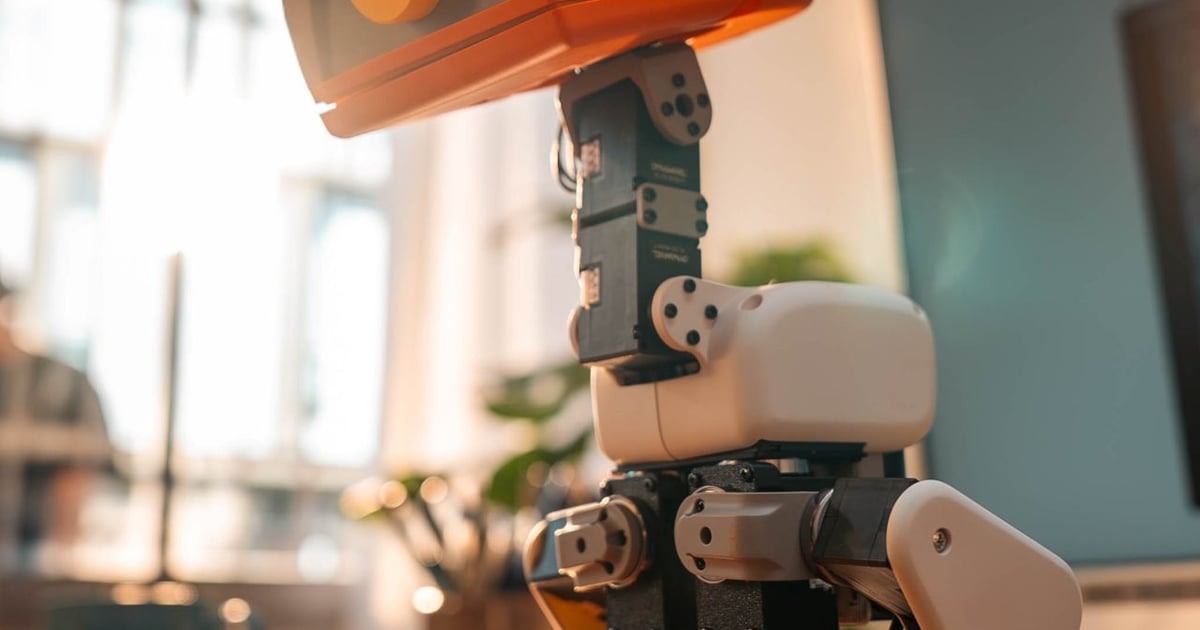
Hugging Face is expanding its push into physical AI with a new programmable robot shaped like a tiny duck.
The open source AI company unveiled the $399 Microduck, a small-scale robot that can be programmed to perform a range of behaviors, including walking, picking up objects and recovering after a fall. The $399 robot is the company's second desktop robot, following Reachy Mini, released in 2025.
The robot was introduced last week by Pollen Robotics, the French company acquired by Hugging Face in 2025.
Hugging Face co-founder and CEO Clem Delangue described Microduck on X as a "tiny open source robot" that users can teach new behaviors using reinforcement learning.
"Welcome to the era of open source affordable robots to democratize physical AI and world models!" he wrote.
The company said the robot can also perform more unusual tasks, including roller-skating.
Microduck uses a camera, lidar sensors and two inertial measurement units to perceive and respond to its surroundings, according to its website.
Its behaviors can be trained in simulation before being deployed directly onto the physical robot, according to Pollen Robotics. Developers can then fine-tune the robot, retrain it and redeploy the resulting behaviors.
The robot's SDK, simulation environment and full reinforcement learning training stack are available as open source software on GitHub.
The launch builds on Hugging Face's growing push into physical AI. The company is best known for its open source AI platform and community, which hosts models and tools for developers, but its acquisition of Pollen Robotics marked a move into robotics and AI hardware. Hugging Face is not alone in betting on this space: major chipmakers and robotics firms, including Nvidia with its Jetson edge computing platform, have been building tools aimed at powering the next generation of physical AI systems, and affordable open source hardware like Microduck is positioned to give developers and researchers a low-cost entry point for experimenting with robot learning in the real world.
Related: Nvidia Targets Physical AI With New Jetson Edge Platform
