Huawei's Horinger AI Data Center Holds About 7% of xAI's Colossus 2 Capacity, Epoch AI Estimates
Key Takeaways
- •Epoch AI estimates Horinger operates at about 81,000 H100-equivalent units, roughly 7.3% of the estimated 1,112,000 units at xAI's Colossus 2.
- •The facilities rely on different chips: Huawei's Ascend 910B and 910C accelerators in China versus Nvidia's Blackwell-series GB200 and GB300 processors in Memphis.
- •Estimated capital costs diverge sharply, with Horinger valued at $6.4 billion and Colossus 2 at $35.8 billion.
- •US export controls in place since 2022 have barred Nvidia's most advanced AI chips from sale to China, and the rules have been tightened repeatedly.
- •Under Epoch AI's projections, Horinger would grow to about 141,000 units while Colossus 2 targets more than 1.2 million by the end of 2026, keeping Horinger's share near 7.7%.
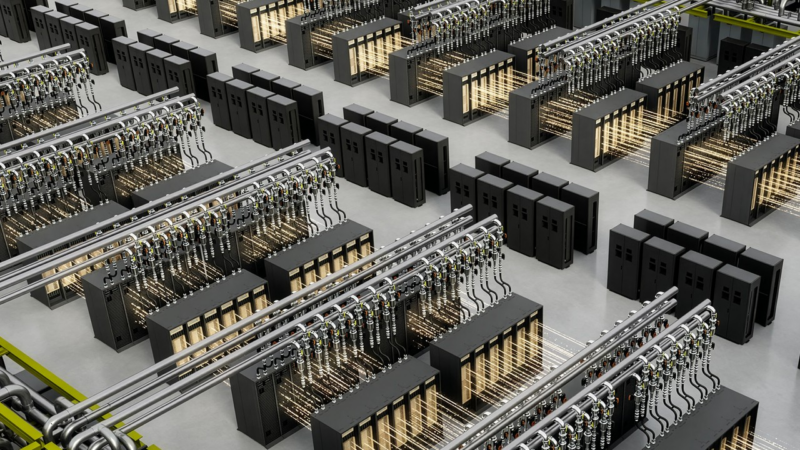
Huawei's Horinger data center in Inner Mongolia, one of China's showcase AI facilities, currently operates with roughly 7% of the computing power inside xAI's Colossus 2 campus in Memphis, Tennessee, according to estimates from AI research organization Epoch AI. Based on those same projections, the gap between the two sites is not set to close meaningfully anytime soon.
The Numbers Behind the Gap
Epoch AI estimates that Horinger is operational with roughly 81,000 H100-equivalent units of AI compute and draws 170 MW of IT power. An "H100-equivalent," or H100e, is a benchmarking yardstick: it converts any mix of chips into the computing muscle of Nvidia's H100 accelerator, so that facilities running very different hardware can be measured on a single scale. Comparisons on that yardstick matter because clusters at this scale are the kind of infrastructure frontier AI models are trained on.
Colossus 2, by Epoch AI's estimate, sits at about 1,112,000 H100e and runs on 946 MW of IT power. Dividing one figure by the other places Horinger at approximately 7.3% of Colossus 2's capacity. Put differently, xAI's Memphis campus packs well over ten times the compute of China's flagship Huawei site.
The financial picture tells a similar story. Epoch AI pegs Horinger's capital cost at $6.4 billion, while its estimate for Colossus 2 comes in at $35.8 billion, more than five times higher.
Two Very Different Hardware Bets
The core of the divide is silicon. Horinger runs mainly on Huawei's own Ascend 910B and 910C accelerators. Colossus 2 leans on a large deployment of Nvidia's newest Blackwell-series chips, the GB200 and GB300, which are spread across multiple buildings on the Memphis campus. The two facilities therefore represent two different approaches to AI infrastructure: one built around domestic Chinese accelerators, the other around Nvidia's latest-generation hardware. The divide also sits against a policy backdrop: US export controls have restricted sales of Nvidia's most advanced AI chips to China since 2022, with the rules tightened repeatedly since.
Horinger is also part of China's "Eastern Data, Western Computing" initiative, formally launched in 2022 with Inner Mongolia designated as one of the country's national computing hubs. The program's name describes the plan neatly: data generated in the country's east is crunched in the west.
Both Campuses Are Still Growing
Neither facility is standing still. Epoch AI projects that Horinger will reach around 141,000 H100e in the near future, a substantial step up from its current estimated level.
Colossus 2's projected trajectory is steeper still. Epoch AI's estimates have the campus reaching about 1,824,000 H100e, and the facility targets more than 1.2 million units by the end of 2026. The campus is the successor to Colossus, the Memphis training cluster xAI brought online in 2024.
If both projections pan out, Horinger would sit at roughly 7.7% of Colossus 2's capacity, barely a nudge from today's 7.3%. In other words, Horinger would be expanding meaningfully in absolute terms while making almost no headway in relative terms.
What This Means for the AI Compute Race
The metrics to monitor going forward are fairly concrete. The key questions are whether Colossus 2 actually reaches its target of more than 1.2 million units by the end of 2026, and whether Horinger hits the roughly 141,000 H100e that Epoch AI expects it to reach. Beyond those milestones, the relative share between the two campuses will serve as a simple yardstick for how the AI compute race develops.
This article is based on reporting published by CryptoBriefing on November 6, 2026.

