HSC Ho Chi Minh Panel Examines Institutional Digital Asset Adoption, Regulation, and Stablecoins
Key Takeaways
- •Institutions are often motivated to adopt digital assets by fear of being left behind rather than by conviction.
- •Panelists said many banks still use third-party vendors or crypto firms instead of directly handling digital assets.
- •The speakers identified regulatory clarity and licensing as essential for wider institutional participation.
- •The discussion focused on practical uses such as stablecoin payments, trade finance, and alternative credit channels.
- •Vietnam’s regulated exchanges and new joint ventures were described as potential infrastructure for future tokenized products and fund structures.
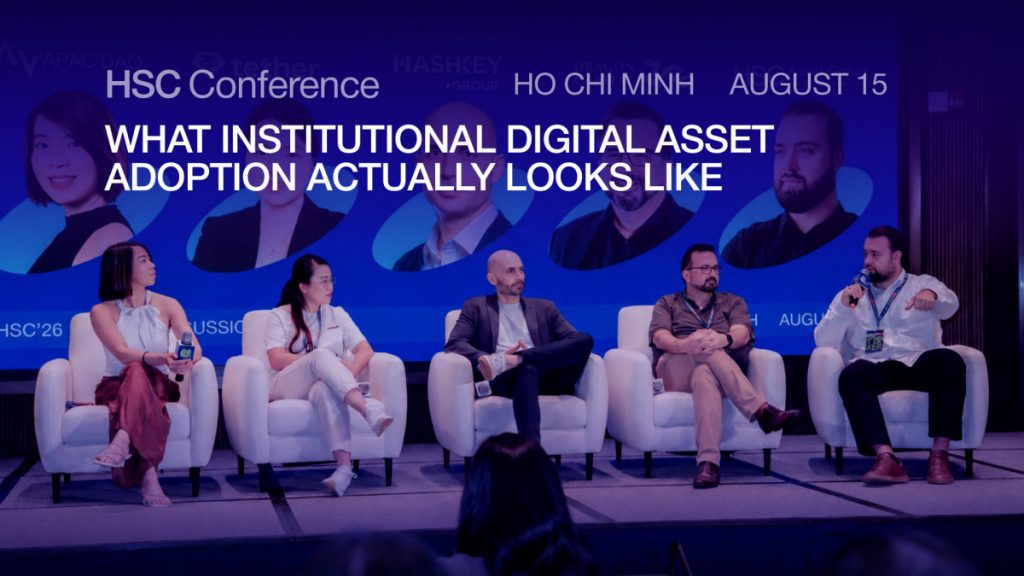
On August 15, the HSC Conference returned to Ho Chi Minh City, bringing together senior voices from financial institutions, technology firms, and venture capital to examine the evolving relationship between traditional finance and digital assets.
The standout session, “What Institutional Digital Asset Adoption Actually Looks Like,” was moderated by Nicole Nguyen, Founder of APAC DAO, and featured Vadim Krekotin, Managing Partner of HSC Asset Group; Will Ross, Chief Client Officer of Dragon Capital, Vietnam’s oldest and largest equity fund manager; Ben El-Baz, Managing Director and Head of International Markets at HashKey Group; and Queenie Le, Regional Expansion Lead APAC at Tether.
Rather than revisiting familiar talking points, the panel focused on how institutions are actually allocating to, custodying, and integrating digital assets, and where the gap between perception and reality remains widest. That emphasis mattered because the debate has moved beyond whether institutions are aware of crypto to what operational, legal, and product infrastructure is required before participation becomes routine.
The psychology of adoption
The discussion opened with a challenge to a common assumption: institutions rarely adopt crypto out of conviction. Will Ross said that “institutions tend to be led by their insecurities rather than their convictions,” adding that the fear of being left behind is a stronger motivator than any visionary outlook.
Vadim Krekotin echoed the theme of integration over isolation, saying digital assets are no longer a separate bubble but are “already everywhere,” from stablecoin payments to Bitcoin allocations. Ben El-Baz added that banks are quietly exploring blockchain across three verticals—investments, payments, and core technology—though progress remains uneven across jurisdictions, underscoring how adoption is being shaped by existing business needs rather than by a single global playbook.
The “hands-off” paradox
A central issue was how institutions actually engage with cryptocurrency. Queenie Le pointed to a clear disconnect: while banks may issue press releases about digital asset initiatives, many remain far removed from the underlying assets.
She said institutions are “still utilizing third-party vendors or crypto companies to actually do the work… rather than touching it themselves.” That “secondhand” model, she argued, shows a significant gap between public positioning and operational reality, suggesting that direct institutional integration is still ahead rather than fully achieved. It also helps explain why partnerships between banks, licensed platforms, and infrastructure providers remain an important bridge for institutions that want exposure without building every capability in-house.
Regulation as a foundation, not a barrier
The panelists agreed that regulatory clarity is the key requirement for broader adoption. Ben El-Baz described HashKey’s experience obtaining licenses in Hong Kong, Singapore, and Japan, saying formal frameworks “unlock some ideas or use cases from corporates.”
In Vietnam, the joint venture between OKX, HashKey, and VB Bank Securities points to the emergence of locally regulated infrastructure. Will Ross said compliance is essential for traditional asset managers: “Our product is heavily regulated. We cannot arbitrarily say, ‘Oh, we’re going to invest in digital assets.’” Without a clear regulatory path, even interested institutions cannot easily move forward, which makes licensing and supervision central to whether new products can be offered at scale.
From assets to applicability
The discussion then shifted toward solving practical economic problems rather than tokenizing assets for their own sake. Will Ross suggested reframing the industry’s focus from “Real World Assets” to “Real World Applicability,” insisting that “you’ve got to be solving a real problem.”
In Vietnam, where banks face strict lending caps and the government is pursuing a $1.3 trillion infrastructure vision, he identified a need for alternative credit channels that digital rails could support. Queenie Le offered examples from trade finance, saying stablecoins can allow exporters to receive fiat while importers in deficit countries avoid costly correspondent banking relationships. In that framing, the appeal of digital assets is not abstract innovation but the possibility of reducing friction in existing cross-border and financing workflows.
Collaboration and the road ahead
The panel closed by outlining potential areas for collaboration. Ben El-Baz pointed to Vietnam’s newly regulated exchanges as possible future distribution channels for tokenized securities and money market funds.
Queenie Le highlighted efforts to support local stablecoins and gold-backed tokens, enabling instant on-chain swaps without repeated fiat conversion. Will Ross said partners could explore Vietnam exposure through innovative fund structures, including subscriptions denominated in USDT.
Vadim Krekotin concluded that the path forward requires understanding government policy and then seeking to “creatively create something else,” reflecting a model of public-private synergy rather than disruption for its own sake.
The post HSC Ho Chi Minh: ‘What Institutional Digital Asset Adoption Actually Looks Like’ Panel Maps The Realities Of Regulation, Stablecoins, And On-Chain Adoption appeared first on Metaverse Post.
