HSC Conference in Ho Chi Minh City Focuses on Regulation, Stablecoins and Recurring Payments
Key Takeaways
- •Panelists agreed that regulatory clarity is the single most important condition for institutional crypto adoption, with Dragon Capital's Will Ross stating institutions cannot invest in digital assets without explicit regulatory approval.
- •Vietnam recognized crypto as property in 2025 under the Law on Digital Technology Industry and launched a pilot program for digital asset trading, according to BitOK founder Dmitry Machikhin.
- •Stablecoin panelists said the assets function primarily as settlement infrastructure rather than retail payment methods, with adoption most advanced in cross-border payments and remittances.
- •Speakers broadly agreed that within two years stablecoins will be absorbed into existing platforms and services, with embedded recurring payments such as payroll and subscriptions seen as the next frontier.
- •Vietnam counts among Asia's largest remittance recipients, with annual inflows estimated above $10 billion, and has repeatedly ranked at or near the top of Chainalysis's Global Crypto Adoption Index.
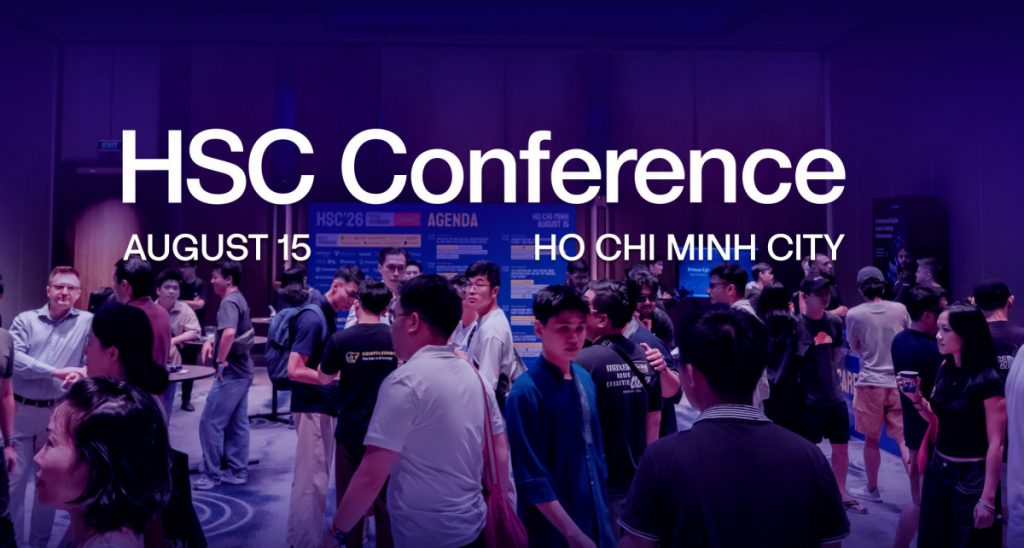
The HSC Conference, dedicated to bridging cryptocurrency and institutional finance, concluded in Ho Chi Minh City on August 15, 2026.
Hosted by Mpost Media Group, the event brought together financial institutions, policymakers, technology companies and academic representatives. More than 40 speakers addressed blockchain infrastructure, digital assets and the evolution of on-chain financial markets. Key themes included institutional adoption, RWA tokenization, stablecoin payments, fragmented liquidity and Vietnam’s emerging role at the intersection of AI and blockchain. The setting carried particular weight: Vietnam has repeatedly ranked at or near the top of Chainalysis’s Global Crypto Adoption Index, a measure of grassroots crypto uptake, and the distance between that everyday usage and formal institutional access animated much of the day’s debate.
The day’s sessions reflected a broader industry shift from experimental pilots to production-grade financial infrastructure, a thread that ran through both the stage program and conversations on the floor.
Regulatory Clarity as the Gateway to Institutional Crypto Adoption
Among the standout sessions was “What Institutional Digital Asset Adoption Actually Looks Like,” which brought together Nicole Nguyen, Founder of APAC DAO; Queenie Le, Regional Expansion Lead, APAC at Tether; Ben El-Baz, Managing Director and Head of International Markets at HashKey Group; Will Ross, Chief Client Officer at Dragon Capital; and Vadim Krekotin, Managing Partner at HSC Asset Group.
The panel examined what real institutional adoption of crypto looks like in practice, stressing that regulation, concrete use cases and integration with existing financial infrastructure matter more than simply holding digital assets. Speakers discussed tokenized assets, regulatory licensing, Vietnam’s funding needs and the need for traditional institutions and crypto companies to collaborate through practical, compliant rails.
The speakers converged on a shared diagnosis: regulatory clarity is the single most important condition for institutional adoption, but it remains uneven and incomplete.
Will Ross, whose Dragon Capital is one of Vietnam’s largest asset managers, said institutions are effectively constrained because they cannot invest in or fundraise through digital assets without explicit regulatory approval, regardless of how compelling the opportunity may be. “We cannot arbitrarily say we’re going to invest in digital assets without having the regulatory approval to do that. Our hands are tied until the regulatory pathway enables us to move forward,” he said.
Ben El-Baz described Vietnam as being in “phase one,” where licensing exchanges lays the groundwork for more complex use cases to emerge organically. He said, “what’s really exciting is what happens after you have this foundation — seeing there being a regulatory framework unlocks ideas and use cases from corporates that go well beyond the exchanges themselves.”
Vadim Krekotin said the direction is clear: governments are not going to let crypto fully replace existing financial systems, so the viable path is to understand the regulatory framework in place, follow it precisely and build creatively within those constraints. Queenie Le added that even when institutions want to engage with digital assets, regulatory uncertainty pushes them to rely on third-party intermediaries rather than touching crypto directly.
Dmitry Machikhin, founder and CEO of BitOK, argued that Vietnam is not at the beginning of the crypto regulation path. He said the country recognized crypto as property in 2025 — codified in the Law on Digital Technology Industry passed by Vietnam’s National Assembly in June of that year — and launched a pilot program for digital asset trading, while locals are already actively using crypto on the ground.
“What authorities should now prioritize is not prohibition but soft regulation that brings the industry out of the gray zone — giving the state new taxpayers and real market oversight,” he said.
For projects planning to enter European or global markets, Machikhin said compliance sequencing matters: “Study the target jurisdiction thoroughly, adapt the business to its standards, only then deploy.” On AML, he said, “In 2026 every serious company needs a dedicated AML specialist capable of screening high-risk financial flows. Rushing this preparation is a liability, not a shortcut.”
On global standards, he noted that while there is no single universal framework, FATF rules (the standards of the Financial Action Task Force, the intergovernmental anti-money-laundering body) serve as the baseline recognized across most jurisdictions, and MiCA (the EU’s Markets in Crypto-Assets framework, fully applicable since the end of 2024) is quickly becoming a de facto template — already adopted by more than ten countries outside the EU. “Even where MiCA seems like sufficient guidance, local adjustments and limits must be mapped jurisdiction by jurisdiction,” he said.
From Stablecoin Transfers to Embedded Payment Infrastructure
The agenda also included “Stablecoins Won the Payments War. What Comes Next?”, with Berken Menges, Chief Marketing Officer at CoinTracking; Carney Mak, Partner at FXHB Asset Management; Nathanael Christian, Co-Founder & CEO of IDRX; Harry Bui, Analyst at The Spartan Group; and Kevin Lee, CSO at BingX.
The discussion focused on the evolution of stablecoins — led globally by Tether’s USDT, the largest by market capitalization — from a payment product into a global settlement and financial infrastructure, with particular attention to cross-border payments, tokenized assets and integration with traditional finance. Speakers addressed regulation and transparency, FX and capital controls, and adoption dynamics across Southeast Asia and Vietnam.
Multiple speakers said stablecoins have proven their value primarily as settlement infrastructure rather than as a retail payment method.
Harry Bui said, “I agree stablecoin won, but not like in the way people think. It’s about a settlement layer — that is the most important here.” The cross-border and remittance segment is where adoption is most advanced: domestic payment systems in Southeast Asia are already efficient enough that stablecoins add little for local retail use, but correspondent banking for international trade remains slow, expensive and intermediary-heavy. The remittance stakes are tangible in Vietnam itself, which the World Bank counts among Asia’s largest remittance recipients, with annual inflows estimated above $10 billion.
Speakers broadly agreed that within two years, stablecoins will disappear into the infrastructure and be absorbed into the platforms and services people already use.
As Nathanael Christian put it: “We as customers wouldn’t realize that we are using stablecoin or not. What we know is only money movement, only payment — and the whole rail would be on the blockchain for sure.” The next frontier identified by the panel is moving from individual transfers to embedded, recurring use such as payroll, subscriptions and platform disbursements, where the real volume and business case are said to lie.
Sergey Kravtsov, Co-founder and CEO of Papaya Finance, framed the issue as an infrastructure problem.
“Every new payment rail starts with one-off transfers, because a single transfer needs no infrastructure. You send once, you are done. Remittances fit that shape perfectly, which is why Vietnam’s stablecoin volume sits there today,” Kravtsov said. “Recurring payments are a different problem. A subscription or a payroll run is not one transfer — it is the same relationship settling over and over on a schedule. On most chains today, each of those payments is its own on-chain transaction, with its own gas cost and its own point of failure. That is acceptable for a one-time remittance and it breaks the moment you try to run it at scale for thousands of payers every month.”
On where the infrastructure becomes embedded, he added: “The durable business is on the paying side — the platforms, payroll providers, and PSPs that need to send recurring payments to hundreds or thousands of workers at once. That is where aggregation matters, and that is where recurring settlement infrastructure gets built into something people use without thinking about crypto at all.”
Broad Industry Participation and Event Support
Participating companies represented the full breadth of the digital asset and traditional finance sectors, including Tether, Bybit, Ledger, HashKey Group, Monad, Metis, BingX, 1inch, The Spartan Group, Ondo Finance, OpenEden, Cactus Custody, Bitstamp by Robinhood, Orderly, Birdeye, Republic Advisory, Solana Superteam Vietnam, OrbitX, Synthesys, Kanga Global, CoinTracking, IDRX, TEIZA, SotaTek, OpenMax, Revve AI, GenAI Fund, Onigiri Capital, TOTM Labs, Varmeta, Hashgraph, DCP Co., GIMA Group, APAC DAO, Nuvei, HSC Asset Group, SC Ventures, Dragon Capital, FXHB Asset Management and Centrifuge.
HSC Conference Ho Chi Minh City was supported by Ledger, Sonic Labs, Hypernative, Securosys, Fystack, Birdeye, Mercuryo, Addressable and Kanga Global. Community partners included Coineasy, Akindo, SqrDAO, APAC DAO, DTC Group, Airova, 9 Cat Group, Allconfsbot, Varmeta and GIMA. OrbitX served as the payment partner, and RMIT University joined as the university partner.
Beyond the stage, the event offered a networking environment where participants connected with global and regional capital, met curated projects vetted for institutional readiness, identified partners and market-entry pathways into Vietnam, and built relationships with institutions shaping the future of digital assets.
Building a Global Institutional Finance Platform
Building on the success of HSC Conference Cannes 2026, the Ho Chi Minh City edition broadened the discussion to examine how blockchain can move beyond pilots into real financial infrastructure, what institutional digital asset adoption looks like at scale, and why mature Web3 infrastructure has yet to reach mainstream markets.
Over the past three years, HSC Conference and HSC Asset Management have developed into two complementary event series. HSC Conference brings together innovators, investors, asset managers, policymakers and industry leaders for high-level discussions about the evolution of digital assets and financial infrastructure, while HSC Asset Management provides a more focused environment for investment, fundraising and dealmaking. Together, they have welcomed more than 100,000 attendees and generated over 10 million social media impressions.
Upcoming editions are scheduled in Seoul and Singapore in October, Hong Kong in November and Abu Dhabi in December.

