HSC Conference Panel Examines Fragmented Liquidity, Regulation, Tokenization, and AI in Global Markets
Key Takeaways
- •Panelists said fragmented trading venues keep liquidity scattered and make execution less reliable across crypto markets.
- •The group identified regulation as the main variable shaping whether market liquidity consolidates or fragments further.
- •Vietnam was presented as an important market because of its high crypto adoption, local talent pool, and upcoming licensing regime.
- •Speakers discussed tokenization as a Wall Street-led trend, citing Larry Fink’s 2030 forecast and Robinhood’s tokenized U.S. stock offerings in Europe.
- •Ran Yi said autonomous AI agents could become a major new source of crypto adoption through blockchain-based trades and payments.
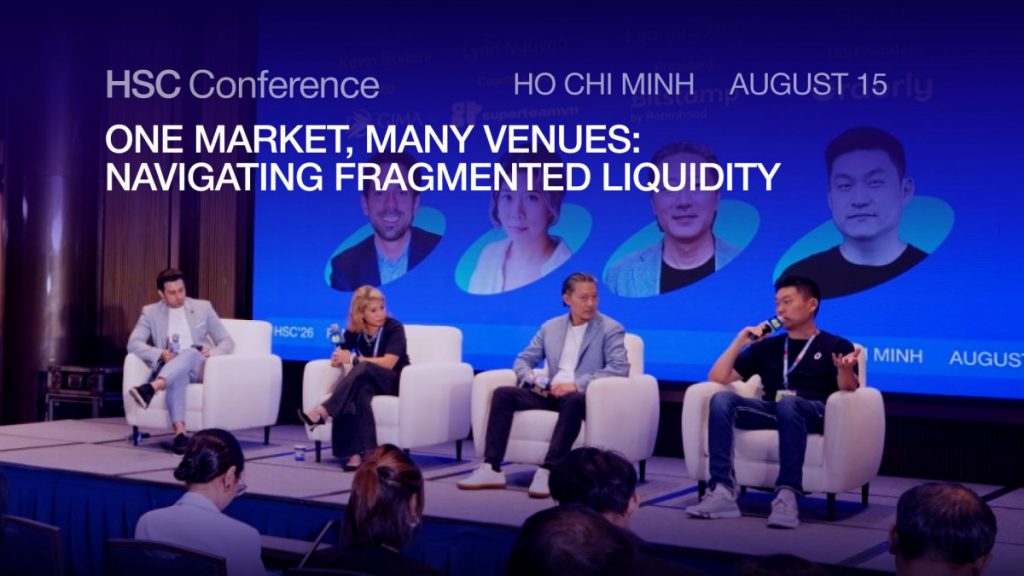
On August 15, the HSC Conference returned to Ho Chi Minh City, bringing together senior voices from financial institutions, technology companies, and venture capital to discuss blockchain infrastructure, digital assets, and the future of on-chain financial markets.
One of the event’s most closely watched sessions was “One Market, Many Venues: Navigating Fragmented Liquidity,” which featured Kevin Sultani of GMA Group, Lynn Nguyen, Country Lead of Solana Superteam Vietnam, Ran Yi, co-founder of Orderly, and Leonard Hoh, Asia-Pacific President of Bitstamp by Robinhood — the European exchange, founded in 2011, that became part of the US brokerage after Robinhood completed its acquisition in 2025.
The panel focused on how traders, market makers, and protocols operate across a fragmented mix of centralized and decentralized venues, while also exploring the larger challenge of connecting those markets into a more unified system.
The challenge of fragmented markets
Sultani framed the discussion around what he described as the “holy grail” of finance: a single dashboard where investors could see and trade all of their holdings, from tokenized Tokyo real estate and classic cars to Tesla stock and cryptocurrencies, on one unified marketplace that never closes. He noted that traditional markets in New York and London eventually consolidated after periods of chaos, but said crypto remains split across many venues, which reduces liquidity and keeps the industry in an “infant” stage.
Hoh said institutional participants still depend on established workflows and prime brokers, and argued that the lack of regulated aggregation services and best-execution standards remains a major barrier to greater capital inflows. For traders, the practical cost of scattered depth is familiar: the same asset can price differently across venues, meaning wider spreads and less dependable execution until that gap is closed.
Regulation as the key variable
The panelists agreed that regulation is the defining factor in the current cycle. Hoh pointed to the European Union’s MiCA framework — the Markets in Crypto-Assets regulation, fully applicable across the bloc since the end of 2024 — as a rare example of a regime that requires best execution. Sultani contrasted that approach with Dubai’s proactive embrace of digital assets, anchored by its dedicated virtual-asset regulator established in 2022, and said Europe has stunted innovation.
Nguyen expressed optimism about Vietnam’s controlled environment, saying she expects licensed exchanges to soon attract both local and international market makers. At the same time, the panel acknowledged a tension: as jurisdictions build regulatory walls, liquidity may become even more fragmented before it eventually consolidates — which makes the pace of regulatory alignment, from Southeast Asia to the Gulf, one of the clearest signals to watch going forward.
Tokenization and Wall Street’s timetable
The discussion then turned to Larry Fink’s widely cited prediction that $10 trillion in assets will be tokenized by 2030. The forecast comes from the chief executive of BlackRock, the world’s largest asset manager, whose spot-bitcoin ETF has already become one of the main conduits for institutional crypto exposure — context that underscores why the panel treated Wall Street’s timetable, rather than retail enthusiasm, as the operative variable.
Nguyen said the demand side is still immature, noting that “not a lot of people are interested in real estate on chain.” Hoh suggested that trading firms will naturally concentrate on equities rather than trying to tokenize every asset class — a shift his own firm has already begun, with Robinhood rolling out tokenized US stock offerings to European customers earlier this summer.
Sultani took a more aggressive view, saying Fink’s estimate “seems small.” He pointed to the liquidity vacuum created by pending traditional IPOs and argued that Wall Street will likely drive tokenization forward rather than wait for retail demand to develop organically.
Vietnam as a focal point
The panel also examined why Vietnam has become a major point of interest. Nguyen highlighted the country’s high crypto adoption rate — Vietnam has repeatedly ranked at or near the top of Chainalysis’ Global Crypto Adoption Index, the industry’s standard annual measure of grassroots usage — as well as its strong builders and fast-learning talent pool. She described her return after two decades abroad as a “legacy” mission to mentor local founders.
Hoh said Bitstamp has “two eyes on Vietnam” and sees the effort to bring liquidity onshore as a possible model for other developing markets.
AI agents and the next wave of adoption
In the final segment, Ran Yi argued that autonomous AI agents could become the next major driver of crypto adoption. He envisioned a future in which personal “Jarvis”-like assistants carry out trades and payments over blockchain rails, noting that agents are likely to prefer permissionless systems that do not involve KYC friction.
Nguyen added that stablecoins could help remove credit-card bottlenecks for agentic transactions, while also allowing users to set spending limits for individual wallets — an argument that tracks with moves already underway in payments, where major card networks have begun integrating stablecoin settlement.
The panel closed with a rapid consensus: consolidation is broadly positive, 24/7 markets are arriving sooner than traditional finance expects, and the next stage of the industry will be shaped by regulated convergence, agentic payments, and closer integration between traditional and on-chain finance. The near-term checkpoints are concrete: whether Vietnam’s licensing regime draws the market makers Nguyen expects, whether best-execution norms spread beyond MiCA, and how quickly tokenized equities move from rollout to mainstream product.
The post HSC Conference: ‘One Market, Many Venues’ Panel Explores How AI, Regulation, And Asset Tokenization Will Reshape Global Liquidity appeared first on Metaverse Post.
