HSC Asset Management Singapore to Convene Global Asset Managers, Banks, and Crypto Infrastructure Leaders
Key Takeaways
- •The one-day conference takes place on October 8, 2026, at the Fairmont Singapore, with more than 100 speakers and roughly 3,000 attendees drawn from asset management, banking, crypto investment funds, and technology.
- •HSBC's asset management arm oversees USD 876 billion across 18 countries and territories, and its banking group obtained one of Hong Kong's first two stablecoin issuer licences and named its HKD stablecoin HSBC RedCoin for launch in the second half of 2026.
- •Tether posted $1.5 billion in second-quarter net operating profit with USDT circulation at $184.6 billion, and received its first full independent audit through a KPMG US unqualified opinion on Tether International's 2025 financial statements.
- •S&P Global tokenized the iBoxx U.S. Treasuries Index, launched digital asset indices with Kaiko, issued its first credit rating for a DeFi protocol, and agreed to acquire smart contract security firm OpenZeppelin.
- •Tokenized real-world assets on the Stellar network have grown several times over since the end of 2025 to approach $4 billion, supported by plans with DTCC to bring tokenized securities onto the network.
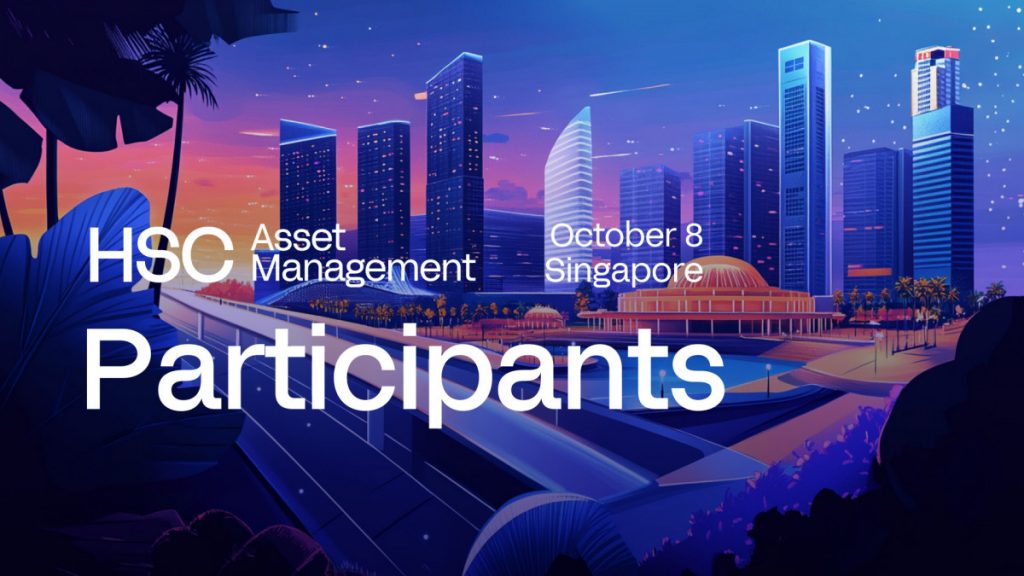
HSC Asset Management Singapore is set to bring together senior leaders from institutional finance and the digital asset industry, uniting global asset managers, banks, crypto investment funds, and technology companies to examine the forces shaping the next phase of financial markets across Asia and beyond. The conference takes place on October 8, 2026, at the Fairmont Singapore in one of Asia's principal financial centres, home to global banks, asset managers, and a growing family office community.
The programme convenes C-suite executives, investors, and infrastructure builders working at the intersection of traditional finance and digital assets, with sessions examining how capital, regulation, and technology are reshaping the financial landscape — from fund allocation strategies and private wealth to tokenization, stablecoin settlement, and the growing convergence of blockchain and artificial intelligence. More than 100 speakers and 3,000 attendees are expected at the event, which is organised by HSC Asset Group in collaboration with Mpost Media Group. The agenda's breadth reflects a year in which stablecoin licensing, tokenized funds, and on-chain settlement have moved from pilots into regulated production at major institutions — developments that run through the participant profiles below.
Among the notable participating companies in the Singapore edition are HSBC Global Asset Management, UBS, S&P Global Ratings, Invesco, Fidelity International, Maybank, Mastercard, Maelstrom, Animoca Brands, Galaxy Digital, Pantera Capital, Ethereum Institutional, Offchain Labs, ZKsync, Tether, Binance, Cactus Custody, and Steakhouse Financial, among many others.
Here is a closer look at some of the conference's top participants.
HSBC Global Asset Management
HSBC's asset management arm oversees USD 876 billion across 18 countries and territories as of March 2026, and sits within a banking group that has spent 2026 building regulated digital-money infrastructure. In April, the Hong Kong Monetary Authority granted the group one of Hong Kong's first two stablecoin issuer licences under the territory's new stablecoin licensing regime, and on September 30 the bank named its Hong Kong dollar stablecoin HSBC RedCoin. The token is scheduled to launch in the second half of 2026 through PayMe and the HSBC HK app, with subscriptions to tokenized investments among its initial uses — an early use case that ties the group's stablecoin directly to tokenized investment products.
Also in April, the group extended its Tokenised Deposit Service — already available in Hong Kong, Singapore, Luxembourg, and the UK — to the United States. In June, it partnered with CSOP on a tokenized class of CSOP's Hong Kong dollar money market ETF.
For attendees tracking how large asset managers and banks approach tokenization and stablecoin rails, Pang Qi Lim, CEO Singapore & Southeast Asia, will offer a macro perspective in a fireside chat on growth, rates, and allocation shifts, moderated by Bloomberg's Abhishek Vishnoi.
Tether
For the issuer of USDT, scale has never been the open question — verification has, and 2026 is when that began to change. According to a BDO attestation released on July 31, the company reported $1.5 billion in net operating profit for the second quarter, up from $1.04 billion in the first quarter. USDT in circulation stood at $184.6 billion, against $187.75 billion in total assets.
On August 13, KPMG US issued an unqualified opinion on the 2025 financial statements of Tether International, the USDT issuer — the company's first full independent audit. Unlike a point-in-time reserve attestation, a full audit examines the financial statements as a whole, narrowing a long-standing gap between Tether's scale and the depth of its public verification. Tether has also launched USAT, a GENIUS Act-compliant dollar stablecoin issued through Anchorage Digital Bank to serve the U.S. regulated market under the federal framework for payment stablecoins.
For institutions evaluating stablecoins as a settlement layer, Tether's reserve disclosures and regulatory positioning bear directly on that case. Matt Crow, Head of Regional Expansion, joins the Infrastructure for a Digital Economy panel.
S&P Global
No traditional financial institution has moved more deliberately into the digital asset space in 2026 than S&P Global. In March, the company tokenized the iBoxx U.S. Treasuries Index on the blockchain — the first time a major index provider made a financial benchmark available as a native digital asset. In September, it launched the co-branded S&P Kaiko Digital Asset Indices suite for global, 24/7 digital asset markets.
The company has also published Stablecoin Stability Assessments and issued its first credit rating for a DeFi protocol. Most recently, S&P Global agreed to acquire smart contract security firm OpenZeppelin, expanding its digital assets strategy into on-chain risk assessment and bringing the security standards behind the world's leading stablecoins, tokenized funds, and DeFi protocols under the S&P umbrella. For institutional allocators, benchmarks and credit assessments are core reference points, so their migration on-chain is a working concern rather than a symbolic one.
With Andrew O'Neill, Managing Director and Digital Assets Analytical Lead at S&P Global Ratings, joining the Stablecoins: The New Settlement Layer panel, Singapore attendees get a direct view of how institutional-grade standards are being applied to on-chain finance.
Maelstrom
Arthur Hayes, co-founder of BitMEX, invests across the crypto and Web3 ecosystem through Maelstrom, his family office. Co-founded with Managing Partner Akshat Vaidya in 2023, the fund takes a patient capital approach that emphasizes quality projects over fast deployment — a philosophy that has defined its portfolio strategy since inception.
In 2025, Maelstrom moved to raise $250 million for its debut private equity fund, Maelstrom Equity Fund I, targeting four to six acquisitions of medium-sized companies in the crypto space, with a focus on trading infrastructure, data analytics, and blockchain service providers. Entering 2026, Hayes positioned the fund at near-maximum risk exposure, betting on a liquidity wave driven by U.S. deficit spending and leaning into privacy coins and emerging DeFi tokens as his highest-conviction plays.
Hayes will join Yat Siu of Animoca Brands for a fireside chat on AI Agents and the Future Economy, making Maelstrom one of the most closely watched perspectives in active crypto investing at the event.
Trezor
At a conference shaped by institutional capital, Trezor offers a different answer to a core question: who should hold the keys? The Prague-founded company introduced the first Bitcoin hardware wallet in 2014 and has built its reputation on open-source transparency, with its firmware and hardware designs open to public scrutiny.
Today, its Safe line, led by the flagship Safe 7, is built around an auditable secure element and a quantum-ready design, giving individuals and organisations a way to keep direct control of their digital assets. Trezor Suite, the company's companion software, supports a growing range of networks, including Stellar.
As tokenized assets and on-chain finance expand, custody, security, and long-term resilience are moving to the centre of the institutional conversation. CEO Matěj Žák on the Navigating the Global Regulatory Landscape panel and Product Lead Jan Setina on Onchain Asset Security will offer the self-custody perspective.
Stellar
Few public blockchains have drawn institutional attention as quickly as Stellar has this year. The open-source network, supported by the Stellar Development Foundation, is increasingly used for tokenized assets and cross-border payments, and its plans with DTCC — the U.S. utility that settles the vast majority of American securities transactions — to bring tokenized securities onto the network signal growing confidence from traditional market infrastructure.
That momentum shows in the data: tokenized real-world assets on the network have grown several times over since the end of 2025 and now approach $4 billion, while stablecoin activity has reached record levels. Payment companies such as MoneyGram have also chosen Stellar for dollar-stablecoin services, extending its reach from capital markets to everyday money movement.
For those assessing which blockchains can carry regulated securities and payments at scale, Stellar offers a closely watched example, with Foundation Chief Business Officer Raja Chakravorti joining the Global Capital in the Era of Transformation panel.
Who's Coming to Singapore: Where Institutional Capital Meets Digital Assets
HSC Asset Management Singapore will bring together asset managers, banks, family offices, protocol builders, and infrastructure providers, each representing a distinct layer of a market in which traditional finance and digital assets are converging across Asia.
Capital allocation and investment perspectives open the Grand Stage. Pantera Capital moderates the Fund Strategies for Digital Asset Allocation panel, joined by Maelstrom, Caerus Global Management, CSOP, and Arcanum, while Drew & Napier adds the regulatory view of how funds are structured and deployed. On the Global Stage, C² Ventures, Bitscale Capital, The Spartan Group, and BingX address where the money goes in crypto, giving a direct read on how professional capital is being allocated in the current cycle.
Private wealth and traditional asset management form the institutional core of the programme. UBS, Invesco, Farro Capital, and Tsao Family Office take part in the Private Wealth in Asia panel on strategies for family offices and banks, with GWM Maybank Singapore also on the speaker list. HSBC Global Asset Management's Pang Qi Lim joins Bloomberg's Abhishek Vishnoi for the Asia Macro Outlook fireside chat on growth, rates, and allocation shifts. Fidelity International and M&G Investments then appear alongside Hivemind Capital, Binance, and the Stellar Development Foundation on the Global Capital in the Era of Transformation panel, closing the Grand Stage.
Tokenization and real-world assets draw on both infrastructure providers and established financial names. RedStone, Ethereum Institutional, Fidelity International, Broadridge, ST0x, and China Asset Management examine the limits of what can be tokenized. Fasanara Capital's head of RWA tokenization appears on the Infrastructure for a Digital Economy panel, and Finloop's Head of RWA delivers the keynote on bridging traditional finance and digital assets from Hong Kong to the world. MetaMask and Turtle Group's session on the operating system for tokenized markets extends the theme into the Global Stage.
Banking infrastructure and regulation are covered by two dedicated panels. makebanc, BitGo, HashKey Cloud, Dune, Dfns, and Jsquare discuss how banking infrastructure is being rebuilt, while EY, CF Benchmarks, Bybit, Detelio, and Trezor — with CoinEasy moderating — the global regulatory landscape. The programme also includes a signing ceremony between HSC Asset Group and CASH Financial Services Group.
Stablecoins and payments are explored from the issuer, ratings, and rails perspectives. S&P Global Ratings, Steakhouse Financial, StraitsX, and Stable take part in The New Settlement Layer panel, moderated by MetaMask, and Tether contributes on the Grand Stage infrastructure panel. On the Global Stage, Mastercard, Mercuryo, Hashgraph, Nethermind, and Gate look to the payment rails of 2030, alongside Aurora Labs.
The Global Stage also covers the technology and market structure underneath. Chainlink, ZKsync, Monad Foundation, Offchain Labs, and Aethir argue that public chains are now infrastructure, with Gosai Law moderating. Binance, MEXC, ChangeNOW, Deribit by Coinbase, and Alpaca address the infrastructure behind liquidity, and Animoca Brands, Figment, FXHB Asset Management, CoinRoutes, and Atom Finance debate active capital versus passive liquidity. Cactus Custody, Safeheron, FailSafe, Trezor, and Lava Foundation take up onchain asset security.
Rounding out the programme, AI and the agentic economy get two sessions. Maelstrom's Arthur Hayes and Animoca Brands' Yat Siu discuss AI agents and the future economy in a fireside chat moderated by CoinMarketCap. Sonic Labs, Ledger Enterprise, Mercuryo, AMBR, and TiDB of PingCAP, with Addressable moderating, then examine the infrastructure and applications behind the agentic economy.
With regulators, issuers, banks, and infrastructure builders sharing the same stages, the Singapore edition doubles as a progress report on the convergence between traditional finance and digital assets — a measure of how much of it has already moved into regulated production as the final quarter of 2026 gets underway.
Source: Metaverse Post — HSC Asset Management Singapore: Where Global Asset Managers, Banks, And Crypto Infrastructure Converge

