HP Warns Fake AI Crypto Trading Tool Delivers Malware Targeting Browser Wallets
Key Takeaways
- •HP's threat research team identified malware disguised as a legitimate AI-driven cryptocurrency trading assistant that deploys malicious code once installed on a victim's machine.
- •The attack targets browser-based wallet extensions like MetaMask and Phantom, which store access credentials and can let malware read wallet data, intercept transaction approvals, or manipulate on-screen content when users send funds.
- •The campaign relies on social engineering rather than a technical exploit, leveraging interest in AI trading tools and promises of automated profits to lure cryptocurrency users.
- •Recommended defenses include downloading software only from verified official sources, rejecting extensions that request unnecessary permissions, and enabling automatic updates for browsers and security software.
- •For infrequently accessed funds, HP suggests hardware wallets or separate browser profiles, since offline devices are physically isolated from browser-borne threats.
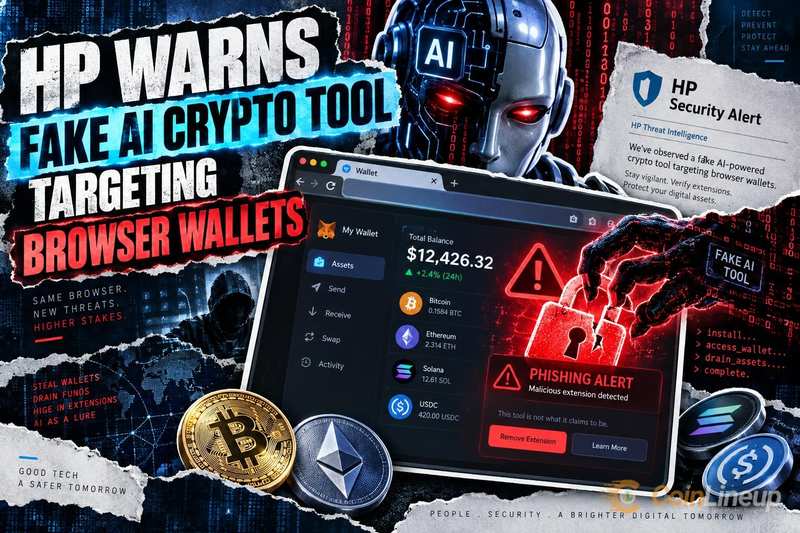
HP has issued a warning about a malicious campaign in which attackers disguised malware as an AI-powered cryptocurrency trading tool. According to the company's alert, the fraudulent software is designed to compromise browser-based cryptocurrency wallet extensions — the add-ons millions of users rely on to store and send digital assets — putting both funds and account access at risk.
A Fake Trading Assistant Hiding Malicious Code
HP, the technology company known for its threat research, said attackers presented the malware as a legitimate AI-driven trading assistant. The lure follows a straightforward pattern: promise a smart, automated trading companion, persuade the target to download and install it, then deploy malicious code in the background once the software is running on the victim's machine.
The technique is a classic form of social engineering. Rather than exploiting a technical flaw, attackers take advantage of genuine interest in a trending topic — in this case, AI trading tools — to trick people into installing software they would otherwise avoid. The promise of automated profits makes the bait especially effective in cryptocurrency circles, where enthusiasm for AI-assisted trading remains high.
Why Browser Wallet Extensions Are in the Crosshairs
Browser wallet extensions such as MetaMask and Phantom are add-ons installed directly into a web browser. They function like a digital keychain, storing the credentials that give a user access to their cryptocurrency. Because they operate inside the browser, they interact closely with every website a user visits, including crypto exchanges and token platforms. For many holders, that keychain is also the day-to-day gateway to the wider crypto ecosystem — the tool used to sign in to decentralized applications, approve token swaps, and confirm transactions.
That deep integration is exactly what makes them attractive to attackers. Malware that gains access to a browser environment can potentially read wallet data, intercept transaction approvals, or manipulate what appears on screen at the moment a user is about to send funds. HP's warning about this attack surface mirrors patterns observed in other cryptocurrency fraud campaigns, including advisories from the US Commodity Futures Trading Commission (CFTC) about crypto ATM scams, which likewise rely on social manipulation rather than technical exploits alone.
Browser-based wallets are popular because they are convenient, but that convenience comes with a trade-off. A hardware wallet kept offline is physically separated from browser-borne threats; a browser extension is not.
How Users Can Protect Their Wallet Extensions
The most effective protective step is also the simplest: download trading tools, wallet apps, and browser extensions only from official, verified sources. Users should check the developer's name, read user reviews, and confirm that the download page matches the project's official website before clicking install.
Permissions deserve close attention as well. A crypto wallet has no legitimate need for access to a microphone, camera, or all data on every website a user visits. Any extension that requests more access than its core function requires should be treated as a warning sign.
Keeping software current is another key defense. Browsers, wallet extensions, and security software should be updated regularly, since vendors routinely patch vulnerabilities that attackers exploit. Turning on automatic updates removes the risk of missing a critical patch.
For funds that are not needed for frequent access, moving them off a browser wallet entirely is worth considering. A hardware wallet stores private keys on a physical device disconnected from the internet, making it significantly harder for browser-based malware to reach. Using a separate, dedicated browser profile — or even a separate device — for unfamiliar services adds another layer of isolation.
Users should also treat any unsolicited offer of an AI trading tool as a red, particularly one promising guaranteed returns or an edge over the market. Legitimate tools do not need to be pushed at potential customers through ads, social media messages, or download links shared in chat groups. Similar social-engineering tactics have appeared in other schemes targeting individual crypto holders, including cases in which insiders exploited trusted access to move user funds.
The Broader Lesson
The core message of HP's warning is that the weakest point in crypto security is often not the blockchain itself but the software sitting between users and their assets. In an ecosystem where a single browser add-on can gate access to funds, campaigns like this one put the spotlight on the choices users make at install time — and on the signals worth watching, from HP's advisory itself to the official support channels wallet developers maintain for separating legitimate extensions from counterfeits. Verifying what gets installed, limiting extension permissions, and keeping software up to date remain the most practical defenses available to any cryptocurrency holder right now.
Disclaimer: This article is for informational purposes only and does not constitute financial or investment advice. Cryptocurrency and digital asset markets carry significant risk. Always do your own research before making decisions.

