How to Research a Crypto Project in 2026: A Practical Guide to Fundamental Analysis Tools
Key Takeaways
- •Crypto project research is commonly divided into three types—technical, sentiment, and fundamental analysis—with fundamental analysis serving as the foundation for assessing lasting value.
- •Evaluating a project's team is critical, as founders with verifiable track records are considered a positive signal while anonymous teams carry greater risk.
- •A project's fundraising history, including the number of rounds and the reputation of participating investors, provides useful reference points, though backing by reputable funds alone does not guarantee success.
- •A wide gap between market capitalization and fully diluted valuation can signal significant future dilution, making the timing of supply releases an important factor to examine.
- •Vesting schedules and upcoming token unlocks are published in advance, enabling researchers to anticipate supply increases and potential sell pressure before they occur.
“Do your own research” remains the most frequently repeated advice in cryptocurrency, yet rarely does anyone explain what the process actually involves. Effective research is less about collecting as much information as possible and more about knowing which signals matter, how to interpret them, and where the main risks may be hiding.
A useful way to approach a crypto project is to treat it like a business being vetted before money is committed. The essential questions are simple: who runs it, how does it make money, who has already backed it, and what could go wrong. Unlike many traditional industries, crypto makes most of this information publicly available: funding rounds, token supply structures, vesting schedules, and holder distribution are typically disclosed and tracked, which is what makes this kind of structured vetting feasible for individual researchers. The goal is not to talk yourself into buying — it is to challenge the initial investment thesis. Strong branding, ambitious roadmaps, and positive narratives can make almost any project appear attractive at first glance; fundamental research looks beyond that surface for weaknesses, risks, and assumptions that may not hold up.
This guide, built with CryptoRank, breaks crypto research into clear steps and shows where to find the data for each one.
The Three Types of Crypto Analysis
Before looking at a single chart, it helps to know that research falls into three broad types.
Technical analysis studies how a token’s price has behaved in the past. By examining price movements and trading patterns over time, it attempts to spot trends and identify favorable moments to buy or sell.
Sentiment analysis looks at how the market feels about a project, mainly through social media and news. It is difficult to measure and easy to manipulate, but it hints at how much attention a token is receiving.
Fundamental analysis studies the actual project behind the token: the problem it solves, the team building it, the tokenomics, the investors who backed the project, and how it is progressing. The aim is to understand whether a crypto project has real, lasting value rather than just short-term price movement. This is the part anyone can carry out with the right data, and it is the focus of this guide.
All three types work best in combination, each adding a different angle on a project. Fundamental analysis is the foundation, since it shows whether a project has real value in the first place.
How to Start Researching a Crypto Project
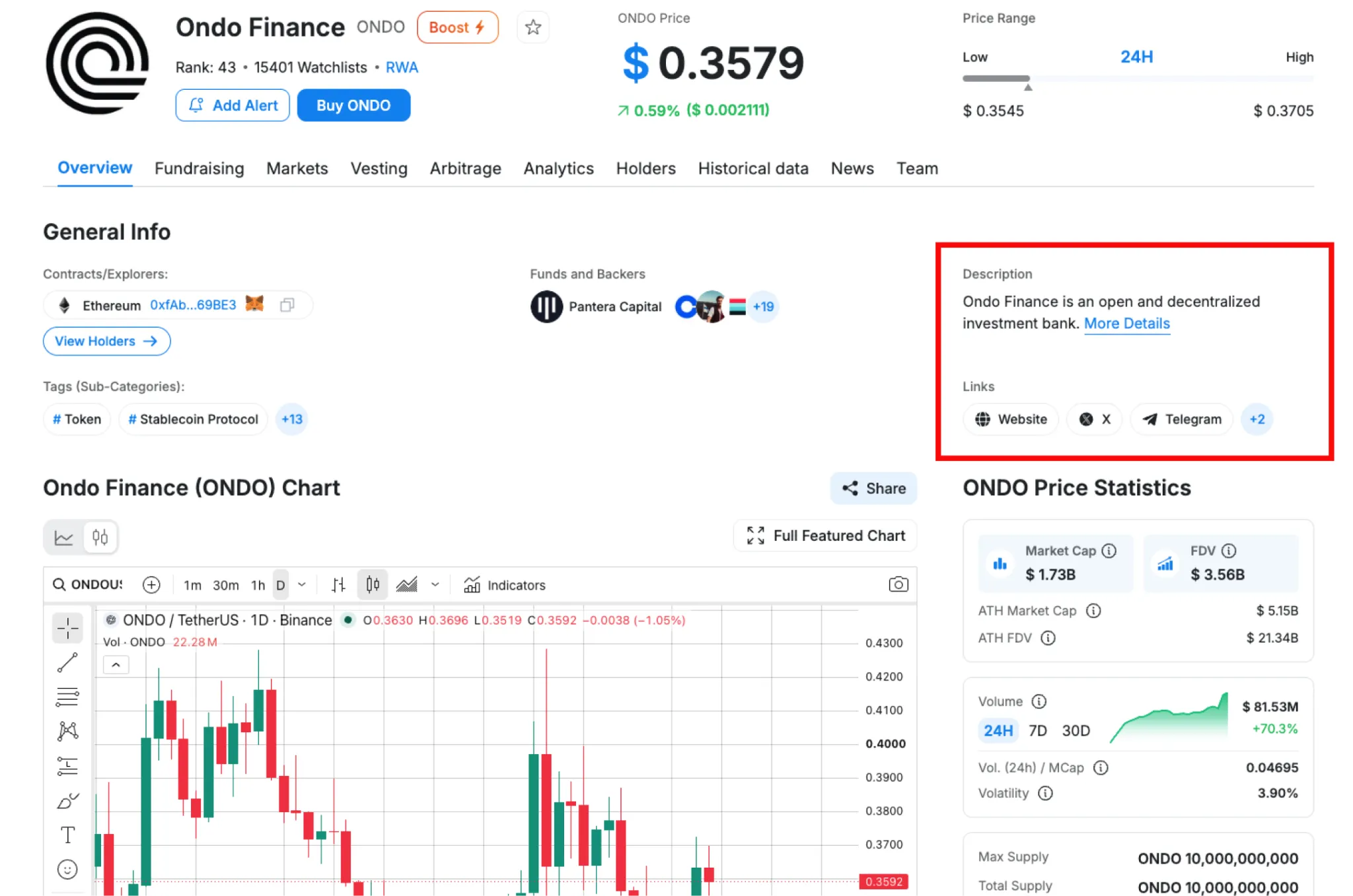
The fastest way to get a feel for a project is to pull its key data together in one view instead of jumping between the project website, block explorers, and social feeds. Start with a broad overview of the project, its development, and its current position in the market. That context makes it easier to assess each individual aspect of the project.
Research the Project and Its Use Case
Before looking at financial metrics, understand what the project is building, what problem it targets, and how its product is supposed to work.
Start with the project’s website, documentation, and whitepaper or litepaper. Look for a clear description of the problem, the proposed solution, the technology behind it, and the project’s intended users or market. A detailed technical document is useful, but the absence of one is not automatically a red flag — some projects communicate their product through documentation and other technical materials instead.
Two well-known examples illustrate the range: Ethereum provides a general-purpose blockchain for running smart contracts and decentralized applications, while Chainlink provides decentralized oracle infrastructure that connects blockchains with external data and computationn
Check the Team’s Background and Experience
The team behind a project matters as much as the idea. Experienced founders with a track record of shipping real products are a good sign, while anonymous teams with no verifiable history carry far more risk.
CryptoRank profiles the people and teams behind projects and funds, showing their roles, backgrounds, and links to their profiles. Opening an individual team member’s profile reveals their positions across crypto projects and links to their social media accounts, making it easier to verify who is actually involved and to assess their relevant experience.
Review a Project’s Crypto Fundraising
Start by looking at the funding history as a whole: how much the project has raised, how many funding rounds it has completed, and when those rounds took place. A project that raised most of its capital in a single round has a different history from one that returned to the market and raised additional capital over time. Multiple rounds also show whether new investors joined the project or existing backers continued to participate, which indicates how consistently the project has been able to attract funding before individual investors are evaluated.
More importantly, look at who participated in those rounds. The presence of established investors can be a positive signal, especially when reputable funds appear across multiple rounds. CryptoRank assigns funds to tiers, which adds another reference point when evaluating a project’s backers. A project backed primarily by Tier 1 funds may deserve more attention than one supported mostly by smaller or less established investors, although investor reputation alone does not guarantee success.
It is also worth reviewing a fund’s own profile to understand what it typically invests in, how active it is, and how its previous investments have performed. The profile includes a chronological history of funding deals as well as Retail ROI — a metric showing the returns earned by retail investors through the IDO, IEO, and ICO projects backed by that fund.
How to Analyze a Crypto Token
Once the project, team, and funding history are understood, the next step is to examine the token itself. That means looking beyond price and assessing its valuation, supply structure, distribution, and future dilution.
Start with market capitalization and fully diluted valuation (FDV). Market cap values the tokens currently in circulation, while FDV estimates the value of the entire token supply at the current price. A large gap between the two can indicate significant future dilution, so it is important to understand how and when the remaining supply may enter circulation.
Trading activity and holder distribution add another layer of context. Start by checking where the token is listed and whether it trades on major exchanges, since broader access through established venues can improve market depth and make larger positions easier to enter or exit. Then look at trading volume and liquidity across those venues to see where actual activity is concentrated, rather than relying on the number of listings alone.
Holder data can show how concentrated the token supply is and how much is controlled by the largest wallets. High concentration may increase the risk that a small number of holders can significantly affect liquidity or price through large transactions. If a token exists on multiple networks, focus primarily on its native or main network, as holder distribution can differ significantly between chains.
How to Understand Tokenomics
Tokenomics helps explain how a token’s supply may change over time and who has the greatest influence over that supply.
Start with circulating, total, and maximum supply. A low circulating share compared with total or maximum supply means a meaningful portion of tokens may still enter the market in the future, increasing dilution. The important question is not just how much supply remains, but how quickly it is expected to be released.
Next, look at how the supply is distributed. Large allocations to the team or private investors are not automatically negative factors, but they matter more when those tokens are subject to short vesting periods or large cliff unlocks. A heavily concentrated allocation can create periods in which a relatively small group receives a large amount of newly liquid supply at once.
Vesting schedules help show when that supply becomes available. Pay attention to upcoming unlocks, who receives the tokens, and how large each release is relative to the circulating supply. Gradual linear vesting creates a different supply profile from a large cliff unlock, which can introduce a sudden increase in available tokens and potential sell pressure. Because these schedules are published in advance, upcoming releases are among the few supply events that can be monitored ahead of time rather than assessed only after they happen.
Conclusion
Researching a crypto project is not about finding one metric that says whether it is good or bad. The goal is to build a complete picture from several areas: what the project is building, who is behind it, how it has been funded, how the token is valued and traded, and how its supply will change over time.
Each part answers a different question. A strong team does not compensate for poor tokenomics, reputable investors do not eliminate execution risk, and an attractive valuation means little if significant dilution is still ahead. The more these factors support one another, the stronger the overall investment thesis becomes. And since funding rounds, token unlocks, and exchange listings all change over time, the picture is never static — revisiting each area periodically is what keeps the analysis current.
This article is not financial advice. Always do your own research and consider the risks before making an investment decision.

