How Tether, Circle and Other Stablecoin Issuers Generate Revenue
Key Takeaways
- •Stablecoin issuers earn an estimated 95-99% of their revenue from interest on reserves held in bank deposits and short-term government securities, while token holders generally receive no yield directly from issuers.
- •Tether generated approximately $13 billion in net profit in 2024, with its direct Treasury exposure estimated at $122 billion by the end of 2025 and more than $186 billion USDT in circulation.
- •Circle reported $2.7 billion in total revenue and reserve income for 2025, up 64%, but shares residual USDC reserve revenue with Coinbase 50/50, with Coinbase receiving about $300 million in the first quarter of 2025 alone.
- •Interest rate changes pose the main risk to the business model, as each quarter-point shift in yield could reduce Tether's annual Treasury income by roughly $305 million, and record sector profits reflect the high-rate environment of 2023 and 2024.
- •The US GENIUS Act requires one-to-one reserves and bars issuers from paying interest to holders, while a 2025 Citibank forecast cited in the article projects the stablecoin market could grow to $1.9 trillion by 2030 from roughly $300 billion.
Stablecoins are designed to maintain a relatively stable price. A token pegged to $1 generally remains near $1, meaning holders do not benefit from price appreciation. The companies that issue these tokens, however, report profits in the billions of dollars. Where that money comes from explains why the sector has drawn close attention from regulators in both the United States and Europe.
The main source of that income is interest earned on the assets backing each token. When users buy stablecoins, issuers place the corresponding dollars into reserves, typically in bank deposits or short-term government securities. The tokens circulate while the underlying assets remain in reserve and generate income.
This article examines the stablecoin business model, compares Tether and Circle, and reviews the factors that could affect issuer revenue. Stripe reports that stablecoin retail-sized transactions exceeded $5.84 billion in August 2025 alone. Larger flows also move through exchanges, payment companies and banks each day. For issuers, those flows are the foundation of the business, since circulation is what turns reserve dollars into an income-generating base.
How the Float Model Works
The basic model is straightforward. If a customer buys 100 units of a dollar-denominated stablecoin from an issuer, the issuer receives $100. That money is placed into reserves, usually consisting of bank deposits or short-term government bonds.
The tokens can then move throughout the market, but the dollars supporting them remain in the reserve and earn interest. The issuer keeps that interest, which Transak refers to as the “float.” The holder receives a token designed to remain close to $1 but generally receives no yield directly from the issuer.
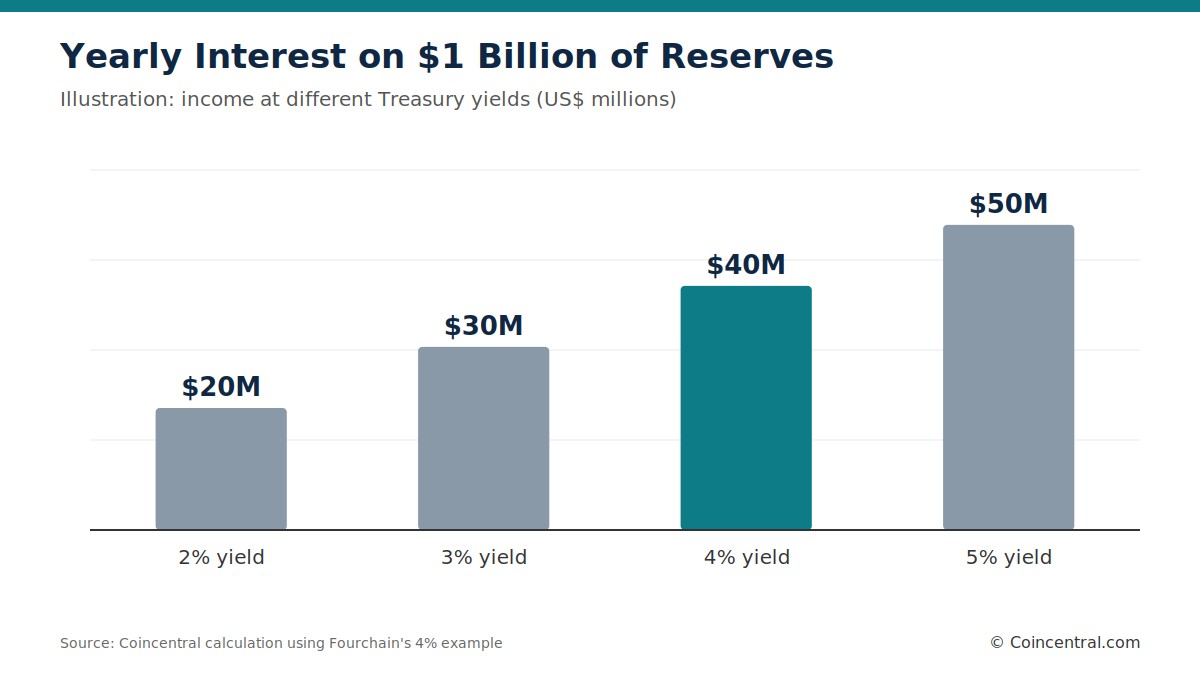
Fourchain provides a simple illustration. An issuer with $1 billion of stablecoins in circulation that earns 4% on its reserves could collect approximately $40 million annually. The amount changes depending on the yield earned on the assets.
Transak notes that when the Federal Reserve keeps interest rates near 4% to 5%, a Treasury bill can offer a similar return. The issuer retains that income. By contrast, a bank typically pays interest to depositors and incurs costs related to branches, staffing and marketing. A stablecoin issuer can create tokens on demand while paying holders nothing in the basic model.
The concept itself is not new. Banks, money market funds and PayPal have earned income on customer balances for decades. What has changed is the potential scale and margin. Transak describes the result as a deposit-like business with the cost structure of a software company.
Issuers must still keep reserves safe and readily saleable because users can request redemptions. Stripe says issuers generally balance three objectives: safety, liquidity and yield. Those objectives pull against one another, and the tension runs through the revenue choices discussed below.
Main Revenue Sources for Issuers
Reserve interest is by far the largest source of issuer revenue. Transak estimates that the float represents roughly 95% 99% of issuer revenue, leaving other sources comparatively small at present.
Issuers can also earn income from minting and redemptions. Some charge explicit fees, while others use a spread by setting a slightly higher price for minting and a slightly lower price for redemption.
Fourchain gives an example in which a customer pays $1.001 to create a token and receives $0.999 when redeeming it. The $0.002 difference goes to the issuer. Individual users rarely interact directly with issuers, so these fees primarily affect larger institutions.
Transaction fees are another possible source of revenue, although many issuers do not charge them. Elliptic explains that free transfers can support adoption, and greater circulation increases the reserves generating interest. For large issuers, the additional reserve income can exceed the revenue that transaction fees would produce.
Elliptic characterizes this as a choice between collecting fees immediately and expanding market share. Many large issuers prioritize circulation because a larger supply creates larger reserves and more interest income.
Issuers can also sell services to banks and large companies. These services may include treasury management, custody and technical support. Partnerships with exchanges, fintech applications and wallets can create revenue-sharing arrangements, while broader use increases the total amount of reserves.
Some stablecoin models also lend assets or generate protocol income. The decentralised stablecoin DAI earns money when users lock collateral, borrow DAI and pay stability fees into the protocol treasury. Other issuers place part of their assets in gold, corporate debt or Bitcoin, potentially increasing both returns and risk.
Stablecoin holders can pursue income through external platforms, but not through the token’s price if it remains pegged to $1. Elliptic lists lending protocols such as Aave, platform rewards and liquidity pools as examples. According to Elliptic, PayPal says holders of PayPal USD can earn up to 4% in rewards on their settled balance. Elliptic also notes that these payments are often small compared with issuer profits.
Tether: The Largest Issuer by Supply
Tether provides the clearest example of the reserve-interest model. Transak reports that Tether generated approximately $13 billion in net profit in 2024. About $7 billion came from Treasuries and repo positions directly backing USDT, while the remainder came from gold, Bitcoin and other holdings.
Elliptic reports that Tether recorded $5.7 billion in net profit during the first half of 2025. For the full year, Transak says Tether reported more than $10 billion. At the end of 2025, more than $186 billion in USDT was in circulation.
Tether’s Treasury holdings are substantial. Stripe says the company held $97.6 billion in US Treasurys by mid-2024, placing it among the largest holders of US government debt. By the end of 2025, Transak estimates that Tether’s direct exposure had reached $122 billion.
Transak says the float has also helped finance Tether’s expansion into other businesses. Tether led a strategic round with IDG Capital focused on payments infrastructure built on the stablecoin’s rails. The company’s profits give it room to invest beyond the token itself.
Transak also highlights Tether’s employee count. The company generated profits comparable to those of large Wall Street firms with only a few hundred employees. Tether has no loan book, branch network or deposit insurance premium.
Tether holds assets beyond Treasuries. Fourchain says the company holds Bitcoin and gold and can lend to borrowers that provide collateral. This diversification creates additional income sources but also introduces greater exposure to price movements.
USDT’s peg has been tested. Stripe notes that the token briefly traded at 94 cents on some exchanges in 2022. Institutions redeemed tokens at face value, and the market price moved back toward $1 as traders closed the gap.
Liquidity remains one of Tether’s strengths. Stripe says USDT became one of the deepest pools in crypto trading because exchanges adopted it early. Fourchain adds that Tether is larger by supply but provides less disclosure than Circle.
Circle: The Same Engine with a Smaller Share of Revenue
Circle issues USDC and uses the same reserve-interest model. Transak says Circle reported $2.7 billion in total revenue and reserve income for 2025, an increase of 64%. Reserve interest represented most of that amount.
Circle retains less of its reserve income because of its distribution arrangements. The company’s S-1 filing showed that Circle and Coinbase split residual USDC reserve revenue 50/50. Coinbase receives 100% of the income generated by USDC held on its own platform.
The amounts involved are significant. Transak reports that Coinbase received approximately $300 million in distribution from Circle during the first quarter of 2025. That exceeded Circle’s total net revenue of $230 million for the quarter.
The arrangement helps explain why Circle’s net margin appears relatively thin compared with its revenue. Distribution is a cost of reaching users, and Coinbase provides access to a large base of USDC holders.
Fourchain says Circle positions USDC as a regulated digital dollar for payments, trading and transfers. The token is designed to maintain a value close to $1. Its emphasis on regulation and reporting may appeal to banks and large companies.
The two companies also manage reserves differently. According to Fourchain, Circle focuses on cash, cash equivalents and short-term US government securities rather than major Bitcoin or gold strategies.
Fourchain says Circle holds more regulatory licenses and publishes more detailed reserve information. Stripe says USDC built its liquidity through banking partnerships. Transak says Circle became the most prominent publicly traded stablecoin issuer after its 2025 initial public offering.
Interest Rates Are the Main Risk to the Model
Issuer profits are closely linked to interest rates. Because revenue comes largely from Treasury yields, a Federal Reserve rate cut can reduce income quickly. Stripe makes the same point, saying a decline in Treasury rates can rapidly lower earnings.
Transak links the record profits of the sector to 2023 and 2024, when interest rates remained above 5%. It argues that the headline profits reflect a high-rate environment rather than a permanent feature of the business.
An illustration based on Tether’s $122 billion Treasury exposure shows the effect. Applying a flat yield while excluding other income, each quarter-point change in yield represents approximately $305 million per year. This is consistent with Transak’s view that a quarter-point rate cut can reduce annual interest income by hundreds of millions dollars.
Circle has greater exposure to this issue relative to its size because reserve interest makes up nearly all of its revenue, while half of its residual reserve income already goes to Coinbase. Transak says Circle is expanding into payment network fees that are less dependent on Federal Reserve policy.
Tether has pursued a different approach by holding gold and Bitcoin as additional sources of income. Stripe says issuers generally maintain short maturities to avoid selling assets at a loss, limiting how much additional yield they can seek.
Cash buffers and very short-term Treasurys improve liquidity, Stripe says, but also limit returns. Maintaining readiness for redemptions is therefore a cost of the model. Seeking higher yields can introduce additional risk.
Competition creates another pressure. Transak says yield-bearing stablecoins and tokenized money-market products are increasingly passing reserve income to holders. That challenges the margin on which traditional stablecoin issuers depend.
Regulation, Competition and Market Growth
Regulation directly affects the stablecoin business model. Transak says the US GENIUS Act requires one-to-one reserves in cash, short-dated Treasuries, repo or money market funds. Issuers must disclose reserve information monthly, keep reserves separate and avoid reusing them.
The act also prohibits issuers from paying interest to holders. Section 4(a)(11) bars issuers from paying yield linked to holding the coin. Transak concludes that the float therefore remains with the issuer.
Europe has separate requirements. Stripe says the European Union’s MiCA regime also limits interest payments to retail holders and defines which assets may back a stablecoin. Rules governing reserve quality, capital and reporting continue to develop.
Elliptic cites a 2025 Citibank forecast that stablecoins could reach $1.9 trillion by 2030, compared with approximately $300 billion at the time of writing. Banks, fintech companies and payment firms are all entering the market.
Reputation can limit issuer revenue. A loss of confidence can reduce the amount of tokens in circulation and therefore shrink the reserves generating interest. Trust and income are closely connected.
Competition is also intense. Stripe says some major stablecoins are interchangeable, creating low switching costs. If an issuer raises fees, provides insufficient disclosure or experiences an outage, circulation can move rapidly to a rival.
Stripe explains that crypto-backed issuers use over-collateralisation to absorb volatility. Under this model, each dollar of DAI is backed by more than a dollar of assets.
The distinction between reserve-backed and market-confidence-based models is important for risk. Stripe notes that the 2022 TerraUSD crash demonstrated how quickly a peg can fail when support depends mainly on market confidence. Reserve-backed issuers generate income by holding real assets.
Why Payment Costs Attract Issuers and Banks
Reserve interest is only one part of the stablecoin business case. The World Economic Forum argues that stablecoins can make settlement function more like cash. When one party sends a stablecoin, the recipient has the asset and the sender no longer does, eliminating the need for reconciliation between the two sides. For issuers, payment adoption compounds the core model, since every token in circulation represents reserves earning interest.
The existing cross-border payment system is slower and more expensive. Capgemini estimates that as much as $4 trillion is held in settlement and liquidity accounts to fund cross-border payments. Providers prefund money in multiple countries so transfers can appear immediate.
Costs are particularly high in smaller markets. According to the World Bank’s latest data, sending $200 to sub-Saharan Africa costs an average of 8.46%, compared with a global average of 6.36%. In 2021, the G20 set a target of reducing retail payment costs to 1% by the end of 2027.
The Financial Stability Board reported last October that costs remain persistent and that the target is unlikely to be reached. The Bank for International Settlements recorded a 25% decline in active correspondent banking relationships between 2011 and 2020. In emerging markets and small island states, the decline reached as much as 41%.
Earlier improvements in payment systems have produced measurable effects. In Kenya, access to M-PESA lifted an estimated 194,000 households, or approximately 2% of Kenyan households, out of poverty. In Brazil, Pix made instant payments free for individuals and reached more than 140 million people within two and a half years, according to the IMF.
The World Economic Forum also notes that settlement delays can generate income. Institutions holding funds during settlement can earn on the float, while other participants bear the cost of prefunding. Faster settlement could reduce costs overall but remove income from parts of the existing system.
Transak advises businesses to build the case for stablecoins around settlement speed and cost rather than borrowed yield. Stripe says businesses can already accept stablecoin payments that settle as fiat in their balances.
What the Numbers Show
Stablecoin issuers generate most of their revenue from interest on reserves. Transak estimates that the float accounts for roughly 95% to 99% of revenue, while fees and services remain small by comparison.
Tether reported approximately $13 billion in profit for 2024. Circle reported $2.7 billion in revenue and reserve income for 2025. The model is sensitive to interest rates, and Circle shares approximately half of its residual reserve income with Coinbase.
Regulations such as the GENIUS Act also determine how reserves can be held and whether issuers can pay yield to holders. The key issue for the sector is whether issuers can expand their revenue beyond reserve interest as interest rates change. Developments worth tracking include the monthly reserve disclosures required under the GENIUS Act, Circle’s expansion into payment network fees, and the G20’s end-of-2027 target for retail payment costs, which the Financial Stability Board has already judged unlikely to be met.
Source: CoinCentral

